Somewhere in the last two decades, one number quietly became the unofficial finish line of Indian financial life. Not a number tied to your actual expenses, your city, or your family size — just ₹1,00,00,000, floating in the cultural background of every SIP calculator reel, every “how to become a crorepati by 40” post, every half-joking dinner table remark about a friend who “crossed a crore.” Nobody quite remembers agreeing that this was the number that mattered. It just became the number.
13 MIN READ
INDIA SERIES / भारत
WRITTEN FOR: THE VIRAL SIP CALCULATOR → THE ACTUAL EXPENSE SHEET
Ask a room full of young, financially aware Indians what a comfortable retirement or “making it” looks like, and a striking number of them will reach for the same figure, almost reflexively: one crore. Not because they’ve calculated their future expenses, adjusted for inflation, and arrived there through some rigorous process — but because the number has, somewhere along the way, become culturally load-bearing in a way few other financial figures ever have. It’s the title of a decades-old game show. It’s the punchline of a meme. It’s the headline number on thousands of “become a crorepati” SIP calculator screenshots that circulate endlessly across Instagram and WhatsApp. It has become, in a very real sense, less a financial target and more a scoreboard everyone quietly agreed to play by, without ever checking whether the scoreboard measures anything that actually matters to their specific life.
₹1 crore was never a financial calculation to begin with. It was a title from a television game show that turned into a national milestone — and milestones borrowed from entertainment rather than arithmetic rarely ask the one question that actually matters: what happens after you cross the line? Understanding where this number came from, and what it does and doesn’t actually mean, is the point of this piece.
Where the obsession actually came from
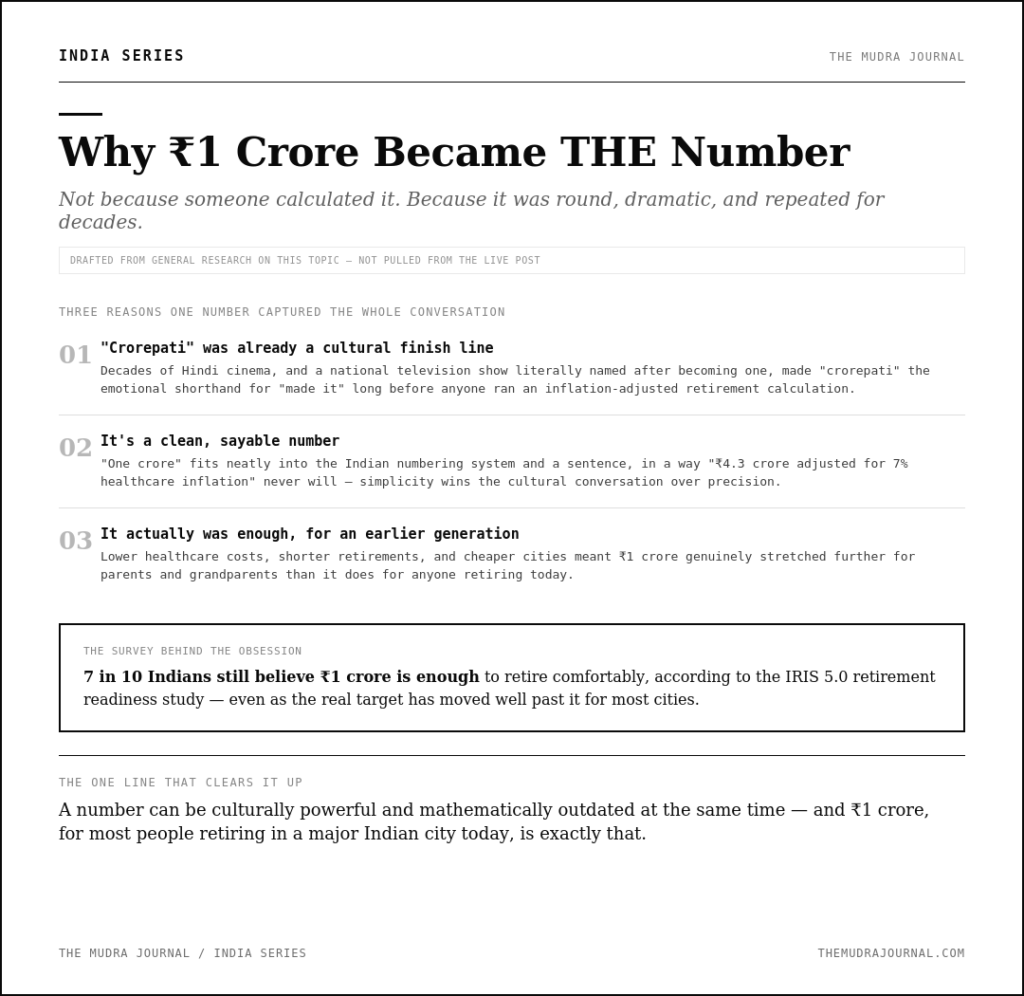
Kaun Banega Crorepati launched in the year 2000 and did something few pieces of Indian media have done before or since: it turned a specific, enormous sum of money into a single, unforgettable word — crorepati — and made becoming one feel like the ultimate, dramatic, life-changing achievement, complete with dimmed lights, a slowed heartbeat sound effect, and Amitabh Bachchan’s pause before the final answer. For an entire generation that grew up watching that show, “crore” stopped being just a unit of counting and started being a symbol of arrival, aspiration, and a life fundamentally transformed — an association that had nothing to do with financial planning and everything to do with the emotional weight of watching an ordinary person’s life change on national television.
Round numbers are also, independently of any game show, simply more psychologically satisfying than precise ones — a well-documented human tendency to anchor on clean, memorable figures rather than the messier, more accurate number a genuine calculation would actually produce. ₹1 crore isn’t just culturally loaded; it’s also exactly the kind of tidy, shareable figure that a mind naturally gravitates toward over something like, say, ₹84,60,000 — even if the second number happened to be the one an individual’s actual expenses and goals pointed to.
And more recently, the rise of SIP calculator content across Instagram Reels and YouTube Shorts — “invest just ₹5,000 a month and become a crorepati by 45” style posts — has given the number a second, more modern life: shareable, screenshot-friendly, algorithmically rewarded content that makes ₹1 crore feel like an achievable, almost gamified target, regardless of whether it bears any relationship to what that specific viewer’s life will actually cost by the time they get there.
What ₹1 crore actually buys — the reality check
Here’s where the obsession runs directly into arithmetic, and the arithmetic isn’t always kind to the number’s mythology.
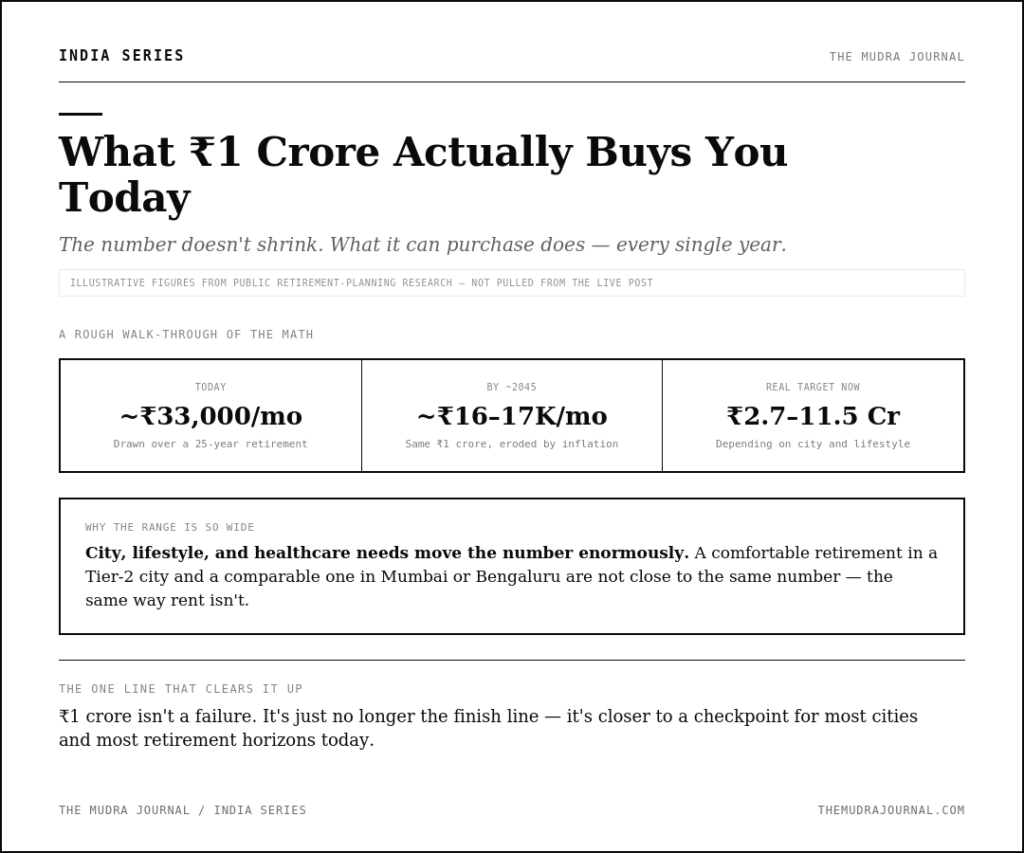
If you apply a conservative, sustainable withdrawal rate — the kind of 3-3.5% figure we’ve discussed in the context of financial freedom planning for India — to a ₹1 crore corpus, you get roughly ₹25,000 to ₹30,000 a month in sustainable income, before accounting for taxes. In a major Indian metro, that’s a modest, careful living, not the transformative, “made it” lifestyle the cultural weight of the word “crorepati” implies. It might comfortably cover essentials for one person with disciplined spending. It is a considerable distance from what most people picture when they imagine crossing this specific finish line.
The problem compounds further when you consider timing. ₹1 crore accumulated today has a certain real purchasing power. ₹1 crore accumulated in 25 years, after a few decades of inflation eroding its value, will buy meaningfully less in real terms — even though the number on the account statement looks identical, and even though it still carries all the same cultural weight it always did. A number fixed in nominal terms, chased over decades, is quietly shrinking in real value the entire time you’re pursuing it, and very little popular content about “becoming a crorepati by 40” pauses to mention that the crore you’ll actually hold at 40 buys less than the crore your parents’ generation might have imagined when the show first aired.
None of this means ₹1 crore is a meaningless number, or that reaching it isn’t a genuine, admirable financial achievement — it’s simply a number that means dramatically different things depending on when you reach it, where you live, what stage of life you’re in, and what you actually intend that money to do. Treating it as a universal finish line skips over every one of those variables.
Why the obsession isn’t entirely irrational
To be fair to the number, it’s done some real, positive work. A clean, memorable, culturally resonant target is genuinely more motivating for many people than a precise, personalised figure that feels abstract and distant — “save toward ₹1 crore” is simply easier to hold in your head and stay disciplined about than “save toward ₹84,60,000 adjusted annually for my specific inflation-adjusted expense trajectory.” As a psychological anchor that gets people to actually start a SIP, stay consistent, and take long-term investing seriously, the crore obsession has arguably functioned as an accidental, informal financial literacy gateway for a huge number of young Indians who might never have started investing at all without a number this culturally vivid to chase.
The problem was never that the number motivated people to save. The problem is what happens when the number stops being a motivating anchor and starts being mistaken for an actual, personalised, sufficient plan.
Where it becomes a genuine problem
01 — THE NUMBER HAS NO DEFINED PURPOSE ATTACHED TO IT
A crore for what, exactly?
Most people chasing this figure haven’t clearly defined what it’s actually meant to fund — retirement, a child’s education, a home, general security — which means even reaching it doesn’t automatically resolve the underlying question the money was supposed to answer. A number without a defined purpose is a scoreboard, not a plan, and crossing it can leave someone with a large sum of money and the same underlying uncertainty about whether it’s actually enough for whatever they needed it for.
02 — IT FLATTENS ENORMOUSLY DIFFERENT LIVES INTO ONE IDENTICAL TARGET
A crore means something completely different in Mumbai and a small town
Someone living in a metro with significant ongoing expenses and someone living in a smaller city with a fully-owned home and modest costs are being measured, culturally, against the exact same number — despite facing wildly different real financial requirements. This flattening creates a false sense of both inadequacy (for people whose genuinely comfortable life would require far more, given their city and circumstances) and false confidence (for people who’ve hit the number without checking whether it’s actually sufficient for what they need).
03 — THE GOALPOST QUIETLY SHRINKS IN REAL VALUE WHILE THE TARGET IN PEOPLE’S HEADS STAYS FIXED
Chasing a nominal number while inflation moves the actual target
As explained above, a fixed nominal target loses real purchasing power the longer it takes to reach — but very little popular “become a crorepati” content adjusts the target for this, which means many people chasing the number today are, without realising it, aiming at a goalpost that will buy considerably less by the time they arrive than it would buy right now.
A better way to think about your number
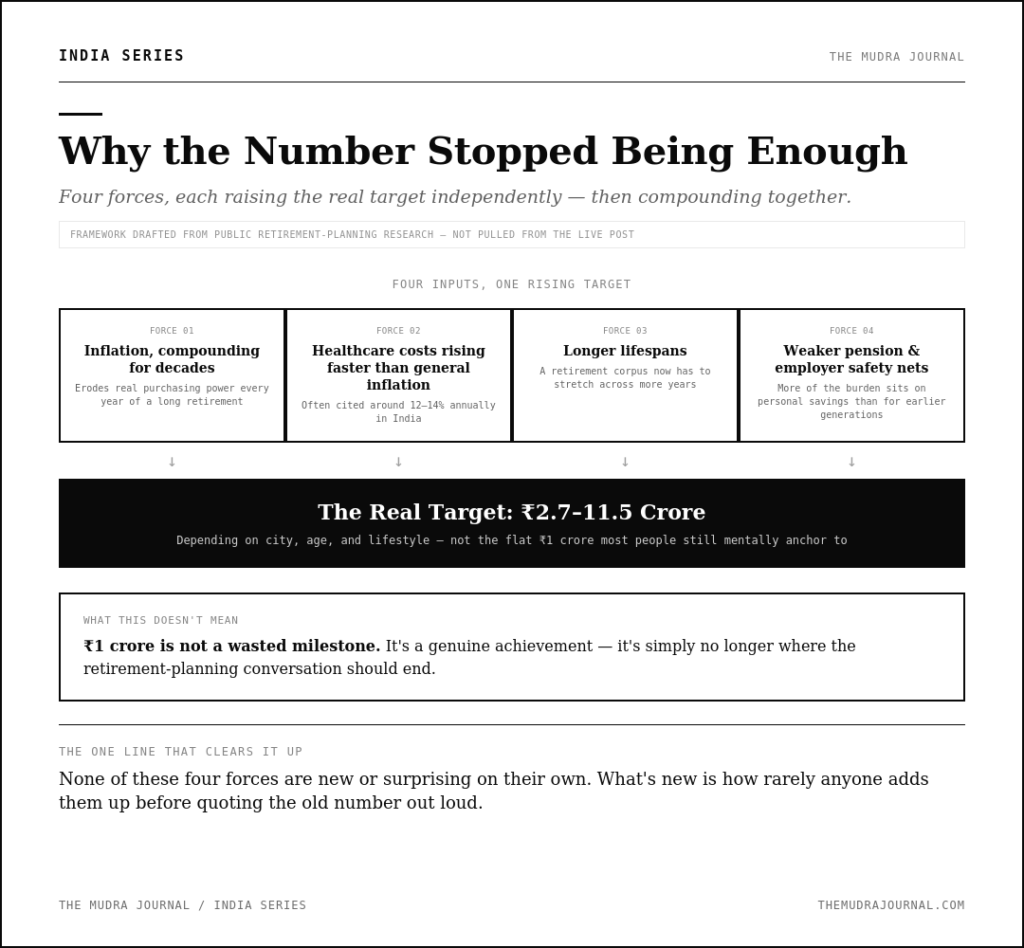
We’ve written before, in more depth, about calculating an actual financial freedom number — built from your real expenses, adjusted for a realistic withdrawal rate and India-specific factors like healthcare costs and family obligations, rather than borrowed from a viral SIP calculator screenshot. The same logic applies here, at a smaller scale, whether your target ends up being far below or considerably above the culturally famous crore mark.
- Use ₹1 crore as motivation to start investing, if that’s what gets you moving — but don’t stop there, treat it as a starting habit, not a finished plan.
- Calculate your own number based on your actual expected expenses, adjusted for your city and life stage, rather than assuming a flat national figure applies to your specific situation.
- Adjust your target for inflation explicitly if your goal is decades away — a number that feels sufficient today will very likely not feel sufficient by the time you reach it, in real terms.
- Attach a clear purpose to whatever number you’re working toward — retirement, a specific goal, a defined lifestyle — so reaching it actually resolves the question it was meant to answer.
- Revisit and recalculate periodically, the same way we’ve recommended for any long-term financial target, rather than fixing your sights on one culturally famous number for decades without checking whether it still makes sense.
₹1 crore will likely keep its cultural weight for a long time yet — the show, the memes, the SIP calculator reels aren’t going anywhere. There’s nothing wrong with using it as the number that gets you to finally open that SIP. The actual work, the part the memes skip entirely, is figuring out your own number underneath the borrowed one — the one that’s actually built for your life, not a game show’s finale.
FROM THE MUDRA JOURNAL — Rooted in India, inspired by the world.