Somewhere between your uncle’s “the market is the market, log paisa kama rahe hain” and a friend’s screenshot of a single lucky options trade, trading and investing have quietly become the same word in everyday conversation. They aren’t. They’re two fundamentally different games, played with different skills, different time horizons, and — the part almost nobody mentions — dramatically different odds of actually winning.
14 MIN READ
MARKETS / बाज़ार
WRITTEN FOR: THE FIRST DEMAT ACCOUNT → THE FIRST HONEST LOOK AT THE DATA
Discount brokers and mobile trading apps made it possible for almost anyone in India to place a trade in seconds, from a phone, with a few hundred rupees — a genuine democratisation of market access that’s brought millions of new participants into Indian markets over the last several years. What that access didn’t automatically bring along with it is a clear understanding that “buying and selling in the stock market” isn’t one activity with one skill set and one reasonable expectation of outcome. Investing in a company for the next decade and trading options that expire this Thursday are related only in the loosest sense — they use the same exchanges and the same app, and almost nothing else about them is actually similar.
This piece draws that line clearly, and backs it with the data that makes the distinction matter far more than it might seem.
Investing and trading aren’t two speeds of the same activity. Investing is acquiring ownership in a business, expecting the economy and the company to grow over years. Trading is attempting to profit from price movements over much shorter periods, often against other skilled, well-resourced participants doing the exact same thing. One of these is a fundamentally different game from the other, and the data on who actually wins each one is not close.
What actually separates the two
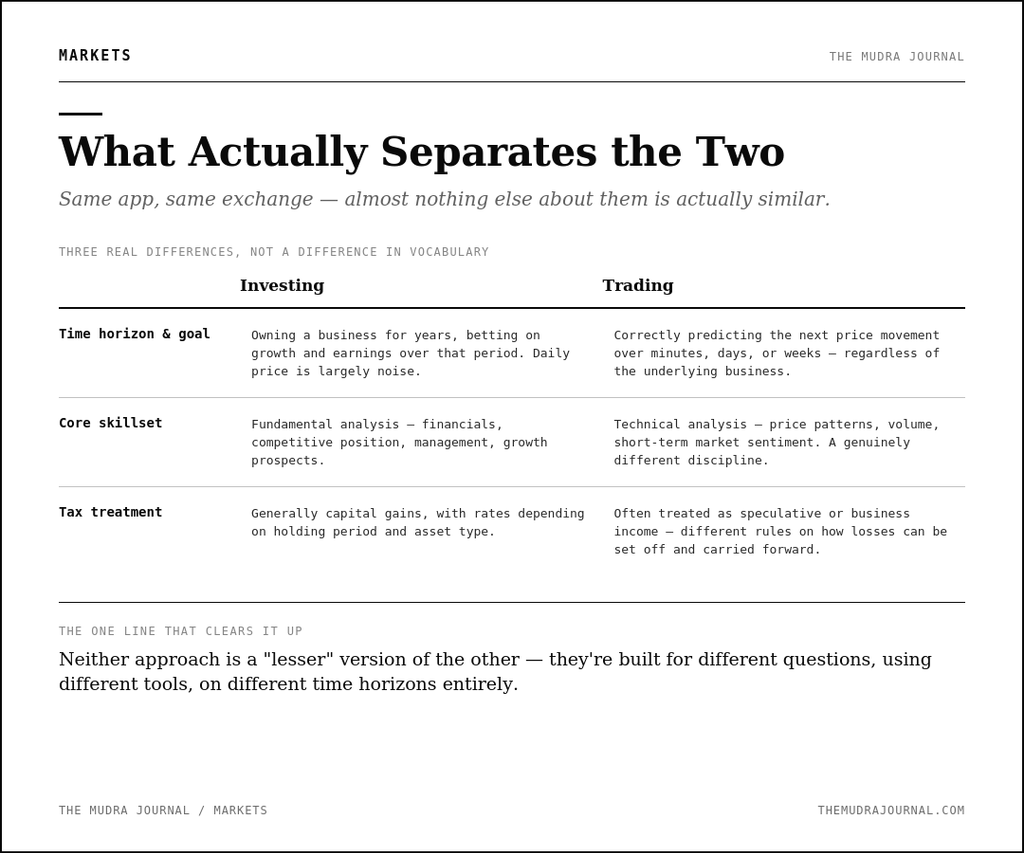
01 — THE TIME HORIZON AND THE GOAL ARE DIFFERENT
Owning a business vs predicting its next price move
Investing is built around holding an asset for years, betting on the underlying business’s growth, earnings, and value creation over that period — the daily price is largely noise to an investor with a genuinely long horizon. Trading is built around shorter time frames — sometimes minutes, sometimes days or weeks — where the goal isn’t owning a growing business, it’s correctly predicting the next price movement, regardless of what the underlying company is actually doing over the long run.
02 — THE APPROACH AND SKILLSET ARE GENUINELY DIFFERENT
Reading a balance sheet vs reading a chart
Investing typically leans on fundamental analysis — evaluating a company’s financials, competitive position, management, and growth prospects, the kind of work we’ve discussed in earlier pieces on reading annual reports and understanding a business. Trading typically leans on technical analysis, price patterns, volume, and short-term market sentiment — a genuinely different discipline, requiring different tools, different data, and a different kind of expertise, neither one a “lesser” version of the other, just built for a different question.
03 — THE TAX TREATMENT DIFFERS MEANINGFULLY
The Income Tax Department treats them as different activities
In India, gains from investments held for the long term are generally treated as capital gains (with different rates depending on the holding period and asset type), while frequent trading — particularly intraday equity trading and derivatives (F&O) activity — is often treated as speculative or business income by tax authorities, with different rules around how losses can be set off and carried forward. This distinction has real financial consequences and is genuinely worth understanding with a tax professional, or at minimum the current Income Tax Department guidance, before assuming your trading activity is taxed the same way a long-term investment would be.
The Indian trading boom, and the data behind it
The last several years have seen a dramatic rise in retail participation in India’s equity derivatives (F&O) market, driven substantially by easy mobile access, aggressive social media content around trading, and a pandemic-era surge in first-time market participants with time and curiosity on their hands. The number of individual traders in the F&O segment grew from roughly 45 lakh in FY22 to over a crore by FY24.
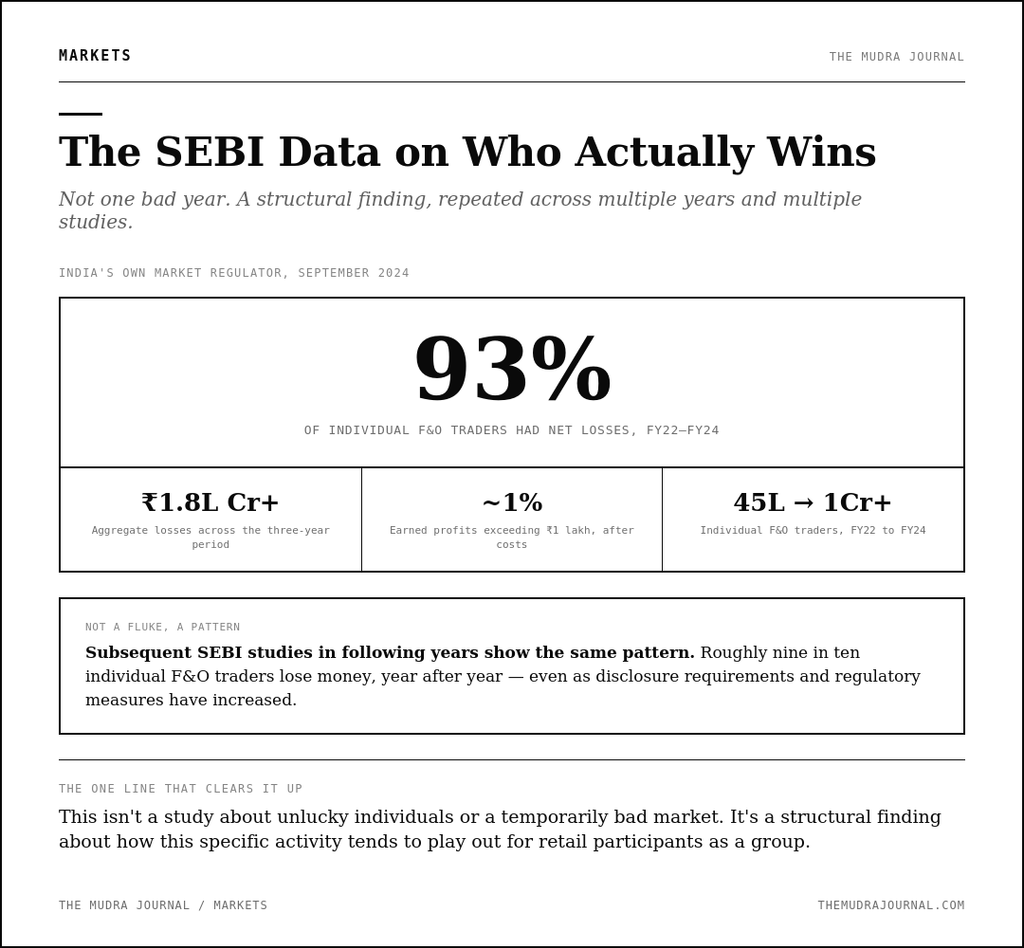
Here’s what a formal SEBI study, published in September 2024, found about how those traders actually did: across the three-year period from FY22 to FY24, 93% of individual traders in the equity F&O segment incurred net losses, with aggregate losses exceeding ₹1.8 lakh crore. Only around 1% of individual traders earned profits exceeding ₹1 lakh over that entire period, after accounting for transaction costs. Subsequent SEBI studies in following years have continued to show a similar pattern — roughly nine in ten individual F&O traders losing money, year after year, even as regulatory measures and disclosure requirements have increased.
This isn’t a study about unlucky individuals or a temporarily bad market — it’s a structural finding, repeated across multiple years and multiple SEBI studies, about how this specific activity tends to play out for retail participants as a group.
Why trading is so much harder than it looks
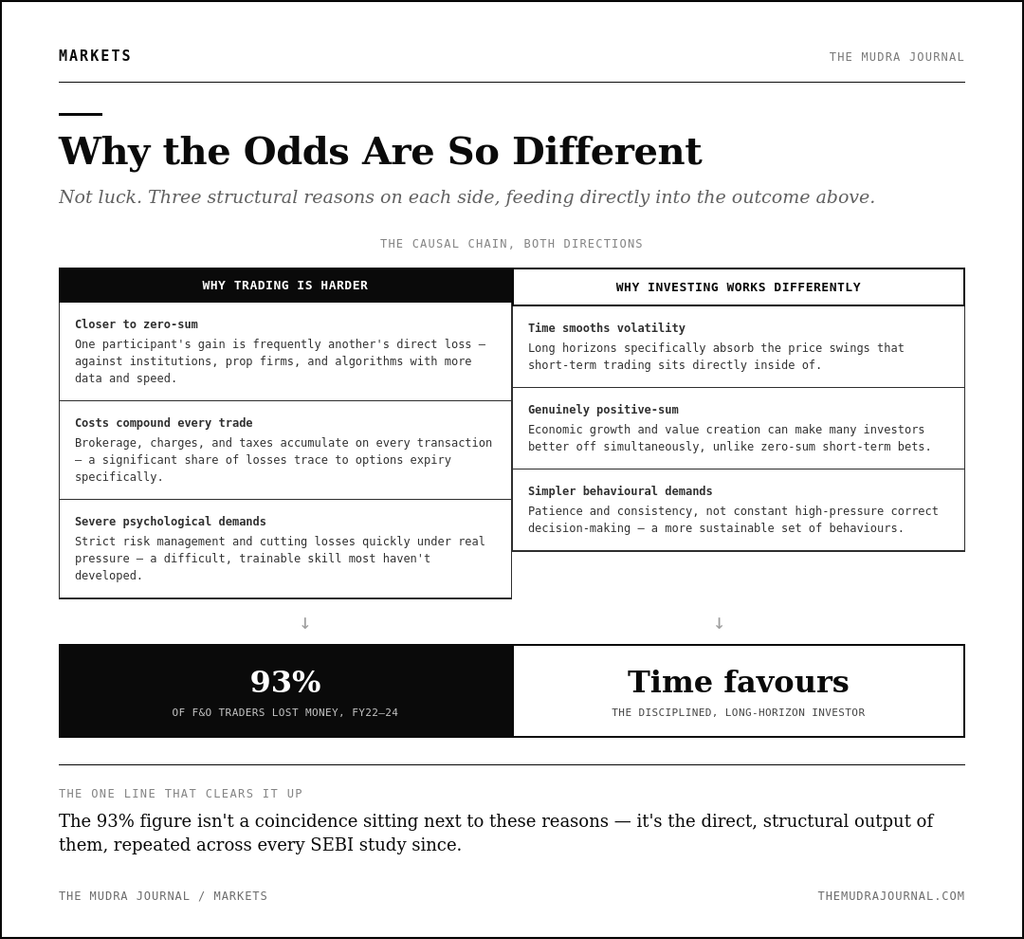
01 — IT’S CLOSER TO A ZERO-SUM GAME THAN INVESTING IS
For every winning trade, there’s frequently a losing counterparty
In derivatives trading especially, one participant’s gain is very often directly another participant’s loss — unlike long-term equity investing, where economic growth and business value creation can genuinely make many participants better off simultaneously over time. When individual retail traders are trading against institutional players, proprietary trading firms, and increasingly sophisticated algorithmic systems with far more data, speed, and capital, the structural disadvantage is significant before a single trade is even placed.
02 — TRANSACTION COSTS AND EXPIRY-DAY DYNAMICS QUIETLY ERODE ANY EDGE
Costs that compound with every trade, in a way long-term investing avoids
Frequent trading accumulates brokerage, transaction charges, and taxes on every single trade — costs that a long-term investor making far fewer transactions largely avoids. SEBI’s own study found that a significant share of aggregate retail losses in F&O trading came specifically from options trading around contract expiry, a genuinely difficult, high-risk window that experienced institutional players are specifically positioned to navigate more effectively than most individual traders.
03 — THE PSYCHOLOGICAL DEMANDS ARE SEVERE, AND MOST PEOPLE UNDERESTIMATE THEM
Discipline under real-time pressure is a rare, trainable, but genuinely difficult skill
Successful trading, to the (small) extent it exists sustainably, generally requires strict risk management, the discipline to cut losses quickly, and emotional control under real financial pressure — skills that take considerable deliberate practice to develop, and that SEBI’s data suggests most retail participants either haven’t developed or aren’t consistently applying, given how the same traders often continue trading, and continue losing, for years.
Why investing works differently
01 — TIME SMOOTHS OUT THE VOLATILITY THAT TRADING SITS DIRECTLY INSIDE OF
The long horizon is the actual mechanism, not just patience for its own sake
We’ve written before about how equity markets have historically recovered from downturns over sufficiently long periods — a mechanism that specifically favours investors with genuine multi-year horizons, and specifically works against short-term traders who are, by definition, exposed to exactly the volatility that a long horizon is designed to absorb.
02 — OWNING GROWING BUSINESSES IS A GENUINELY POSITIVE-SUM ACTIVITY
Everyone can win, roughly, as the economy actually grows
Unlike the more zero-sum dynamics of short-term trading, long-term investing in a diversified basket of growing companies benefits from genuine economic value creation — profits, innovation, and productivity growth that can make many investors better off simultaneously over time, a structurally different proposition from betting against other participants on short-term price direction.
03 — THE BEHAVIOURAL DEMANDS ARE SIMPLER, EVEN IF NOT EASY
Consistency over cleverness
A disciplined, long-term investing approach — SIPs, diversification, staying invested through downturns — asks for patience and consistency more than it asks for constant, correct, high-pressure decision-making. This doesn’t make investing effortless or risk-free, but it asks for a fundamentally more sustainable set of behaviours than active short-term trading does, which is a meaningful part of why the long-term outcomes for the two activities, in aggregate, look so different.
Where the lines genuinely blur
None of this means every trade is reckless or every long-term holding is automatically wise. Some experienced, disciplined individuals do trade professionally and sustainably, with rigorous risk management and years of deliberate skill development — SEBI’s data shows a small minority genuinely do profit consistently, even if it’s a small minority. Equally, “investing” done with excessive churn — frequently buying and selling long-term holdings based on short-term news or emotion — starts to functionally resemble trading, with much of the same risk and cost profile, even if it isn’t labelled that way. The honest distinction isn’t really about which app you use or how the activity is labelled. It’s about the actual time horizon, the actual approach, and the actual discipline being applied.
Making an honest choice
- Be honest with yourself about which activity you’re actually doing — a long holding period alone doesn’t make something “investing” if the decisions are still driven by short-term price movements and emotion.
- If you’re drawn to trading, treat it as a serious, separate skill requiring dedicated learning, strict risk management, and capital you can genuinely afford to lose — not an extension of your long-term investment portfolio.
- Keep your core, long-term financial goals — retirement, major life milestones — in investment vehicles built for that horizon, entirely separate from any trading activity, so a bad trading period can’t derail your actual financial plan.
- Review the SEBI data honestly before assuming you’ll be in the profitable minority — it’s not impossible, but the base rate is real, and it’s worth weighing seriously rather than assuming your situation will be different.
- Understand the tax treatment of whichever activity you’re doing, since intraday and F&O trading is generally taxed differently from long-term capital gains, with real implications for how much you actually keep.
A note on this piece: this article is educational and explains market mechanics and publicly available regulatory data — it is not investment or trading advice, and not a recommendation to trade, invest, or avoid either activity. Please read all scheme and product-related documents carefully, and consult a qualified financial advisor for guidance specific to your situation.
Trading and investing were never meant to be interchangeable words for “being in the stock market.” One is a long-term bet on ownership and growth, favoured by time and patience. The other is a short-term, skill-intensive contest against some of the most sophisticated participants in the market — and the data, published by India’s own market regulator, makes clear which one most people are actually equipped to win.
FROM THE MUDRA JOURNAL — MARKETS / बाज़ार – Markets, Made Understandable