You’ve heard the disclaimer at the end of every mutual fund ad in India so many times it’s stopped registering as information: “mutual funds are subject to market risks, please read all scheme related documents carefully.” It’s said fast, in a monotone, right before the screen cuts away — and it might be the single most ignored sentence in Indian personal finance.
13 MIN READ
MARKETS / बाज़ार
WRITTEN FOR: THE FIRST SIP → THE FIRST MARKET DOWNTURN
Ask someone who’s just started a mutual fund SIP whether their investment carries risk, and a surprising number will hesitate, then say something like “not really, it’s a SIP” — as if the disciplined, automated nature of the investing method somehow removes risk from what’s being invested in. This isn’t a knowledge gap that’s anyone’s individual fault. Mutual funds are frequently sold by the same bank relationship managers who sell fixed deposits, marketed with reassuring language about discipline and long-term wealth creation, and wrapped in a name — “mutual” — that sounds cooperative and institutional rather than market-exposed. Nothing about how mutual funds are typically presented in India prepares a first-time investor for what “subject to market risks” actually means until the first real downturn arrives.
This piece exists to make that disclaimer mean something specific, before you need it to.
A mutual fund isn’t a safer version of a fixed deposit. It’s a professionally managed way to be exposed to real market risk — and understanding exactly what kind of risk you’re holding is the difference between staying invested through a downturn and panic-selling at the worst possible moment. Here’s what’s actually inside that risk, category by category.
Why mutual funds get mistaken for a safe investment
01 — THEY’RE SOLD ALONGSIDE FDs, BY THE SAME PEOPLE
The sales context shapes the perception
When a bank RM presents a mutual fund SIP in the same conversation, sometimes the same breath, as a fixed deposit renewal, it’s easy for the products to blur together in an investor’s mind — associated with the same trusted institution, presented with similar confidence, without an equally clear explanation of how differently the two actually behave when markets move.
02 — THE WORD “MUTUAL” SOUNDS COLLECTIVE AND SAFE
Language shapes perception more than most investors realise
“Mutual” evokes something cooperative, pooled, almost communal — a word that, to an unfamiliar ear, can sound closer to insurance or a cooperative society than to direct market exposure. The actual mechanism — your money pooled with others’ and invested in stocks or bonds whose value fluctuates daily — isn’t obvious from the name alone.
03 — SIP MARKETING EMPHASISES DISCIPLINE, NOT RISK
“Start small, stay consistent” says nothing about what you’re investing in
The dominant marketing message around SIPs focuses almost entirely on behavioural benefits — start with a small amount, invest consistently, let compounding do the work — which are genuinely valid points, but which also crowd out any real discussion of what’s happening to the underlying investment during the inevitable periods when markets fall.
The risk that’s actually inside a mutual fund
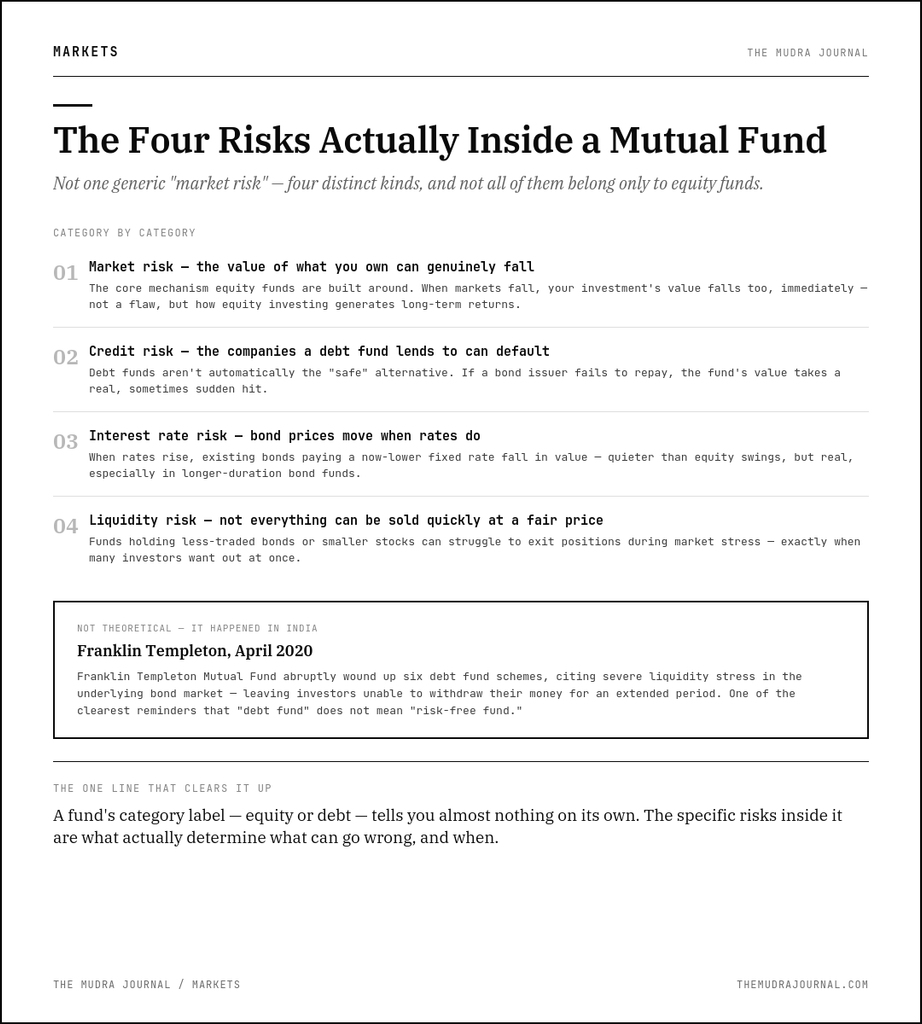
01 — MARKET RISK: THE VALUE OF WHAT YOU OWN CAN GENUINELY FALL
This is the risk equity funds are built around
An equity mutual fund’s value moves with the stock market — when markets fall, meaningfully and sometimes sharply, so does the value of your investment, on paper, immediately. This isn’t a flaw or a rare event; it’s the fundamental mechanism through which equity investing generates long-term returns, and any equity fund, regardless of its past performance or its manager’s reputation, carries this risk in full.
02 — CREDIT RISK: THE COMPANIES A DEBT FUND LENDS TO CAN DEFAULT
Debt funds aren’t automatically the “safe” alternative
Debt mutual funds invest in bonds issued by companies and governments, and if a company whose bonds a fund holds runs into financial trouble and fails to repay, the fund’s value takes a real, sometimes sudden hit. This isn’t a theoretical risk in India — in April 2020, Franklin Templeton Mutual Fund abruptly wound up six of its debt fund schemes, citing severe liquidity stress in the underlying bond market, leaving a large number of investors unable to withdraw their money for an extended period. It remains one of the clearest reminders that “debt fund” does not mean “risk-free fund.”
03 — INTEREST RATE RISK: BOND PRICES MOVE WHEN RATES DO
A quieter, more technical risk inside debt funds
When interest rates rise, the market value of existing bonds (which pay a fixed, now comparatively lower rate) tends to fall, which affects the value of debt funds holding those bonds — an effect that’s usually less dramatic than equity market swings, but real, and more pronounced in funds holding longer-duration bonds.
04 — LIQUIDITY RISK: NOT EVERYTHING CAN BE SOLD QUICKLY AT A FAIR PRICE
The risk that surfaces exactly when you need to exit
Some funds, particularly those holding less-traded bonds or smaller companies’ stocks, can struggle to sell holdings quickly without affecting the price, especially during periods of market stress when many investors want to exit simultaneously — precisely the scenario that played out during the Franklin Templeton episode, and a risk that’s easy to overlook until the moment liquidity is actually needed.
Understanding the SEBI riskometer
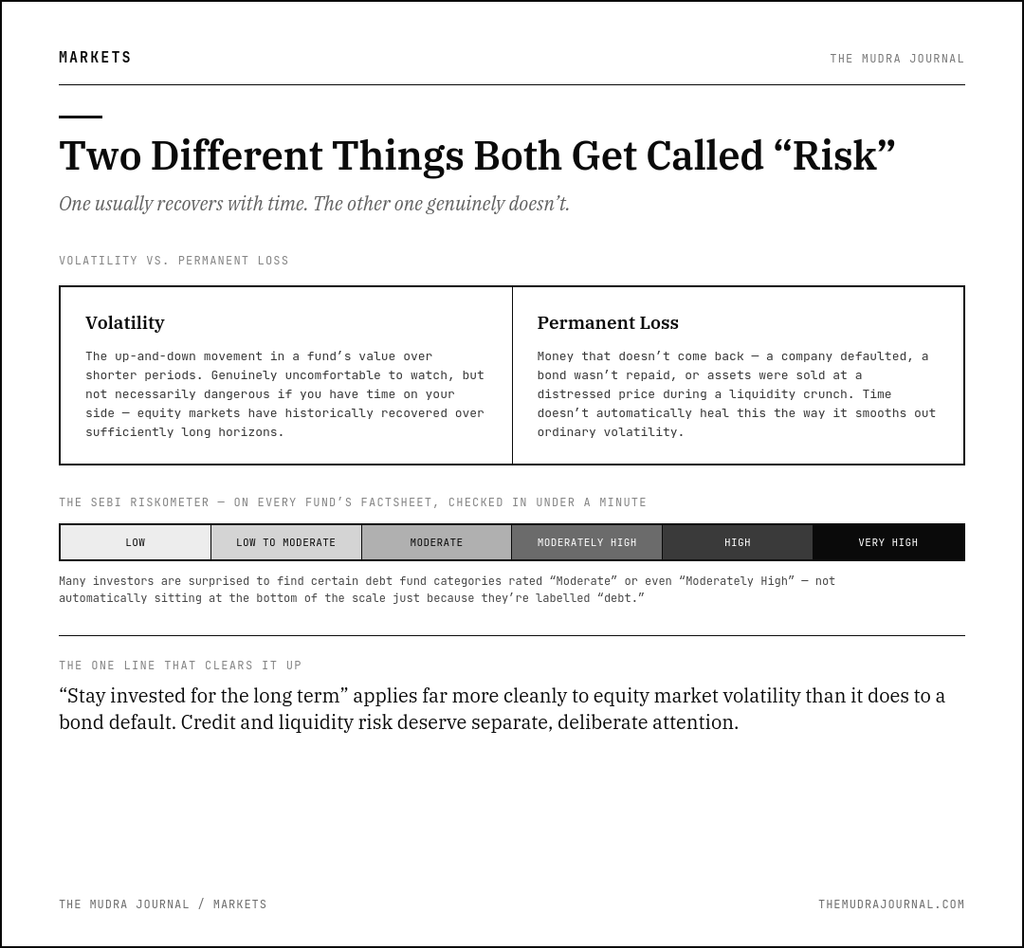
Every mutual fund scheme in India is required to display a riskometer — a simple visual gauge, ranging from “Low” to “Very High,” indicating the fund’s risk level based on its actual holdings, updated periodically by the fund house according to SEBI’s methodology. It appears on every factsheet and scheme document, and it’s one of the most direct, standardised tools available to an investor trying to understand what they’re actually signing up for.
The riskometer is worth checking before investing in any fund, not just for equity funds — many investors are surprised to find certain debt fund categories rated “Moderate” or even “Moderately High” rather than “Low,” a useful, immediate corrective to the assumption that all debt funds sit safely at the bottom of the risk scale. Reading this one indicator takes under a minute and tells you more about a fund’s actual risk than its brand name, its past returns, or how it was described in a bank branch.
Not all risk is the same kind of risk
It’s worth distinguishing between two genuinely different things that both get called “risk.”
Volatility is the up-and-down movement in a fund’s value over shorter periods — genuinely uncomfortable to watch, but not necessarily dangerous if you have time on your side. Equity markets have historically recovered from downturns over sufficiently long horizons, which is exactly why equity fund investing is generally recommended for goals several years or more away, giving volatility time to smooth out.
Permanent loss is different — money that doesn’t come back, because a company defaulted, a bond wasn’t repaid, or a fund had to sell assets at a distressed price during a liquidity crunch. Time doesn’t automatically heal this kind of risk the way it can smooth out ordinary volatility, which is precisely why credit risk and liquidity risk in debt funds deserve separate, deliberate attention rather than being waved away with “just stay invested for the long term” — advice that applies far more cleanly to equity market volatility than to a bond default.
Common mistakes born from the “mutual funds are safe” myth
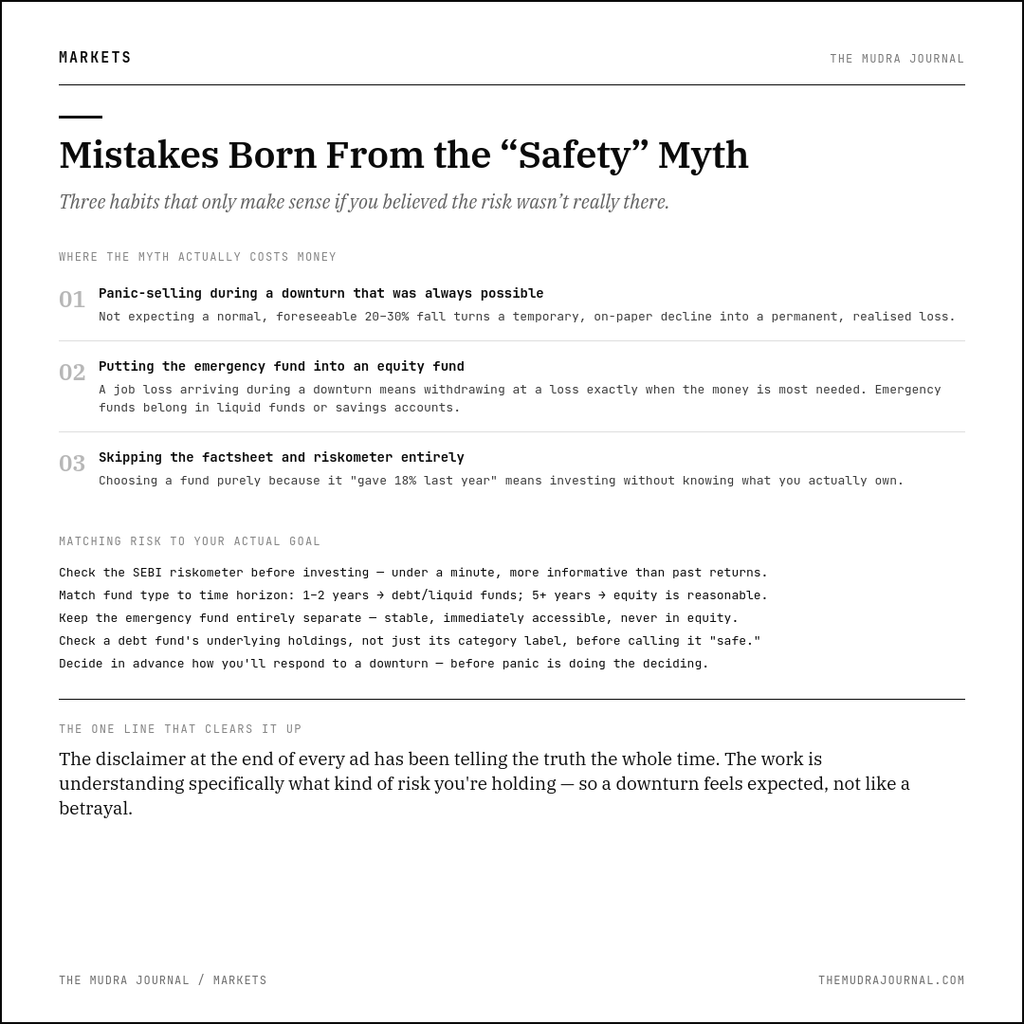
01 — PANIC-SELLING DURING A DOWNTURN THAT WAS ALWAYS POSSIBLE
Selling low because the fall wasn’t expected in the first place
Investors who didn’t fully understand that equity funds could fall 20-30% in a bad year are far more likely to panic and redeem at the worst possible time, converting a temporary, on-paper decline into a permanent, realised loss — a behavioural mistake that stems directly from not expecting volatility that was, in fact, entirely normal and foreseeable for the asset class.
02 — PUTTING THE EMERGENCY FUND INTO AN EQUITY FUND
Treating volatile money like it’s instantly accessible and stable
An emergency fund needs to be reliably there, in full, exactly when it’s needed — which is incompatible with equity market volatility, since a job loss or medical emergency arriving during a market downturn would mean withdrawing at a loss precisely when the money is most needed. Emergency funds belong in liquid funds, savings accounts, or similarly low-volatility instruments, not equity mutual funds, however good their long-term returns might look on a chart.
03 — SKIPPING THE FACTSHEET AND RISKOMETER ENTIRELY
Investing based on past returns alone
Choosing a fund purely because it “gave 18% last year,” without checking its risk category, its underlying holdings, or how it performed during a downturn, means investing without actually knowing what you own — a habit that the mutual fund industry’s own required disclosures are specifically designed to prevent, if investors take the minute needed to read them.
Matching risk to your actual goal
- Check the SEBI riskometer on any fund before investing, not just its past returns — it takes under a minute and tells you what category of risk you’re actually taking on.
- Match the fund type to your time horizon: money needed within 1-2 years belongs in low-risk debt or liquid funds, not equity; money genuinely not needed for 5+ years can reasonably carry equity market risk.
- Keep your emergency fund entirely separate from your investment portfolio, in something stable and immediately accessible — never in an equity fund, regardless of its track record.
- Understand that debt funds carry their own distinct risks (credit and interest rate risk), and check a fund’s underlying holdings, not just its category label, before assuming it’s automatically the “safe” choice in your portfolio.
- Before any downturn actually happens, decide in advance how you’ll respond to one — a plan made calmly in advance is far more reliable than a decision made during a market fall, when panic is doing most of the thinking.
Mutual funds were never marketed as risk-free, whatever the tone of a bank branch conversation might have implied. The disclaimer at the end of every advertisement has been telling the truth the entire time — the work that’s actually needed is understanding, specifically, what kind of risk you’re holding, so a market downturn feels like an expected part of the plan, not a betrayal of one.
FROM THE MUDRA JOURNAL — MARKETS / बाज़ार – Markets, Made Understandable