Somewhere between a Twitter thread about retiring at 35 and a WhatsApp forward about crorepatis, “financial freedom” became a number everyone quotes and almost nobody has actually calculated for their own life. Here’s what the number really depends on — and why the popular figure floating around probably isn’t yours.
12 MIN READ
INDIA SERIES / भारत
WRITTEN FOR: THE 9-TO-5 SKEPTIC → THE NUMBER-BACKED PLANNER
“Financial freedom” has become one of those phrases that gets used constantly and defined rarely. For some, it means never checking a price tag again. For others, it means quitting a job they’ve quietly hated since 2019. For a growing number of young Indians on social media, it means retiring at 40 with a corpus calculated using an American formula, in an American cost-of-living context, applied directly to an Indian life without adjustment. All three versions get called the same thing, and all three arrive at wildly different numbers — which is exactly the problem.
Financial freedom, stripped of the aesthetic, means one specific thing: having enough invested wealth that your living expenses are covered by returns on that wealth, without needing active income from a job. It’s not about being rich. It’s about the gap between what you need each month and what your money can generate on its own closing completely. That’s a calculable number — but it’s a number that depends heavily on decisions most people haven’t consciously made yet: where you’ll live, whether you own or rent your home, how many people depend on your income, and how much of the imported FIRE playbook actually survives contact with Indian healthcare, family structures, and inflation.
This is a long one, because the honest answer to “how much do I need” was never going to fit in a tweet. Let’s build it properly.
Financial freedom isn’t a fixed number you copy from an influencer’s reel. It’s your own annual expenses, multiplied by a factor that depends on how long your money needs to last and how safely you want to withdraw it. Everything else in this piece is just the process of finding your specific multiplier and your specific expense number — the two inputs that actually matter.
Why the imported number doesn’t fit an Indian life
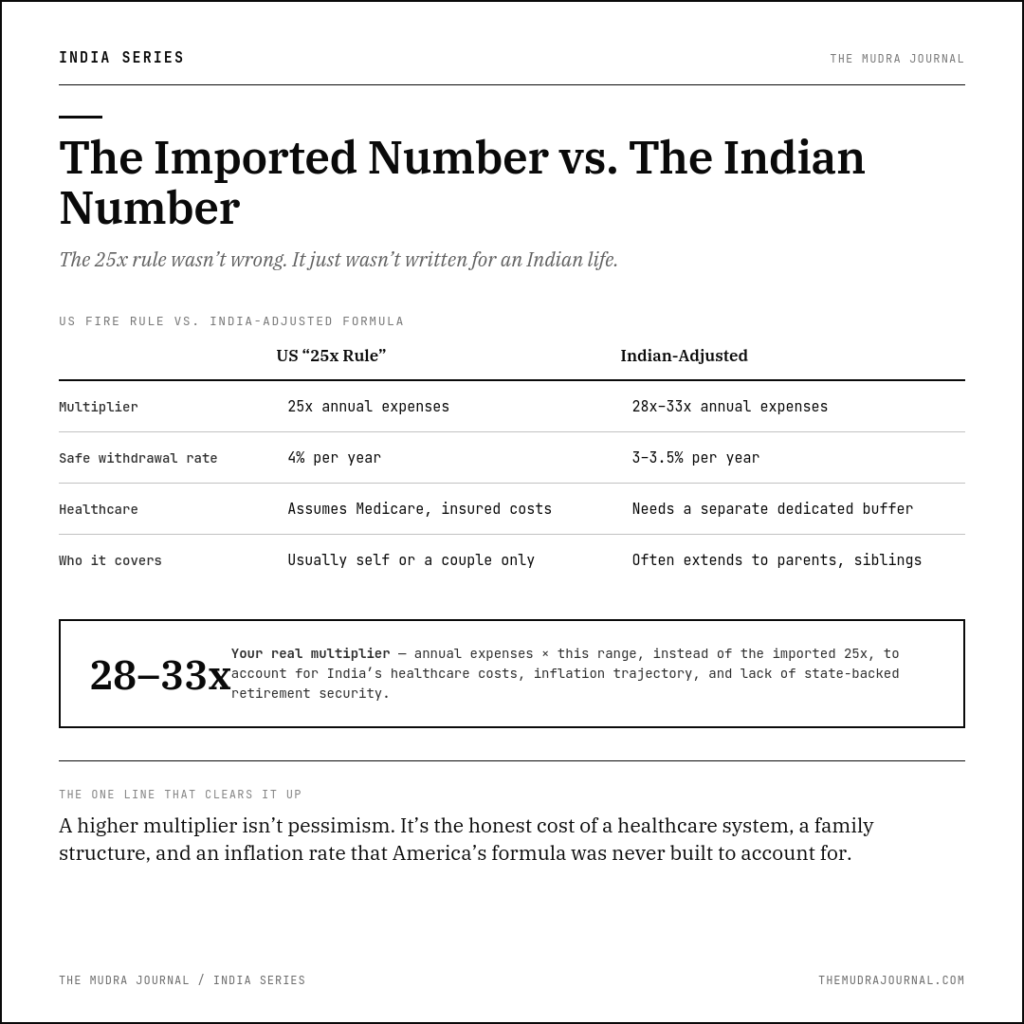
The FIRE movement — Financial Independence, Retire Early — originated in the US, and its most quoted rule, the “25x rule,” says you need 25 times your annual expenses invested, allowing you to withdraw 4% a year indefinitely. It’s a clean, elegant piece of math. It’s also built on assumptions that don’t hold up cleanly once you cross into an Indian context.
01 — HEALTHCARE CHANGES THE ENTIRE EQUATION
The 4% rule assumes costs you can’t assume here
The American version of this math generally assumes access to Medicare after 65 and a healthcare system with predictable, insured costs. In India, healthcare inflation has consistently outpaced general inflation for years, and there’s no universal safety net equivalent — a single serious hospitalization for yourself or a parent can undo years of careful compounding if you’re under-insured. Any Indian financial freedom number that doesn’t build in a large, dedicated healthcare buffer is quietly borrowing an assumption that doesn’t apply here.
02 — THE JOINT FAMILY STRUCTURE ADDS DEPENDENTS THE FORMULA DOESN’T SEE
“Your” expenses are rarely just your own
The standard FIRE calculation is built around an individual or a couple covering their own expenses. In a large number of Indian households, financial responsibility quietly extends to ageing parents, siblings, or extended family — an obligation that’s rarely written down anywhere but shows up reliably every year. A financial freedom number that only accounts for your own grocery bill and rent, while ignoring a very real, very likely future obligation toward parents’ medical care, isn’t actually your number.
03 — INDIA’S INFLATION AND INTEREST RATE ENVIRONMENT ISN’T AMERICA’S
The safe withdrawal rate itself needs adjusting
The 4% safe withdrawal rate was calculated primarily using historical US market data. India’s equity markets, inflation trends, and available investment instruments don’t perfectly mirror that history, and many Indian financial planners now suggest a more conservative 3–3.5% withdrawal rate for long retirement horizons here, precisely because a higher withdrawal rate carries more risk of running out of money over a 40-50 year retirement in a higher-inflation economy.
The actual formula, adjusted for where you live
Here’s the corrected version of the math, built for an Indian context rather than borrowed wholesale from one that isn’t.
01 — START WITH YOUR REAL ANNUAL EXPENSES, NOT YOUR CURRENT SALARY
The number that matters is what you spend, not what you earn
Financial freedom is calculated against expenses, because that’s what your investments need to cover — your salary is irrelevant to the math once you’re not working. Track a full year of actual spending, not an estimate: rent or home upkeep, groceries, insurance premiums, travel, family support, and a realistic annual allowance for irregular costs like festivals, gifts, and repairs.
02 — MULTIPLY BY A MORE CONSERVATIVE FACTOR
30x to 33x instead of 25x
Using a 3–3.5% withdrawal rate instead of 4% pushes your multiplier from 25x up to roughly 28x–33x your annual expenses. It’s a meaningfully larger number, and that’s intentional — it’s building in the extra margin that India’s healthcare costs, inflation trajectory, and lack of state-backed retirement security actually require.
03 — ADD A SEPARATE, DEDICATED HEALTHCARE BUFFER
On top of the core number, not folded into it
Beyond comprehensive health insurance (for yourself and, if possible, your parents), many Indian financial planners recommend a separate medical corpus — an amount set aside specifically for treatments, procedures, or care not fully covered by insurance, especially as you and your parents age. This isn’t part of your regular annual expense calculation; it’s a buffer sitting alongside it, because a single major health event is one of the most common ways a “sufficient” corpus turns out not to be.
What the number actually looks like, at different lifestyles
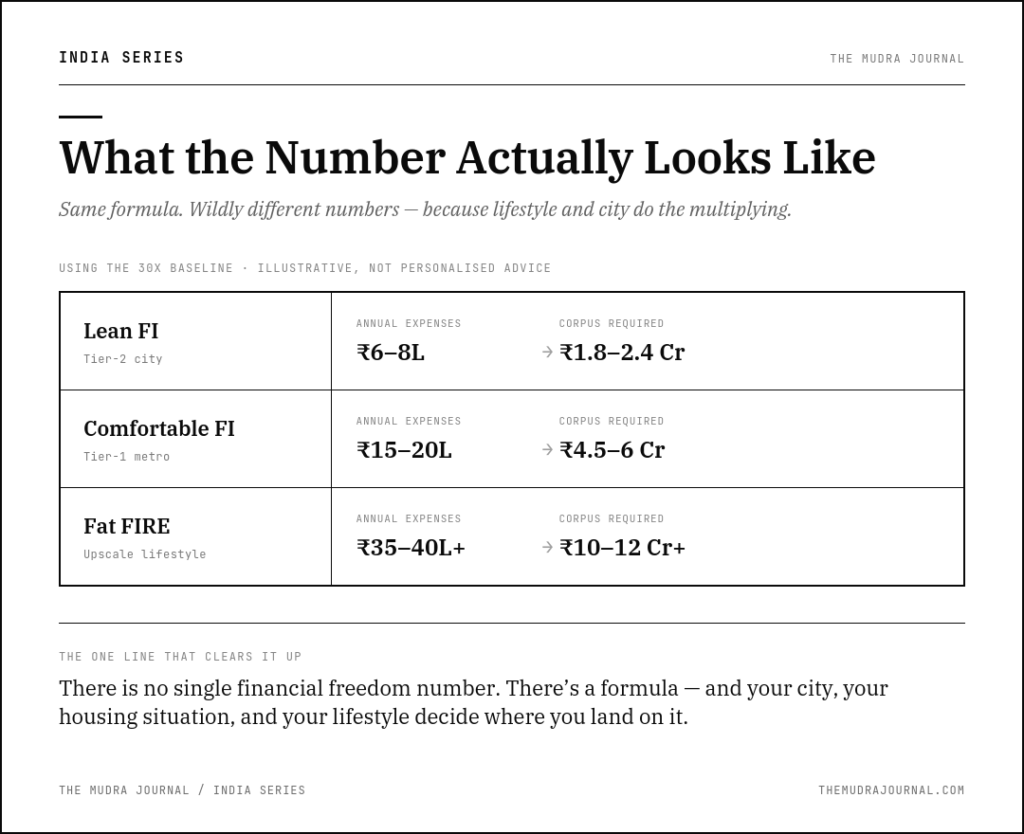
To make this concrete rather than abstract, here’s roughly how the corpus requirement shifts depending on lifestyle and city — using the 30x multiplier as a baseline, and rounded for simplicity. These are illustrative starting points, not personalised advice, but they should give you a real sense of scale.
Lean financial independence, tier-2 city: Annual expenses of roughly ₹6–8 lakh (modest housing already owned outright, limited discretionary spending, basic healthcare buffer) suggest a corpus in the ₹1.8–2.4 crore range.
Comfortable financial independence, tier-1 metro: Annual expenses of roughly ₹15–20 lakh (rented or owned housing in a major city, moderate discretionary spending, family support included, solid healthcare buffer) suggest a corpus in the ₹4.5–6 crore range.
“Fat FIRE” — a genuinely upscale lifestyle: Annual expenses upward of ₹35–40 lakh (larger home, international travel, private schooling for children, extensive family support) push the required corpus toward ₹10–12 crore or more.
The point of this range isn’t to anchor you to any one of these numbers — it’s to show how dramatically the answer shifts based on lifestyle and location, which is exactly why quoting a single “financial freedom number” without context is close to meaningless.
The hidden variables that quietly move your number
Even with the corrected formula, a few Indian-specific variables can shift your real number significantly in either direction — and most calculators don’t ask about any of them.
01 — WHETHER YOU OWN YOUR HOME OUTRIGHT
The single biggest lever in the entire calculation
Owning your home outright, with no home loan remaining, removes what is often the single largest recurring expense from your annual number, dramatically lowering your required corpus. Conversely, planning to rent indefinitely means housing costs — which tend to rise with inflation and city growth — need to be fully funded by your corpus for as long as you live, making this arguably the most consequential single decision in the entire calculation.
02 — HOW MANY PEOPLE YOUR INCOME WILL SUPPORT
Your number and your household’s number are different questions
A financial freedom calculation for a single person supporting only themselves looks very different from one that includes a spouse, children’s education (including potentially expensive higher education, possibly abroad), and ageing parents. Being explicit about who your money needs to support — not just today, but over the next 20-30 years — changes the expense number this entire formula is built on.
03 — WHETHER YOU’RE PLANNING TO FULLY STOP WORKING, OR JUST STOP NEEDING TO
“Coast FIRE” and “Barista FIRE” are legitimate middle paths
Not everyone pursuing financial freedom is aiming to never work again — many aim instead for a corpus large enough that they could take a lower-paying, lower-stress job, freelance selectively, or take extended breaks without financial anxiety, topping up their corpus’s growth with modest active income rather than replacing it entirely. This meaningfully lowers the required number, and it’s often a more realistic, less extreme goal than full early retirement for most people.
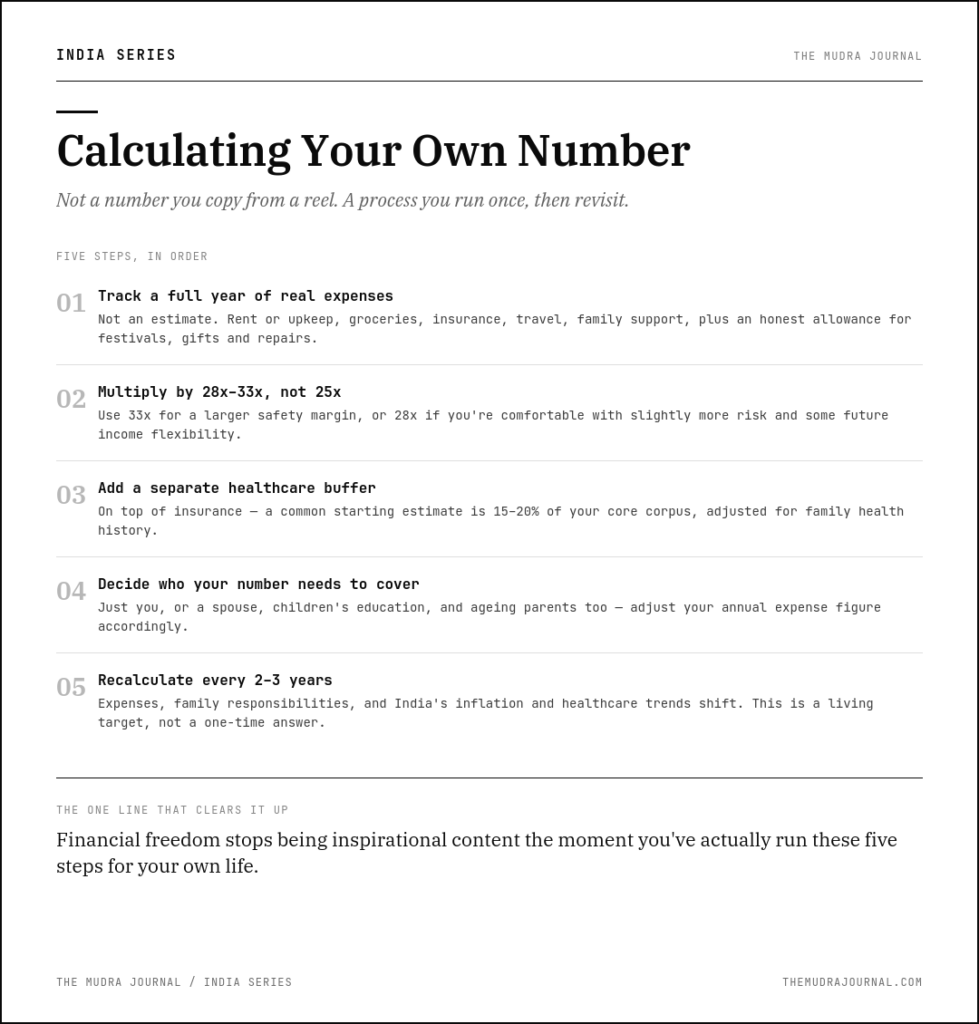
Calculating your own number
This isn’t a calculation you do once and forget — it’s worth revisiting as your life circumstances change. But the first pass looks like this.
- Track a full year of your actual expenses (not an estimate), including an honest allowance for annual costs like festivals, travel, and family obligations.
- Multiply that annual figure by 30 as a starting point, adjusting toward 33x if you want a larger safety margin, or 28x if you’re comfortable with slightly more risk and flexibility (like a willingness to earn some income later).
- Add a separate healthcare buffer on top — a commonly used starting estimate is 15-20% of your core corpus, adjusted based on your family’s health history and existing insurance coverage.
- Decide honestly whether your number needs to support just you, or extends to a spouse, children’s education, and ageing parents — and adjust your annual expense figure accordingly, not just your final corpus.
- Recalculate every 2-3 years, since your expenses, family responsibilities, and India’s inflation and healthcare cost trends will all shift over time — this number is a living target, not a one-time answer.
Financial freedom was never meant to be a number you borrow from someone else’s Instagram carousel. It’s your own expenses, honestly tracked, multiplied by a factor that accounts for how India’s healthcare system, family structures, and inflation actually work — not how a different country’s do. Once you’ve done that math for your own life, the number stops being inspirational content and starts being an actual, trackable target.
FROM THE MUDRA JOURNAL — Rooted in India, inspired by the world.