“Vodafone Idea merger” and “Walmart’s acquisition of Flipkart” both showed up in Indian business headlines within a few years of each other, both involving enormous sums of money, both covered with roughly the same tone of breathless significance. One of those words was chosen carefully. The other one, in a lot of everyday usage, gets treated as a rough synonym for the first — and the gap between what they actually mean is bigger, and more consequential, than most readers ever pause to notice.
13 MIN READ
THE LEDGER — BOARDROOM
WRITTEN FOR: THE DEAL HEADLINE → THE ACTUAL DEAL STRUCTURE
Business news in India, like most places, uses “M&A” — mergers and acquisitions — as a single, blended category, which is technically accurate and practically responsible for a great deal of confusion. A merger and an acquisition are structurally different transactions, with different implications for control, ownership, employees, shareholders, and regulatory process. They get grouped together because both involve one company’s fate becoming entangled with another’s, and because, as this piece will get to, the word “merger” is frequently chosen for reasons that have very little to do with the actual structure of the deal.
A merger is two companies combining to form one entity, typically as something closer to a partnership between comparably positioned businesses. An acquisition is one company buying and taking control of another, which may continue operating with its own name, or may be fully absorbed — but either way, one side is clearly buying, and the other is clearly being bought. The distinction sounds simple stated plainly. It gets deliberately blurred, constantly, in how these deals are actually announced.
What each term actually means

01 — A MERGER: TWO COMPANIES BECOMING ONE
Structurally closer to a combination than a purchase
In a merger, two companies combine to form a single entity — sometimes a genuinely new company, sometimes one company legally absorbing the other while both sets of shareholders end up holding stock in the combined business. This is typically structured through a share swap: shareholders of both original companies receive shares in the merged entity, in a ratio reflecting each company’s relative value, rather than one side simply receiving a cash payout and exiting.
02 — AN ACQUISITION: ONE COMPANY BUYING CONTROL OF ANOTHER
One side is clearly the buyer, the other the target
In an acquisition, one company (the acquirer) purchases a controlling stake — sometimes the entirety, sometimes a majority — of another company (the target), typically paying the target’s shareholders in cash, in the acquirer’s own shares, or some combination of both. The target company’s shareholders exit their position (receiving cash or acquirer stock in exchange), and the target may continue operating under its own name as a subsidiary, or eventually be folded entirely into the acquirer’s operations, depending on the acquirer’s strategy.
Why “merger” is so often a euphemism
This is the part that actually matters for reading business news correctly: the word “merger” is very frequently used publicly for transactions that are, structurally and practically, acquisitions — because “merger” sounds like a partnership between equals, and “acquisition” sounds like exactly what it often is: one company being bought out and losing independent control. This pattern isn’t unique to India — the Daimler-Chrysler combination in the late 1990s was famously branded a “merger of equals” and was widely understood, in the years that followed, to have functioned much more like a Daimler acquisition of Chrysler in practice. The label chosen at the announcement stage is often as much a public relations and morale decision — for employees, for the weaker party’s shareholders, for the surrounding narrative — as it is an accurate description of the underlying structure.
How the structures actually differ, mechanically
In a genuine merger, valuing each company correctly and agreeing on a fair share-exchange ratio is central to the negotiation — since both sets of shareholders will hold stock in the combined entity going forward, the ratio directly determines how much of the new company each side effectively owns. In an acquisition, the core negotiation is the acquisition price and the form of consideration — cash, acquirer shares, or a mix — since the target’s shareholders are being bought out rather than continuing as co-owners of an ongoing combined entity in the same way. This is also why acquisitions frequently involve a premium — a price above the target’s current market value — to persuade target shareholders to sell control, a dynamic that doesn’t map onto a genuine merger in quite the same way.
Why the distinction matters practically
01 — FOR EMPLOYEES: THE INTEGRATION EXPERIENCE OFTEN DIFFERS SIGNIFICANTLY
Acquisitions tend to have a clearer chain of command; mergers can mean prolonged ambiguity
In many acquisitions, the acquirer’s management structure, systems, and culture tend to take precedence relatively quickly, since one party is clearly in control from the outset. Genuine mergers can, somewhat counterintuitively, create more prolonged uncertainty — with two sets of leadership, systems, and cultures needing to be reconciled without an obvious default, sometimes for years after the deal is announced.
02 — FOR SHAREHOLDERS: THE TAX AND FINANCIAL OUTCOME CAN DIFFER
A share swap and a cash payout are treated differently
Shareholders receiving shares in a merged entity (common in genuine mergers) may face a different, often deferred tax treatment compared to shareholders receiving cash in an acquisition, which frequently triggers an immediate capital gains tax event. This is a genuinely important, deal-specific detail for any shareholder affected by a transaction, well worth checking against current tax rules or with a professional rather than assuming either structure behaves identically for tax purposes.
03 — FOR REGULATORS: BOTH TYPES TRIGGER SCRUTINY, BUT THROUGH DIFFERENT MECHANISMS
CCI approval applies broadly; SEBI’s takeover code specifically governs listed-company acquisitions
In India, the Competition Commission of India (CCI) reviews both mergers and acquisitions above certain size thresholds, to assess whether the combination would harm market competition, regardless of which label the deal carries. Additionally, when an acquisition involves purchasing a substantial stake in a publicly listed company, SEBI’s Substantial Acquisition of Shares and Takeovers (SAST) Regulations — commonly known as the takeover code — impose specific obligations, including a mandatory open offer to minority shareholders once an acquirer crosses a defined shareholding threshold, a regulatory mechanism specifically built around the acquisition structure rather than a merger of two entities into one.
Real examples from Indian business, correctly labelled
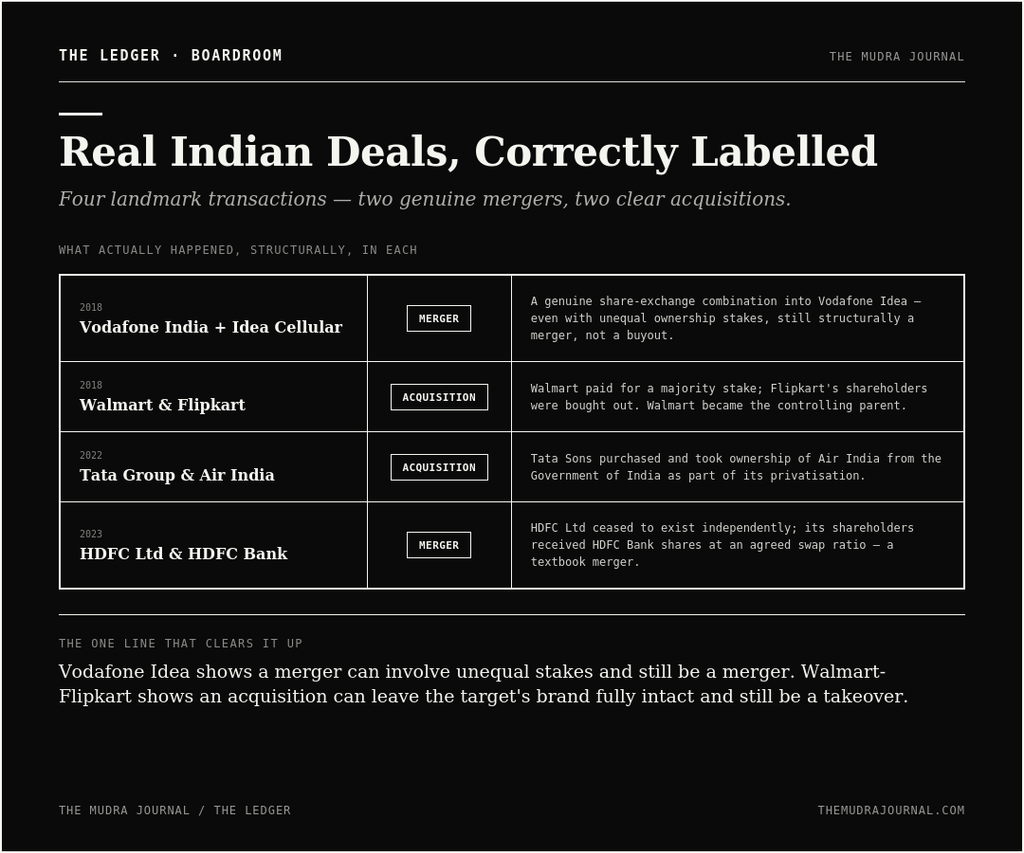
Vodafone Idea (2018): Vodafone India and Idea Cellular combined to form Vodafone Idea, structured as a genuine merger between two major telecom operators — a share-exchange combination, even though the two companies didn’t emerge with precisely equal ownership stakes in the merged entity, illustrating that a “merger” can still involve unequal proportions while remaining structurally a combination rather than one side simply buying out the other.
Walmart and Flipkart (2018): Walmart’s purchase of a majority stake in Flipkart was a clear acquisition — Walmart paid a substantial sum for control of Flipkart, Flipkart’s existing shareholders were bought out (fully or partially) in the process, and Walmart became the controlling parent, with Flipkart continuing to operate under its own brand as a controlled subsidiary.
Tata Group and Air India (2022): The Tata Group’s purchase of Air India from the Government of India, as part of the airline’s privatisation, was an acquisition — Tata Sons paid for and took ownership and control of Air India, which continues operating as a distinct airline, now under Tata’s ownership rather than government ownership.
HDFC Ltd and HDFC Bank (2023): The amalgamation of HDFC Ltd (the housing finance company) into HDFC Bank was a genuine merger in the fullest sense — HDFC Ltd ceased to exist as an independent company, its shareholders received HDFC Bank shares according to an agreed swap ratio, and the two entities combined into a single, larger institution, making it one of the clearest recent examples of an actual merger, as opposed to an acquisition dressed in merger language.
Making sense of the next deal headline
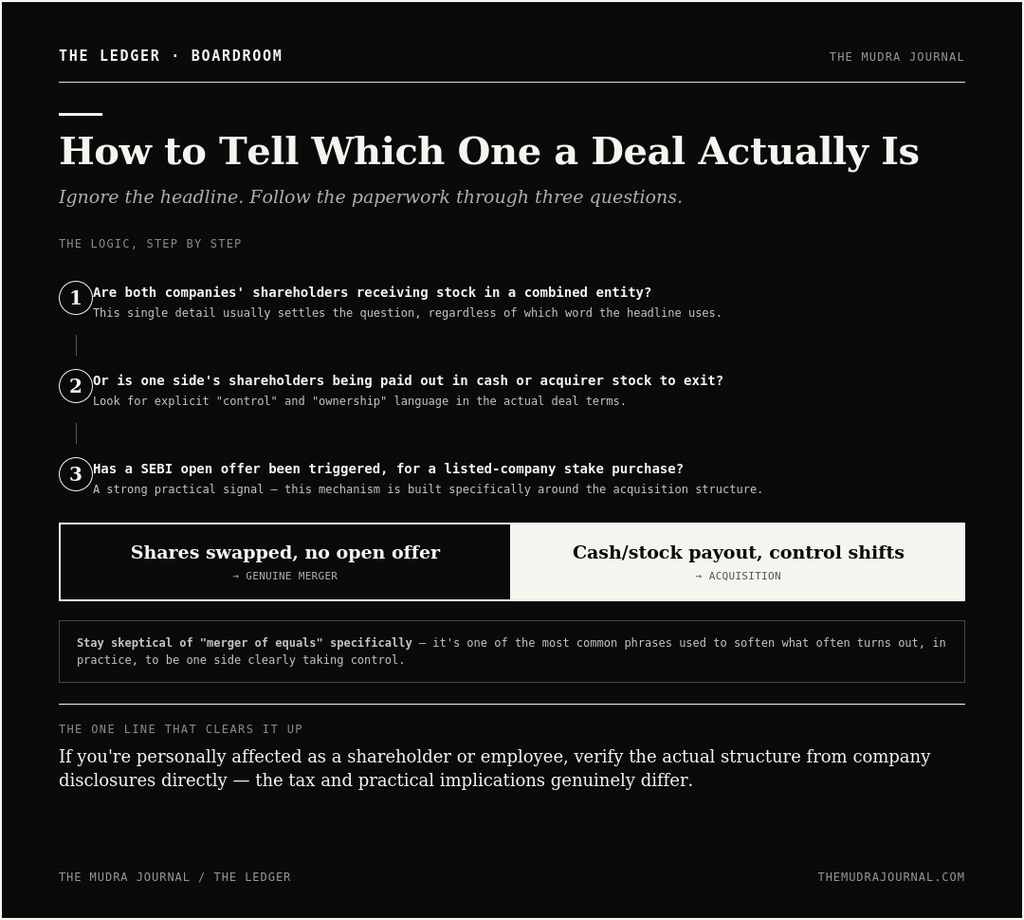
- Check whether shareholders of both companies are receiving stock in a combined entity (merger) or whether one company’s shareholders are being paid out in cash or acquirer stock to exit (acquisition) — this single detail usually settles the question regardless of which word the headline uses.
- Look for language around “control” and “ownership” in the actual deal terms — an acquisition almost always specifies one company taking a controlling or majority stake in the other, while a genuine merger describes a combination into one entity.
- If the deal involves a publicly listed company and a stake purchase, check whether a SEBI open offer has been triggered — that’s a strong practical signal you’re looking at an acquisition, since this specific regulatory mechanism is built around exactly that structure.
- Be appropriately skeptical of “merger of equals” language specifically — it’s one of the most common phrases used to soften what often turns out, in practice, to be one side clearly taking control of the other.
- If you’re personally affected as a shareholder or employee, understand the actual structure of your specific deal directly from company disclosures, not just headline language, since the practical and tax implications genuinely differ between the two.
The words “merger” and “acquisition” were never meant to be interchangeable, however often headlines treat them that way. One describes two companies choosing to combine as something closer to partners. The other describes one company buying control of another — and the label a deal is given publicly often has as much to do with managing perception as it does with describing what’s actually happening in the paperwork.
FROM THE MUDRA JOURNAL — Rooted in India, inspired by the world.