
Every Indian family has a gold story before it has a stock market story. Here’s why that isn’t superstition — and where it’s starting to genuinely change.
6 MIN READ
OLD MONEY
WRITTEN FOR: THE DHANTERAS BUYER → THE SGB INVESTOR
Ask any Indian parent what a “safe investment” looks like, and the answer arrives before the question is finished: gold. Not a fund, not a fixed deposit — gold. A wedding chain that’s technically your grandmother’s, sitting in a bank locker, appreciating quietly while nobody calls it an “asset allocation.” For a generation raised on SIP calculators and expense-splitting apps, this can look like nostalgia dressed up as strategy. It isn’t. It’s one of the few investment instincts in Indian households that was actually right for a very long time — for reasons that had nothing to do with returns.
Gold was never really an investment. It was a survival mechanism that also happened to pay off. No paperwork, no bank dependency, sellable at 2 a.m. in a family emergency, and — critically — inheritable in a form nobody could dispute or freeze. You don’t get that combination anywhere else in the Indian financial system, even today.
That’s the part worth understanding before deciding whether to keep the habit or replace it.
Why the habit made sense
01 — THE ESCAPE HATCH
Liquidity nothing else offers
Sell gold on a Sunday, a festival day, or during a bank strike, and someone in your neighbourhood will still buy it. No stock market has ever offered that — try liquidating a mutual fund at 11 p.m. because a hospital needs a deposit right now. Gold’s liquidity isn’t about returns. It’s about never being trapped by a closed market on the one day you actually need the money.
02 — THE INFLATION SHIELD
It didn’t beat the market — it beat forgetting
Gold hasn’t reliably outperformed equity over the long run, and it was never meant to. What it did was hold value while currency quietly lost its purchasing power year after year — a ₹100 note in 1990 doesn’t buy what it used to, but a gram of gold from 1990 still buys roughly a gram’s worth of value today. For a generation of savers with no access to formal markets, that was the whole strategy: don’t try to grow it, just don’t let it evaporate.
03 — THE TRUST PROBLEM
It didn’t require trusting an institution
Fixed deposits require trusting a bank. Stocks require trusting a company, a broker, and a regulator. Gold required trusting a jeweller you’d known for twenty years — and even then, only for the purity test, not the value. In a country where formal banking reached rural households only a couple of decades ago, that mattered more than any interest rate ever could.
What’s actually changing
The instinct is still correct. The form it takes is where this generation is doing something genuinely different — and it’s less about rejecting gold, and more about removing everything inefficient that used to come attached to it.
01 — THE STORAGE PROBLEM
Physical gold is being unbundled from “owning gold”
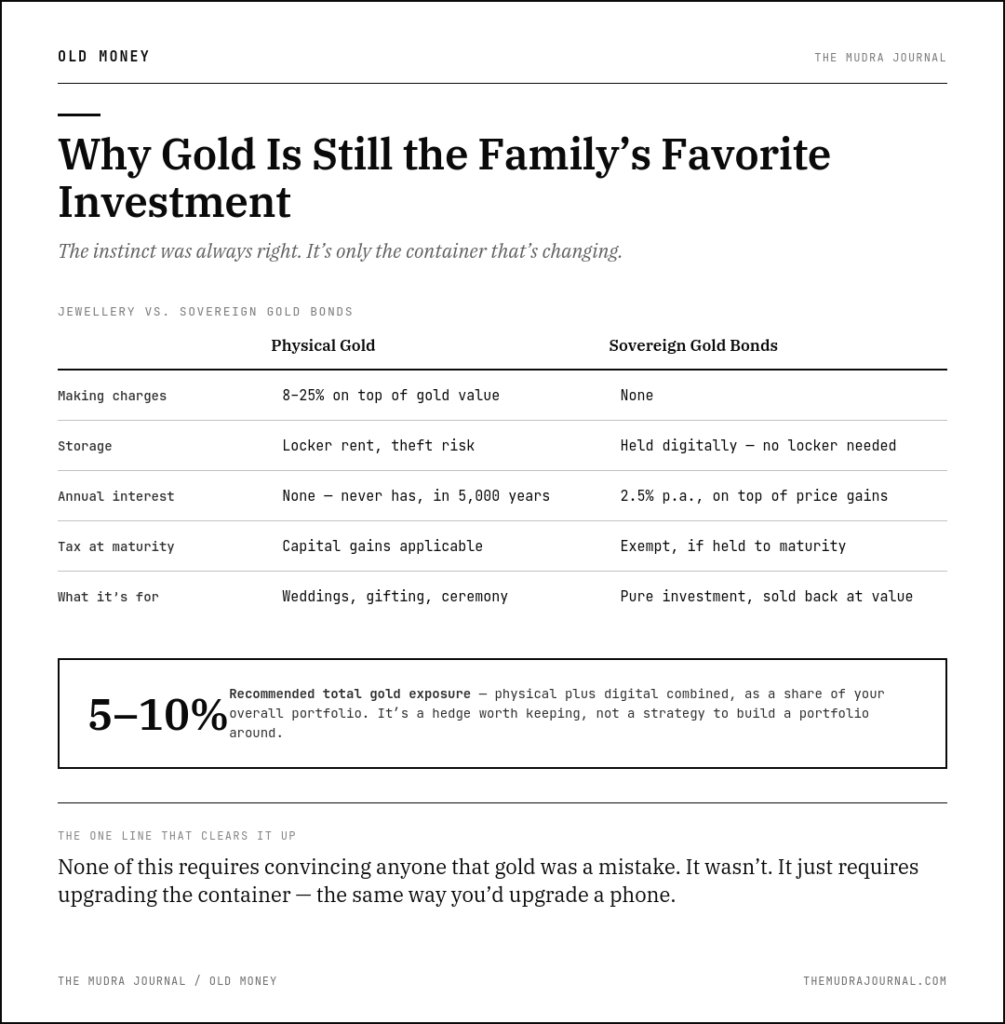
You can now own gold without ever touching it — Sovereign Gold Bonds, Gold ETFs, and digital gold on UPI apps all let you buy in rupee amounts instead of grams, with no making charges, no locker rent, and no 2 a.m. anxiety about theft. The emotional need physical gold met — security — is being separated from the financial need — returns — and each is now being solved on its own terms.
02 — THE MAKING CHARGE TAX
The 8–25% you were quietly paying
Jewellery has never just been gold — it’s gold plus making charges plus wastage plus GST, and resale rarely returns that premium. A generation that reads the fine print on every subscription is applying the same scrutiny here, increasingly treating jewellery as a purchase for wearing and investment gold as a separate, deliberate line item — bought in bond or digital form specifically because it can be sold back at closer to its actual value.
03 — THE INTEREST NOBODY MENTIONED
Gold that pays you to hold it
This is the one most families haven’t caught up to yet: Sovereign Gold Bonds pay 2.5% annual interest on top of any price appreciation, and are exempt from capital gains tax if held to maturity. Physical gold has never paid interest in its five-thousand-year history. For the first time, “gold as tradition” and “gold as a competitive instrument” don’t have to be different conversations.
Making the switch without the family argument
You don’t need to win the “gold is safe” debate — you were both right, just about different things. Here’s how to keep the instinct and lose the inefficiency.
Set this up once
- Keep a small amount of physical gold for what it’s actually for — weddings, gifting, genuine emergency liquidity. This isn’t the part to optimise away.
- Route new gold investment (not jewellery) into Sovereign Gold Bonds during RBI issue windows, or a Gold ETF if you want it liquid on any trading day.
- Cap total gold exposure — physical plus digital — at roughly 5–10% of your overall portfolio. It’s a hedge, not a strategy on its own.
- If a family member insists on physical gold for an occasion, suggest coins or bars over jewellery specifically to sidestep making charges when it’s bought purely as an investment.
- Revisit the split once a year, ideally around the same festival your family already buys gold — the timing does the reminding for you.
None of this requires convincing anyone that gold was a mistake. It wasn’t. It just required upgrading the container the same way you’d upgrade a phone — the reason you bought it in the first place hasn’t changed.
FROM THE MUDRA JOURNAL — Rooted in India, inspired by the world.