Your salary doesn’t disappear. It just never had anywhere to go. Here’s how to give every rupee a job before your card does it for you.
7 MIN READ
BUDGETING BASICS
WRITTEN FOR: FIRST SALARY → FIFTH YEAR
Salary day feels good for about eleven days. Then the balance quietly halves, you can’t point to where it went, and you tell yourself next month will be different. Next month is never different — not because you’re bad with money, but because your money has no system. It just sits in one account, waiting to be spent by whichever notification reaches you first.
The fix isn’t a stricter budget or a guilt-inducing spreadsheet you’ll abandon in nine days. It’s simpler than that: the moment your salary lands, split it — automatically, before you ever see the full number. Four accounts, four jobs. No willpower required, because the decision gets made once, on day one, not every day for the rest of the month
You don’t need more discipline. You need fewer decisions.
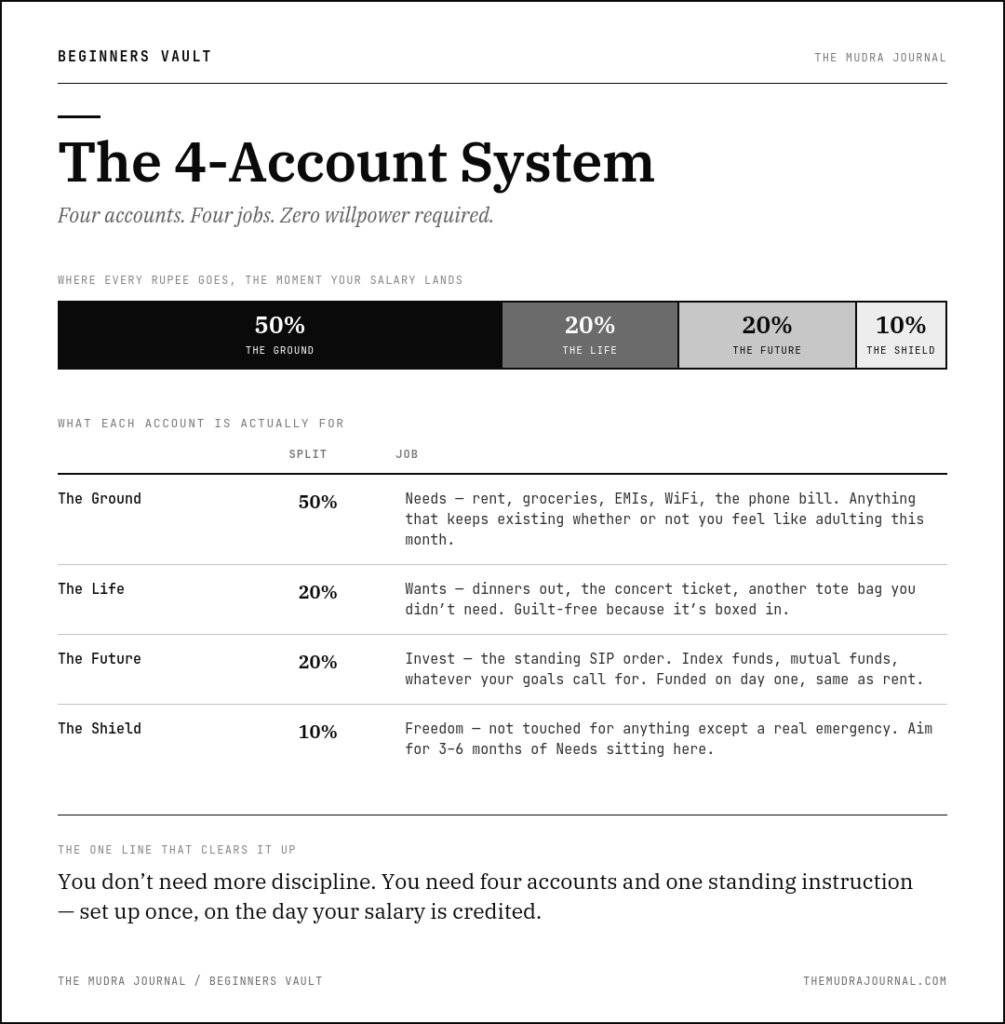
The four accounts
Each rupee gets assigned a role before it can be spent on impulse. Here’s the split we’d suggest starting with — adjust the percentages to your city and your rent, not the other way around.
01 — THE GROUND
Needs account
50% of take-home
Rent, groceries, EMIs, WiFi, the phone bill — anything that keeps existing whether or not you feel like adulting this month. This account should never be a surprise. If it’s climbing past half your salary, that’s the actual conversation to have, not a savings problem.
02 — THE LIFE
Wants account
20% of take-home
Dinners out, the concert ticket, another tote bag you didn’t need. This is guilt-free money precisely because it’s boxed in — once it’s spent, it’s spent, and there’s no borrowing from rent to fund it. Budgeting isn’t about killing joy. It’s about pricing it.
03 — THE FUTURE
Invest account
20% of take-home
This is the account with a standing SIP order on it — index funds, mutual funds, whatever your goals actually call for. The trick is that it’s funded on day one, same as rent. Investing on “whatever’s left” means investing nothing, because there’s never anything left.
04 — THE SHIELD
Freedom account
10% of take-home
Not investments. Not touched for anything except a real emergency — job loss, a medical bill, a broken laptop you need for work. Aim for three to six months of the Needs number sitting here in a plain savings account or liquid fund. This is the account that lets you take risks everywhere else.
Making it automatic
The system only works if you never have to remember it. Set this up once, on the same day your salary is credited, and let standing instructions do the discipline for you.
Set this up once
- Open three additional savings accounts, or use the “pots” / “jars” feature most digital banks now offer inside a single account.
- Set up auto-sweep or standing instructions dated one day after your salary credit — so the split happens before you’ve had a chance to spend from the main account.
- Point your SIP’s auto-debit at the Invest account specifically, not your primary salary account.
- Rename the accounts in your banking app to their job — “Rent,” “Life,” “Future,” “Shield” — so every notification already tells you what that money is for.
- Review the percentages every six months, not every week. The system is supposed to run quietly in the background.
None of this requires you to earn more, track every UPI payment, or feel bad about a coffee. It just requires four accounts and one standing instruction — set up once, on a day you’ll actually remember: the day the salary lands.
FROM THE MUDRA JOURNAL — Rooted in India, inspired by the world.