Ask an Indian family what “doing well” looks like, and somewhere in the answer — usually early — a piece of property gets mentioned. Not a portfolio. Not a number in a bank app. A plot, a flat, a house with someone’s name on the registry. This is the story of how that came to be, told through three generations of one ordinary family that never existed, except in the sense that almost every Indian family has lived some version of it.
14 MIN READ
INDIA SERIES / भारत
WRITTEN FOR: THE FAMILY LAND RECORD → THE FIRST HOME LOAN EMI
Real estate didn’t become India’s favourite wealth symbol because it was the best investment. It became the favourite because, for most of the last century, it was the only asset ordinary Indians could trust, touch, and pass down without anyone being able to argue about what it was worth. Everything else about the obsession — the status, the stubbornness, the arguments at family functions — follows from that one plain fact.
1968: the plot near the highway
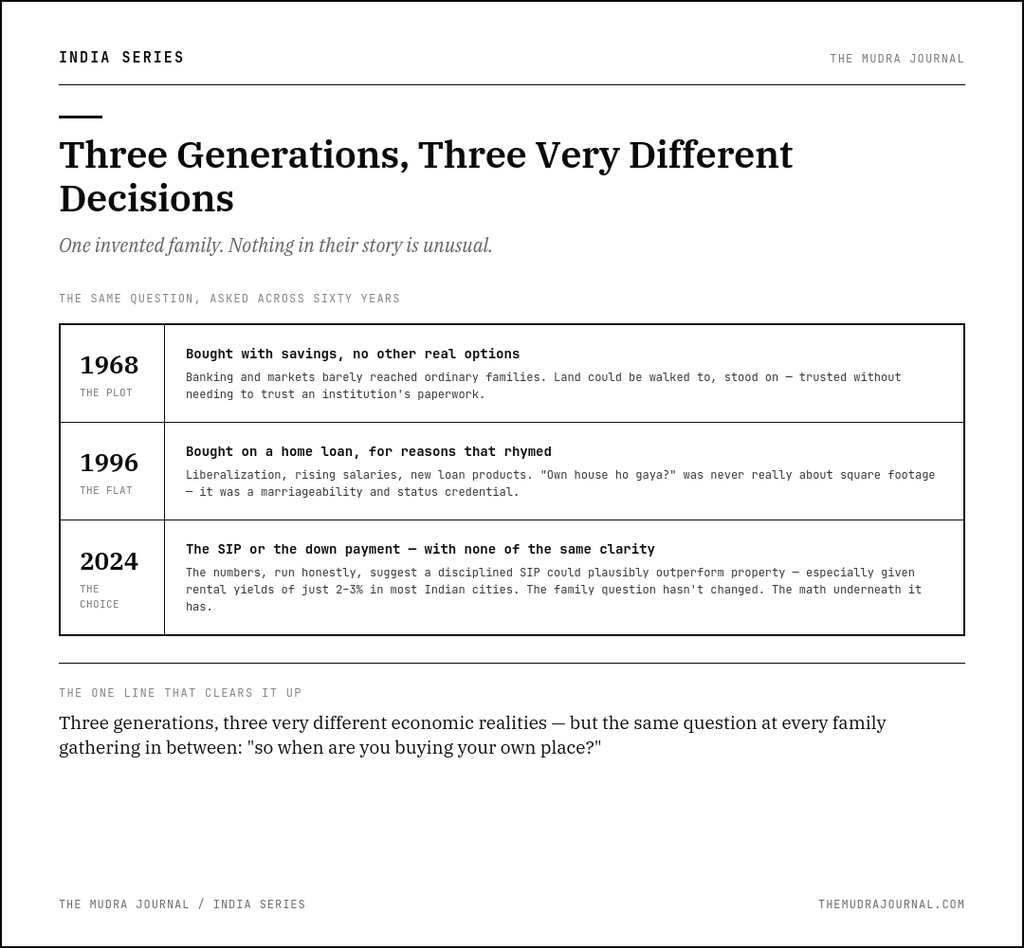
He was in his thirties when he bought it — a modest, unremarkable stretch of land just outside a growing town, bought with savings accumulated slowly over a government job and a wife’s careful management of a household budget that left almost nothing to spare. There was no financial advisor involved, no comparison against other options. There barely were other options. The bank offered a savings account with modest interest and a locker for the gold. The stock market was, for someone in his position, a rumour more than a real possibility — inaccessible, unfamiliar, and associated, in the limited stories that reached him, with people losing everything rather than building anything.
Land, by contrast, was something he could walk to. He could stand on it. When a monsoon flooded low-lying parts of the town two years later, the plot — slightly elevated, slightly lucky — was untouched, and the story of that flood became, in the family’s retelling for decades afterward, proof that he’d chosen well. Nobody in that story asked what the land’s annual return had been. Nobody could have told you. It was never bought to generate a number. It was bought because it was solid in the most literal sense of the word, in a country and a decade where very little else available to an ordinary family felt that way.
1996: the flat in the new colony
His son bought differently, but for reasons that rhymed. Liberalization had reached the cities by then, salaries were rising in ways his father’s generation hadn’t seen, and a new kind of urban colony was emerging — flats, not plots, sold off blueprints by developers promising modern conveniences the old family home never had. He bought a two-bedroom flat with a bank loan, one of the newly available home loan products that hadn’t really existed for his father’s generation, and the purchase meant something his father’s land never quite had to mean: it meant he’d arrived, visibly, in a way relatives at weddings would ask about directly. “Own house ho gaya?” wasn’t really a question about square footage. It was a question about whether he’d made it.
Around this time, the flat became something else too — a fixed point that made him a more serious prospect in his own upcoming marriage conversations, a detail mentioned early and pointedly by relatives arranging introductions. Property, by the 1990s, had become entangled with respectability and marriageability in a way that no mutual fund statement, however impressive, ever quite managed to replicate. He didn’t buy the flat purely for that reason. But he’d be lying if he said it played no part at all.
2024: the SIP or the down payment
His daughter, three decades later, faces a version of the same decision with none of the same clarity. A flat in the city she works in costs enough that a down payment alone would take years of aggressive saving, an EMI would consume a significant share of her monthly income for the next two decades, and the numbers — when she actually runs them, which her grandfather never had reason to and her father never quite wanted to — suggest that a disciplined SIP into equity mutual funds, left to compound for the same twenty years, could plausibly outperform the property, especially once she accounts for how low rental yields actually are in most Indian cities: often only 2-3% of a property’s value annually, far below what the same money might earn invested elsewhere.
And yet, at every family gathering, the same question arrives, nearly unchanged across three generations: “so when are you buying your own place?” Not “how’s your portfolio.” Not “what’s your net worth.” The specific, physical, ownable thing remains the marker everyone is actually asking about, even as the financial case for it has quietly gotten weaker with every passing decade of rising urban property prices outpacing income growth.
Why this specific asset, out of everything available
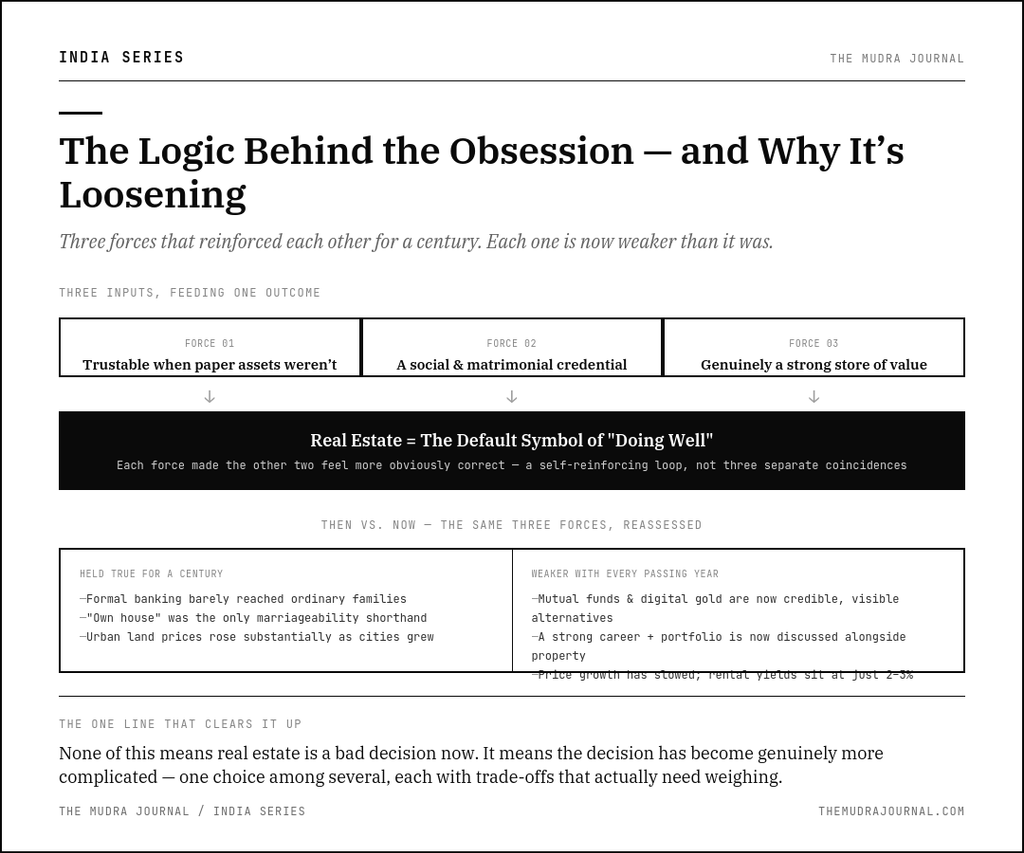
The family above is invented, but nothing in their story is unusual — versions of all three generations exist, almost unchanged, across an enormous number of real Indian households. Understanding why real estate specifically became the symbol, rather than gold, or shares, or anything else, comes down to three things that reinforced each other for most of a century.
It was trustable in a way paper assets weren’t. For a country where formal banking and stock markets reached rural and even much of urban India only gradually, and where financial fraud and bank failures weren’t unheard of, land and property had a distinct advantage: you could see it, and its existence didn’t depend on trusting an institution’s paperwork or a company’s balance sheet.
It became a social and matrimonial credential, not just a financial one. Owning property became shorthand for stability, seriousness, and marriageability in a culture where family introductions and matchmaking conversations routinely surface financial questions indirectly — “own house” doing work that “healthy investment portfolio” simply never was asked to do.
And for a meaningful stretch of decades, it was, genuinely, a strong store of value — urban land and property prices in many Indian cities rose substantially as urbanization accelerated, and for a family entering the property market early in that growth curve, real estate wasn’t just a status symbol, it was actually a very good financial decision, which further cemented the cultural belief that it always would be.
What’s actually changing now
The three forces above haven’t disappeared, but each has weakened in ways that matter. Financial trust has genuinely broadened — mutual funds, digital gold, and increasingly transparent markets have given ordinary Indians credible, visible, trackable alternatives to a physical asset for the first time. The matrimonial and social premium on property ownership persists, but is visibly softening in urban, dual-income households, where a strong career and a healthy investment portfolio are increasingly discussed alongside, and sometimes instead of, property ownership. And the pure financial case has weakened considerably in many cities — property price growth has slowed relative to the earlier boom decades, rental yields remain low, and the illiquidity of real estate (the inability to sell a portion, or sell quickly, without significant transaction costs) looks like a real disadvantage next to instruments that can be bought and sold, partially and instantly, at will.
None of this means real estate has become a bad decision. It means the decision has become genuinely more complicated than it was for either of the earlier generations in this story — no longer the obvious, only trustworthy option, but one choice among several, each with real trade-offs that actually need weighing rather than assuming.
If you’re the one deciding, this time
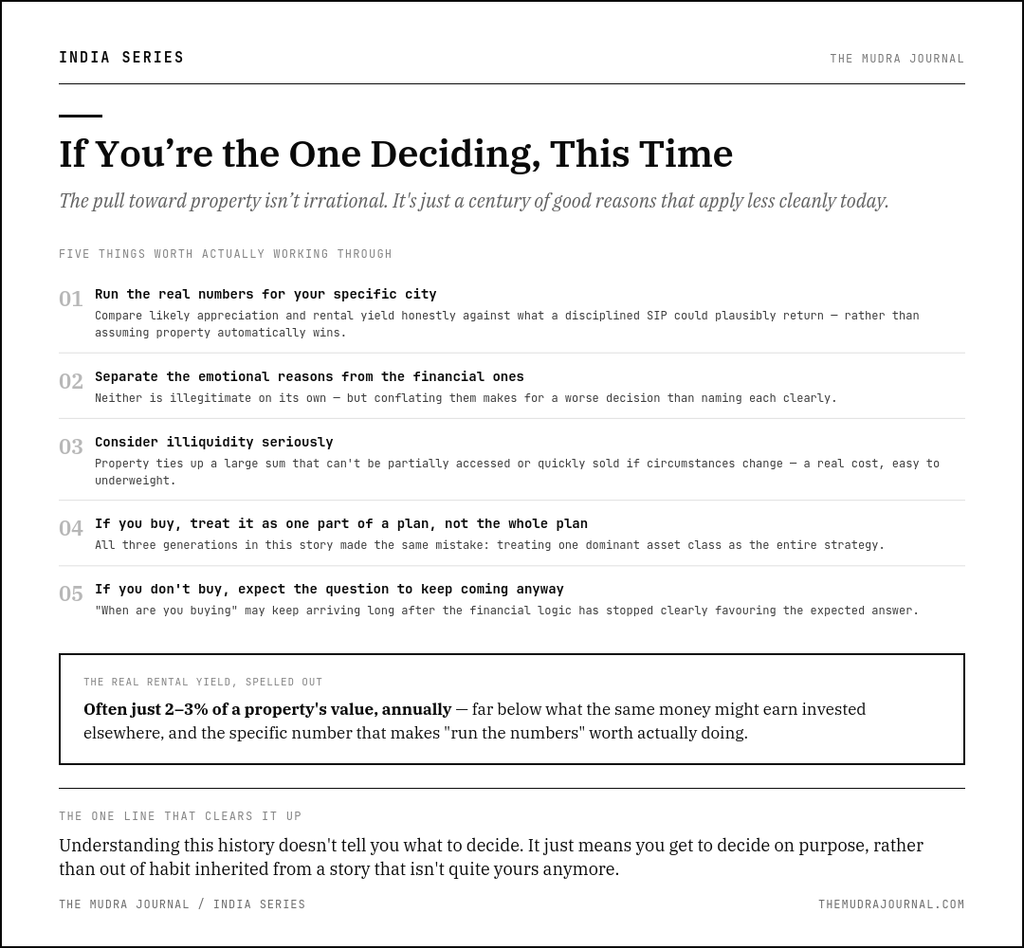
The daughter in this story, and the many real people living some version of her situation, aren’t wrong to feel torn. The pull toward property isn’t irrational — it’s the accumulated weight of a century of genuinely good reasons that happen to apply less cleanly today than they used to. A few things worth actually working through, rather than deciding by instinct or family pressure alone:
Run the real numbers for your specific city and situation — comparing a property’s likely appreciation and rental yield honestly against what a disciplined long-term SIP could plausibly return, rather than assuming property automatically wins because it always used to.
Separate the emotional and social reasons for buying from the financial ones, and be honest with yourself about how much weight each is actually carrying in your decision — neither is an illegitimate reason, but conflating them makes for a worse decision than naming them clearly.
Consider illiquidity seriously — property ties up a large sum of money that can’t be partially accessed or quickly sold if your circumstances change, a real cost that’s easy to underweight when everyone around you treats ownership as an unambiguous milestone.
If you do buy, treat it as one part of a broader financial picture rather than the entire plan — a mistake common to all three generations in this story was treating one dominant asset class as the whole strategy, simply because it was the trusted default of its era.
And if you don’t buy, be prepared for the family conversation to keep happening anyway — the question “when are you buying” may keep arriving long after the financial logic has stopped clearly favouring the answer everyone expects.
Three generations, three very different economic realities, and the same question asked at every family gathering in between. The plot near the highway, the flat in the new colony, and the SIP-or-down-payment decision facing a generation now were never really about the asset itself. They were about what each generation had reason to trust, in the specific decade they were living through — and understanding that history doesn’t tell you what to decide. It just means you get to decide on purpose, rather than out of habit inherited from a story that isn’t quite yours anymore.
FROM THE MUDRA JOURNAL — Rooted in India, inspired by the world.