“Compound interest is the eighth wonder of the world” gets quoted in nearly every Indian personal finance conversation, often attributed to Einstein despite no reliable record of him ever saying it. The quote gets repeated constantly. The actual math behind it — the part that would make it useful rather than just inspirational — almost never does.
14 MIN READ
BEGINNERS VAULT / ज्ञान
WRITTEN FOR: THE FIRST SIP → THE TWENTY-YEAR PORTFOLIO
Everyone investing in India has heard that compounding is powerful, that starting early matters, that patience pays. Very few people have actually sat down and watched the numbers do what they’re supposed to do — because the truth about compounding is that its most dramatic effects are backloaded, arriving late, after years of growth that look almost disappointingly ordinary. This is precisely why compounding is so widely quoted and so poorly understood: the part everyone repeats is the eventual payoff, and the part everyone skips is the long, unglamorous stretch of time that has to happen first for that payoff to arrive at all.
This piece is the actual math, laid out plainly, alongside why so many people give up on compounding right before it would have started working the way they were promised it would.
Compounding isn’t a rate. It’s what happens when your returns start earning their own returns — and the reason it feels unimpressive for years and astonishing eventually is that the growth is exponential, not linear, which means almost all of the visible benefit arrives in the later years, not the early ones. Once you actually see the numbers, the popular quote stops being inspirational fluff and starts being an instruction.
What compounding actually is
Simple interest pays you a fixed return on your original amount, every period, forever — invest ₹1,00,000 at 10% simple interest, and you earn ₹10,000 a year, every year, on that same original ₹1,00,000, no matter how many years pass. Compound interest is different in one crucial way: each period’s return gets added to your principal, and the next period’s return is calculated on that new, larger amount. Your gains start earning their own gains. In year one, ₹1,00,000 at 10% still earns ₹10,000. But in year two, you’re earning 10% on ₹1,10,000, not ₹1,00,000 — a small difference at first, but one that keeps compounding on itself, year after year, until the difference between simple and compound growth becomes enormous.
This is the entire mechanism. There’s no more to it than that. What makes it hard to appreciate isn’t the concept — it’s genuinely simple — it’s that the visible effect of this mechanism takes a surprisingly long time to become dramatic, which is exactly where most people’s understanding, and patience, runs out.
Why compounding gets so widely misunderstood
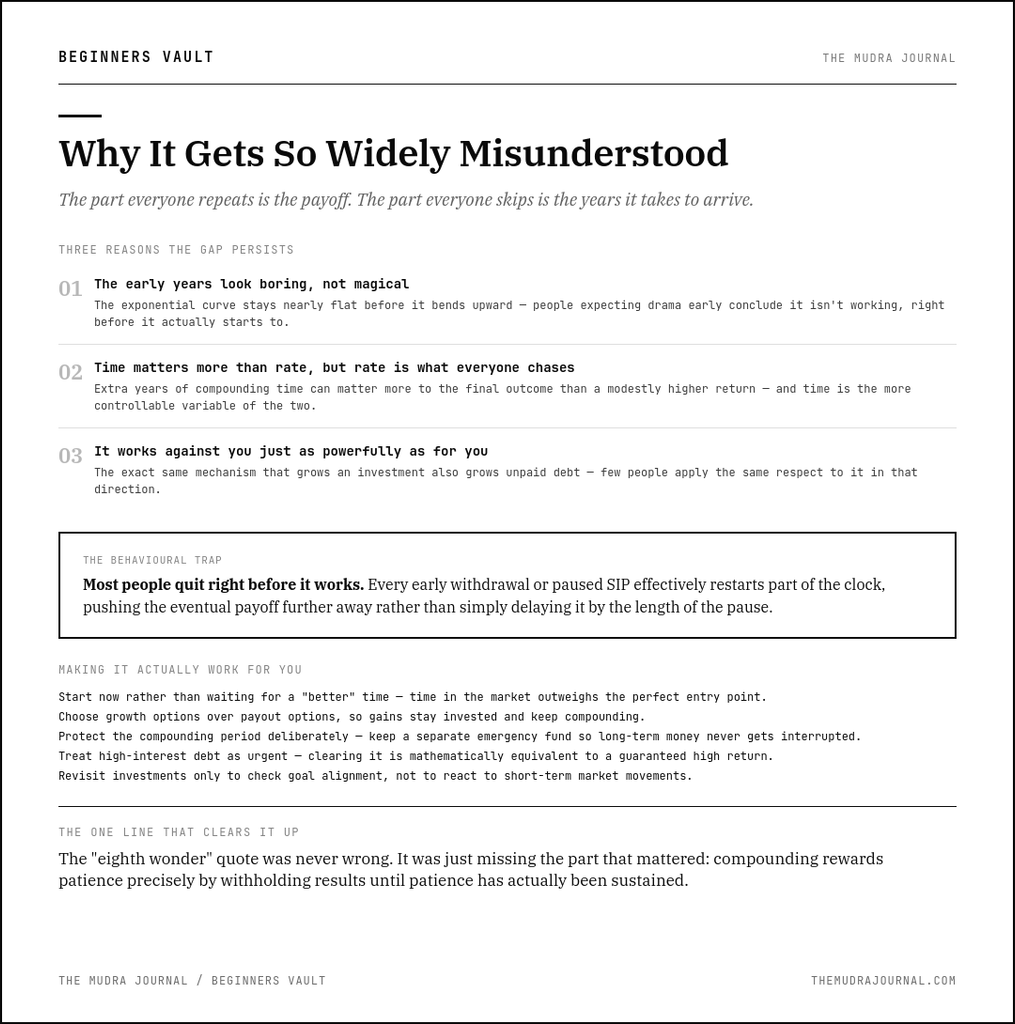
01 — THE EARLY YEARS LOOK BORING, NOT MAGICAL
The exponential curve stays nearly flat before it bends upward
Anyone who’s actually watched a long-term SIP or investment grow will tell you the first several years often look unremarkable — modest, steady growth that doesn’t feel like it’s living up to the “eighth wonder” billing. This isn’t a flaw in the mechanism; it’s the actual shape of exponential growth, which looks almost linear for a long stretch before the curve visibly bends upward. People expecting drama early, and not seeing it, often conclude compounding isn’t working — right before the period when it actually starts to.
02 — TIME MATTERS MORE THAN RATE, BUT RATE IS WHAT EVERYONE FOCUSES ON
Chasing a higher return often matters less than starting sooner
Investors frequently spend enormous energy trying to find a fund or strategy offering 2-3% more annual return, while giving comparatively little thought to starting a few years earlier — even though, over long horizons, additional years of compounding time can matter more to the final outcome than a modestly higher rate. This isn’t an argument against seeking good returns; it’s a reminder that the compounding period itself is often the more powerful, and more within your control, variable.
03 — COMPOUNDING WORKS AGAINST YOU JUST AS POWERFULLY AS IT WORKS FOR YOU
The same mechanism, applied to debt instead of investment
The exact mathematical mechanism that grows an investment also grows unpaid debt — credit card balances, in particular, compound at rates that can be startlingly high when annualized, and paying only the minimum due each month can mean the bulk of your payment goes toward interest rather than principal for a very long time. Most people who marvel at compounding’s power in the context of investing never apply the same respect to how devastatingly it can work in the opposite direction.
The math that actually proves it

Consider a SIP of ₹5,000 a month, invested consistently in an equity mutual fund assumed to grow at 12% annually (a commonly used illustrative long-term assumption, not a guarantee) — the actual numbers reveal exactly why patience matters more than most people expect.
After 10 years: total amount invested is ₹6,00,000. The corpus, with compounding, grows to approximately ₹11.6 lakh — roughly 1.9 times what was actually put in.
After 20 years: total invested is ₹12,00,000. The corpus grows to approximately ₹50 lakh — roughly 4.2 times the amount invested, a noticeably steeper multiple than the 10-year mark.
After 30 years: total invested is ₹18,00,000. The corpus grows to approximately ₹1.77 crore — nearly 9.8 times the amount actually invested.
Notice what’s happening here: the amount invested only triples between year 10 and year 30 (from ₹6 lakh to ₹18 lakh), but the corpus grows roughly fifteen-fold over the same period. That’s compounding — the growth curve gets steeper over time precisely because a larger and larger share of the corpus, in later years, consists of past growth generating its own further growth, not new money being added.
Now consider the same mechanism working in reverse. A credit card balance of ₹50,000, left largely unpaid with only the minimum amount due covered each month, typically accrues interest at rates around 3% a month — roughly 36% annualized, among the highest borrowing costs in common consumer use. Because minimum-due payments are often barely enough to cover the interest that’s accrued, meaningful progress on the actual principal can take years, and the total interest paid over that time can end up exceeding the original amount borrowed. The same exponential mechanism that turns a modest SIP into a large corpus over decades can turn a modest, seemingly manageable credit card balance into a debt that takes years to escape.
Where compounding actually shows up in Indian financial life
01 — EPF AND PPF: PATIENCE REWARDED THROUGH STRUCTURE
Long lock-ins that force the compounding period to actually happen
The Employees’ Provident Fund (EPF) and Public Provident Fund (PPF) both compound interest annually over long, structurally enforced time horizons — PPF’s 15-year lock-in, in particular, removes the temptation to withdraw early and interrupt the compounding period, which is arguably as valuable a feature as the interest rate itself, since it protects the investor from their own impatience.
02 — EQUITY MUTUAL FUND SIPs: COMPOUNDING THROUGH REINVESTED GROWTH
Growth options that keep the engine running
Choosing a fund’s growth option (as opposed to a dividend payout option) means gains are reinvested rather than paid out, allowing the compounding mechanism to continue uninterrupted — a small structural choice with meaningful long-term consequences, and one worth checking explicitly when selecting a fund.
03 — CREDIT CARDS AND PERSONAL LOANS: COMPOUNDING’S DESTRUCTIVE MIRROR IMAGE
The same mechanism, working against your net worth instead of for it
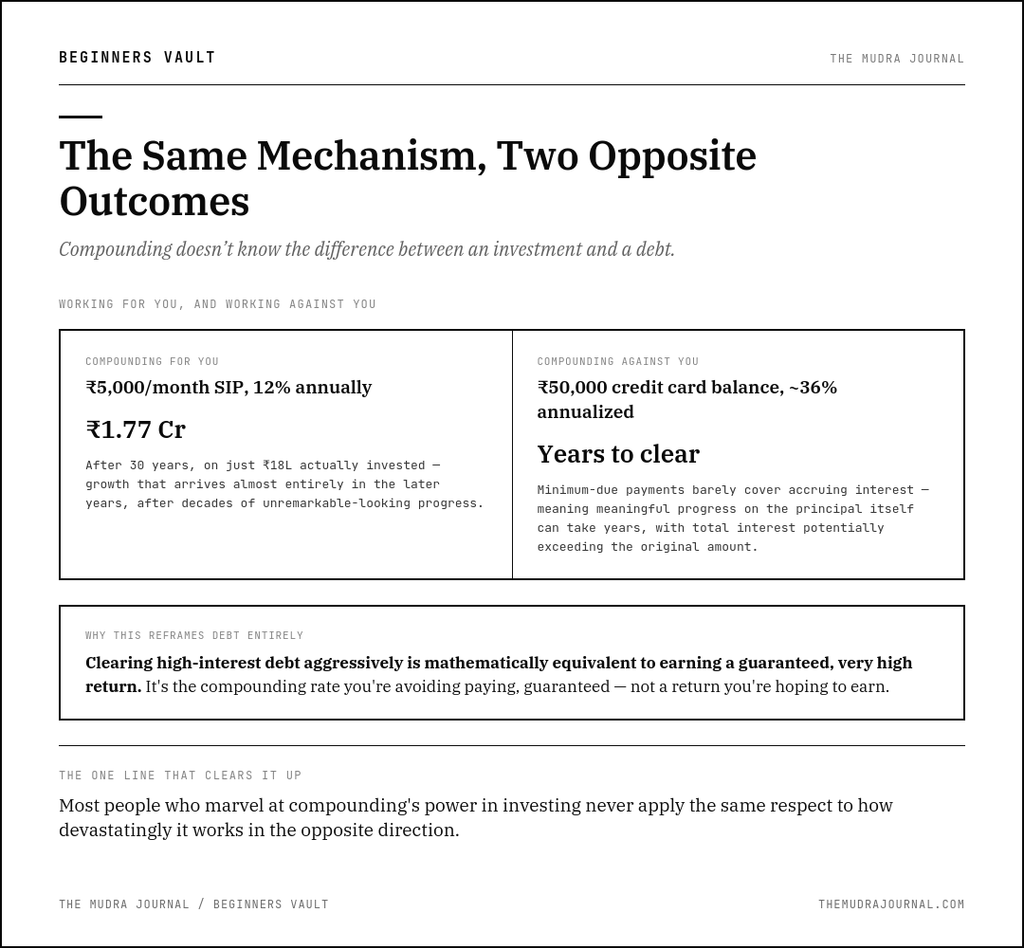
As covered above, high-interest revolving debt compounds just as powerfully as any investment — the crucial difference being that here, the exponential curve is working against your financial position, not for it, which is precisely why clearing high-interest debt aggressively is one of the most mathematically reliable “investments” available, since it’s the compounding rate you’re avoiding paying, guaranteed, rather than a return you’re hoping to earn.
The behavioural trap: quitting right before it works
We’ve written before about how market downturns tempt investors to panic-sell equity mutual funds, converting a temporary decline into a permanent loss. The same behavioural pattern shows up with compounding specifically: because the early years of any long-term investment look unremarkable, and because market downturns periodically interrupt the visible growth, many investors stop their SIPs, withdraw early, or switch strategies during exactly the stretch of years when the compounding curve is quietly building toward the acceleration that would eventually make it feel worthwhile. The mathematics of compounding assumes an uninterrupted time horizon — every early withdrawal or paused SIP effectively restarts part of the clock, pushing the eventual payoff further away rather than simply delaying it by the exact length of the interruption.
Making compounding actually work for you
- Start now rather than waiting for a “better” time or a larger amount — the math above shows time in the market consistently matters more than the exact starting amount or the perfect entry point.
- Choose growth options over payout options in mutual funds and similar instruments, so gains stay invested and continue compounding rather than being paid out and spent.
- Protect the compounding period deliberately — avoid withdrawing from long-term investments for short-term needs, and keep a separate emergency fund specifically so you’re never forced to interrupt long-term compounding to cover an unexpected expense.
- Treat high-interest debt, especially credit card balances, as an urgent priority precisely because it compounds against you — clearing it aggressively is mathematically equivalent to earning a guaranteed, very high return.
- Revisit your investments only to check they’re still aligned with your goals, not to react to short-term market movements — the single most common way people damage their own compounding outcomes is stopping partway through.
The “eighth wonder of the world” quote was never wrong. It was just always missing the part that actually mattered: compounding rewards patience specifically because it withholds its most dramatic results until patience has been sustained for a genuinely long time. Understanding the shape of that curve — flat for years, then steep — is what turns a popular quote into something you can actually use.
FROM THE MUDRA JOURNAL — Rooted in India, inspired by the world.