
Ask most Indians how their money is doing, and they’ll tell you their salary. Almost nobody will tell you their net worth — because almost nobody has actually calculated it.
6 MIN READ
We’re taught to track our salary down to the rupee — the hike, the bonus, the in-hand versus CTC math we all quietly do in our heads. But almost nobody is taught to track the one number that actually tells you how your money is doing over time. Not income. Net worth.
Net worth isn’t how much you earn. It isn’t your salary, your CTC, or the number on your offer letter. It’s a much simpler — and much more honest — question: if you added up everything you own and subtracted everything you owe, what would be left?
Your salary tells you what you’re paid. Your net worth tells you what you’re actually keeping. Two people earning the exact same salary can have wildly different net worths — one saving and investing quietly, the other spending it all and calling it “living well.” Salary is a headline number. Net worth is the scoreboard.
Here’s how to actually calculate yours, and why most Indians never do.
The formula, in full
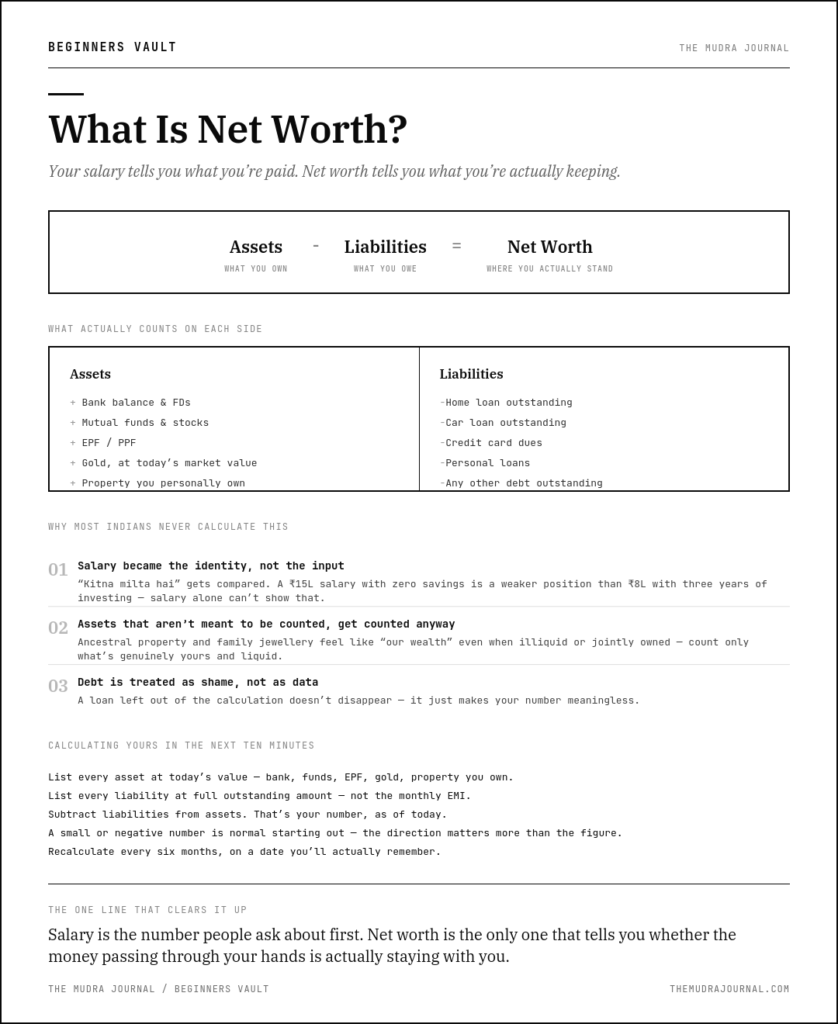
Net worth is: everything you own (assets) minus everything you owe (liabilities).
That’s it. No hidden complexity, no finance degree required. Assets include your bank balance, mutual funds, stocks, EPF, gold, and property. Liabilities include your home loan, car loan, credit card dues, and any personal loans. Subtract one from the other, and you get a single number that represents your actual financial position on this exact day — not your potential, not your salary trajectory, just where things stand right now.
Why most Indians never calculate this
01 — SALARY BECAME THE IDENTITY, NOT THE INPUT
“What do you earn” replaced “what do you own”
In most Indian social circles, salary is the number people actually compare — at family gatherings, in matrimonial conversations, in casual “kitna milta hai” chats between cousins. It’s treated as a proxy for how well someone is doing financially, when it’s really just an input. A ₹15 lakh salary with zero savings and a maxed-out credit card is a weaker financial position than a ₹8 lakh salary with three years of consistent investing behind it — but salary-as-identity culture has no way of capturing that difference.
02 — ASSETS THAT AREN’T MEANT TO BE COUNTED, GET COUNTED ANYWAY
The ancestral house and the wedding gold complicate the math
Indian households often consider ancestral property or family jewellery part of “our wealth,” even though it’s usually illiquid, jointly owned, or not actually available to any one individual. This isn’t wrong to value emotionally — but it makes personal net worth feel like an impossible, tangled family calculation instead of a simple personal one. The fix is separating what’s genuinely yours and liquid from what’s shared, sentimental, or someone else’s to eventually inherit.
03 — DEBT IS TREATED AS SHAME, NOT AS DATA
Loans get hidden instead of subtracted
Many Indians are uncomfortable openly acknowledging a personal loan, credit card debt, or an EMI as part of their financial picture — it can feel like an admission of failure rather than a normal part of the equation. But net worth only works if liabilities are counted honestly alongside assets. A home loan isn’t a source of shame; it’s simply one side of a two-sided calculation, and leaving it out doesn’t make it disappear — it just makes your number meaningless.
Calculating yours in the next ten minutes
You don’t need an app, a spreadsheet template, or a financial advisor for this. A notes app and ten honest minutes will do.
- List every asset you can actually access: bank balances, mutual funds, stocks, EPF and PPF balances, FDs, and gold you personally own (at today’s market value, not purchase price).
- List every liability: outstanding home loan, car loan, personal loan, and credit card balance due — the full outstanding amount, not the monthly EMI.
- Add up your assets. Add up your liabilities. Subtract the second number from the first.
- Don’t panic if the number is small, or even negative — most people starting out have a net worth close to zero, and a fresh graduate with an education loan often starts negative. The number matters far less than the direction it moves in.
- Recalculate the same way every six months, on a fixed date you’ll actually remember — a birthday, a financial year-end, a festival. The single number matters less than the trend line it builds over time.
Your salary will always be the number people ask about first. Let your net worth be the number you actually track — because it’s the only one that tells you whether the money passing through your hands is actually staying with you.
FROM THE MUDRA JOURNAL — Rooted in India, inspired by the world.