
Every large Indian business family has always had someone quietly managing the money — a trusted accountant, an elder relative, the karta of a joint family holding the ledger close. What’s changed isn’t the need. It’s that this role has formalized into an entire institution with a name most people have heard but few can actually explain: the family office.
14 MIN READ
OLD MONEY / धन
WRITTEN FOR: THE FAMILY BUSINESS LEDGER → THE MULTI-GENERATIONAL TRUST
“Family office” sounds, to most people encountering the term for the first time, like it should be a literal room somewhere — a physical office where a family conducts its affairs. It’s closer to the truth than it sounds: a family office is indeed a dedicated institution, often with its own staff, mandate, and infrastructure, built specifically to manage one wealthy family’s financial life across generations. But its function goes considerably beyond picking stocks or managing a portfolio. A well-run family office handles investment management, tax and legal structuring, succession planning, and often philanthropy and family governance — essentially becoming the institutional memory and decision-making infrastructure for a family’s wealth, in a way no single bank relationship manager or mutual fund could replicate.
This piece looks at what a family office actually does, why India’s business families — old and new — increasingly build them, and what principles from this rarefied world are actually worth borrowing, even if you’ll never need one yourself.
A family office isn’t a product you buy off a shelf, the way you’d buy a mutual fund or open a demat account. It’s an institution a family builds or hires, specifically designed to make sure wealth survives not just markets, but generations, disputes, and time. Understanding that distinction is the key to understanding everything else about how it works.
What a family office actually is
01 — IT MANAGES INVESTMENTS, BUT ISN’T ONLY AN INVESTMENT MANAGER
A far broader mandate than picking assets
Investment management — deciding asset allocation, evaluating opportunities, monitoring a portfolio — is typically a core function of a family office, but it’s rarely the entire mandate. Unlike a mutual fund or a portfolio management service you subscribe to, a family office is built around one specific family’s complete financial picture, coordinating investments alongside tax planning, legal structuring, and long-term family goals, rather than offering a standardised product to many unrelated clients.
02 — IT HANDLES SUCCESSION AND GOVERNANCE, NOT JUST GROWTH
Preparing wealth to pass between generations deliberately
A significant part of a family office’s work involves structuring how wealth will transfer to the next generation — through trusts, wills, and clearly defined governance structures — and often facilitating family conversations and agreements about roles, decision-making authority, and expectations, well before those conversations become urgent or contentious. This is fundamentally different from what any conventional financial product offers, since it’s addressing family dynamics and long-term structure, not just returns.
03 — IT’S BUILT FOR ONE FAMILY’S SPECIFIC COMPLEXITY
Customization that a retail financial product can’t offer
Because a family office serves one family (or, in a multi-family structure, a small number of families) rather than thousands of retail customers, it can build genuinely customised strategies — around a specific business the family owns, specific tax jurisdictions relevant to them, specific philanthropic priorities, or specific family circumstances — in a way that a standardised financial product, built to serve a broad market, structurally cannot.
Single-family offices vs multi-family offices
01 — SINGLE-FAMILY OFFICES: DEDICATED INFRASTRUCTURE FOR ONE FAMILY
Built and staffed exclusively for a single family’s needs
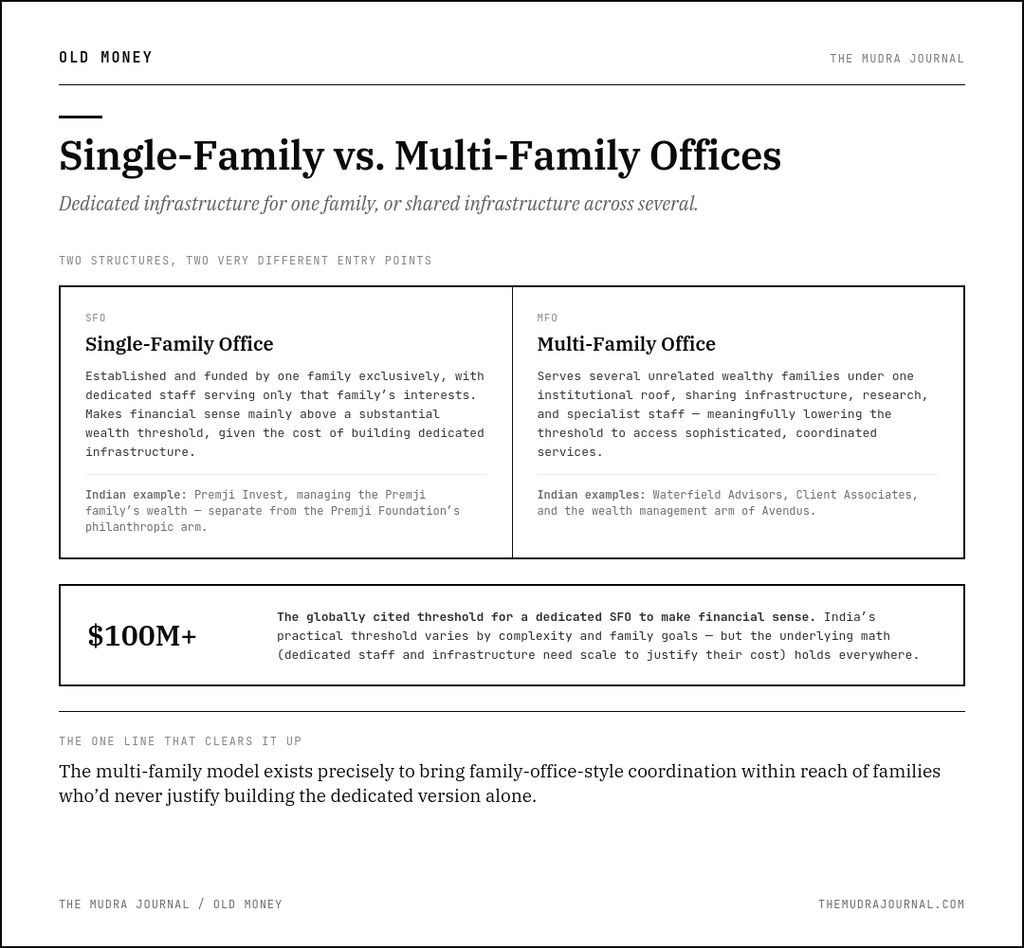
A single-family office (SFO) is established and funded by one family exclusively, with dedicated staff serving only that family’s interests. Premji Invest, managing the wealth of Azim Premji’s family (separate from the Premji Foundation’s philanthropic arm), is a well-known Indian example of this structure operating at significant scale. Because of the cost of building dedicated infrastructure and staff, SFOs generally make financial sense only above a substantial wealth threshold — often cited globally in the range of $100 million or more in investable assets, though the practical threshold in India varies based on complexity and family goals.
02 — MULTI-FAMILY OFFICES: SHARED INFRASTRUCTURE, LOWER ENTRY POINT
Several wealthy families sharing the same institutional resources
A multi-family office (MFO) serves several unrelated wealthy families under one institutional roof, sharing infrastructure, investment research, and specialist staff — which meaningfully lowers the wealth threshold needed to access sophisticated, family-office-style services compared to building a dedicated single-family structure. Indian players like Waterfield Advisors, Client Associates, and the wealth management arms of firms like Avendus operate in this space, offering many of the same coordinated investment, tax, and estate planning services to multiple families at once.
Why family offices exist — beyond just chasing returns
01 — MOST FAMILY WEALTH DOESN’T SURVIVE THE THIRD GENERATION
A pattern old enough to have its own saying, in nearly every culture

There’s a well-known pattern, observed across cultures and expressed in different sayings — “shirtsleeves to shirtsleeves in three generations” is the common English version — describing how family wealth is frequently built by one generation, maintained by the next, and dissipated by the third, often due to a lack of structured planning, family disputes, or simply no deliberate system for preserving and transferring wealth thoughtfully. Family offices exist specifically to interrupt this pattern, treating wealth preservation across generations as an explicit, structured goal rather than an assumption.
02 — FAMILY DISPUTES OVER WEALTH ARE COMMON, PUBLIC, AND COSTLY
India has watched several such disputes play out publicly
Public disputes within large Indian business families over ownership, succession, and control are neither rare nor new — the Ambani family’s well-publicised split in the mid-2000s remains one of the most widely known examples, and it’s far from the only one in Indian business history. A significant part of a family office’s governance work is aimed precisely at reducing this risk — through clear documentation, defined roles, and structured decision-making processes established well before tensions have a chance to build.
03 — PHILANTHROPY AND LEGACY, MANAGED WITH THE SAME RIGOUR AS INVESTMENTS
Giving, structured as deliberately as growing
Many Indian family offices manage structured philanthropic activity alongside investment management — the Premji Foundation and the older, larger-scale example of the Tata Trusts (which predate the modern “family office” terminology by decades but reflect a similar principle) show how giving can be run with institutional discipline rather than as an informal, occasional activity. For many wealthy families, legacy and philanthropy are treated as seriously as portfolio returns, and a family office is often the structure that makes that possible.
The rise of family offices among India’s new wealth
01 — STARTUP EXITS ARE CREATING A NEW GENERATION OF FAMILY OFFICES, EARLIER
New wealth, built and formalized faster than old wealth typically was
A newer pattern has emerged in the last decade: founders and early employees of successful Indian startups, following significant exits or liquidity events, increasingly setting up formal family offices relatively early in their wealth journey — a contrast to many older Indian business families, who often relied for generations on informal, trusted structures (a family accountant, a senior relative, an in-house legal advisor) before ever formalising into something resembling a modern family office.
02 — THE NEEDS ARE SIMILAR, BUT THE STARTING POINT IS DIFFERENT
New wealth still needs the same governance work old wealth eventually built
Whether wealth comes from a decades-old family business or a recent, sudden startup exit, the underlying challenges a family office addresses — professional investment management, tax efficiency, succession planning, avoiding disputes — remain largely the same. What’s different is that many new-wealth families are building this infrastructure deliberately and early, rather than accumulating it informally over generations the way many older business families historically did.
What a family office actually does, day to day

A functioning family office typically coordinates several distinct workstreams: investment management and asset allocation across public markets, private equity, real estate, and other holdings; tax and legal structuring, ensuring the family’s wealth is organised efficiently and compliantly across relevant jurisdictions; estate and succession planning, including wills, trusts, and clearly documented governance for eventual wealth transfer; risk management, including insurance and contingency planning for the family’s various holdings and members; philanthropy management, where relevant, structuring and overseeing charitable giving; and often, administrative and lifestyle support, handling everything from property management to coordinating family logistics — the “concierge” function that’s popularly associated with the term, even though it’s typically a smaller part of the overall mandate than investment and governance work.
Is any of this relevant if you’re not managing a large family fortune?
Almost certainly, you’ll never need a family office in the literal sense — and that’s exactly the point of including this piece in a series about generational wealth. The specific institution doesn’t scale down. The underlying principles genuinely do.
We’ve written before about how Indian families historically avoided talking about money altogether, and what that silence quietly cost across generations — unclaimed assets, undocumented decisions, conversations never had until it was too late. A family office, at its core, is simply the wealthy world’s structured answer to exactly that problem: documented succession plans instead of assumptions, clear governance instead of informal authority held by one person, and professional counsel brought in deliberately rather than avoided out of discomfort. None of that requires a hundred million dollars to apply. It requires a decision to treat your own family’s financial life with the same deliberate structure, at whatever scale it exists.
Practical takeaways, at any scale
- Write down your own succession intentions — a will, updated nominations on accounts and policies — regardless of the size of your estate; the principle a family office applies at scale is exactly this simple at heart.
- Have the money conversation with your family proactively, the way we’ve discussed before, rather than leaving documentation and decisions to be discovered after the fact.
- Separate your major financial decisions from in-the-moment family emotion where possible — a defined process, even an informal one, reduces the kind of dispute risk that professional family governance exists to prevent.
- Consider a fee-only financial advisor, even without family-office-scale wealth, if your financial life has grown complex enough that professional, conflict-free counsel would genuinely help — a modest, personal-scale version of what a family office provides at the very top.
- Treat your own family’s version of “legacy” deliberately, whatever that means at your scale — structured giving, a clear plan for supporting parents, or simply a written record future generations can actually use.
The family office was never really about the size of the fortune. It was always about treating wealth as something that needs active, structured stewardship to survive beyond the person who built it — a lesson worth borrowing at any scale, long before anyone needs a dedicated office to manage it.
FROM THE MUDRA JOURNAL — Rooted in India, inspired by the world.