We’ve mapped out before where ETFs sit relative to stocks and mutual funds — a basket you can trade like a stock. That map explains the relationship. It doesn’t explain the mechanism. This is the piece that opens up what’s actually happening inside an ETF, and the specific things worth checking before you buy your first one.
13 MIN READ
MARKETS / बाज़ार
WRITTEN FOR: THE DEMAT ACCOUNT HOLDER → THE FIRST ETF ORDER
An ETF looks deceptively simple from the outside — a single ticker on your trading app, a price that moves throughout the day, a name that usually tells you exactly what it tracks: Nifty 50, Gold, a specific bond basket. That simplicity on the surface hides a genuinely interesting mechanism underneath, and more importantly, hides a handful of practical details that determine whether a specific ETF is a good, efficient way to invest, or a quietly costly one. Two ETFs tracking the same index can behave meaningfully differently depending on their liquidity, their tracking accuracy, and how they’re actually traded — details a beginner rarely gets told before placing that first order.
This piece goes deep on exactly that.
An ETF’s price on your screen isn’t guaranteed to equal the value of what it actually holds — a mechanism involving large institutional participants keeps the two close together, but “close” isn’t automatic, and the gap between them is exactly where a beginner can lose value without realising it. Here’s how that mechanism works, and what to actually check before you buy.
How an ETF actually works under the hood
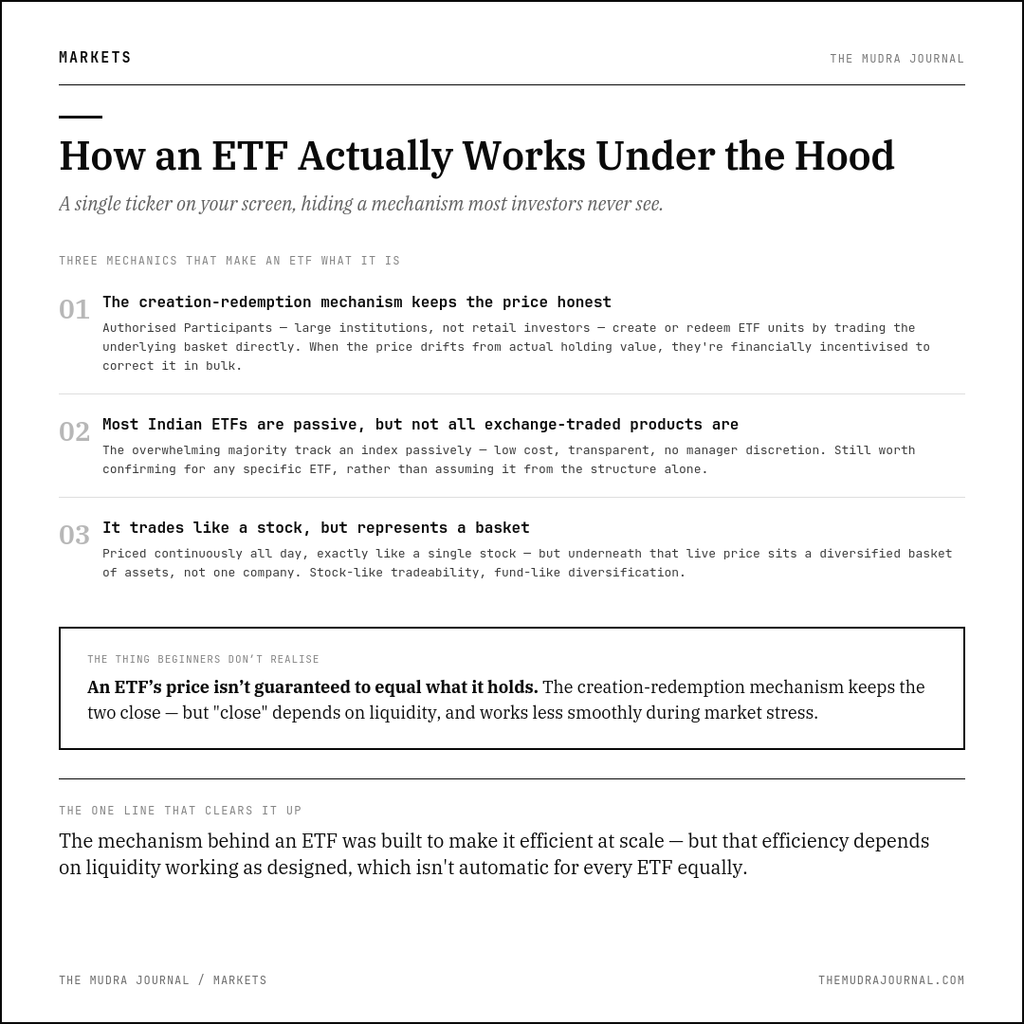
01 — THE CREATION-REDEMPTION MECHANISM KEEPS THE PRICE HONEST
Large institutions, not individual investors, do the real balancing act
ETFs maintain a price close to the value of their underlying holdings through a mechanism involving Authorised Participants (APs) — large institutional entities that can create new ETF units by delivering the underlying basket of securities to the fund, or redeem ETF units in exchange for the underlying securities. When an ETF’s market price drifts too far from its actual holding value, APs are financially incentivised to step in and correct it, buying or selling in bulk until the gap closes. This is invisible to a retail investor, but it’s the entire reason an ETF’s price generally stays close to what it actually holds — and it works better when an ETF is liquid and actively traded than when it isn’t.
02 — MOST INDIAN ETFs ARE PASSIVE, BUT NOT ALL EXCHANGE-TRADED PRODUCTS ARE
Check what you’re actually buying before assuming it’s index-tracking
The overwhelming majority of ETFs available to Indian retail investors passively track a specific index or asset — Nifty 50, Gold, a specific bond basket — rather than being actively managed. This is generally the appeal: low cost, transparent holdings, no manager discretion. But it’s worth confirming for any specific ETF you’re considering, since the exchange-traded structure itself doesn’t guarantee passive management, even if that’s the common case in the current Indian market.
03 — IT TRADES LIKE A STOCK, BUT REPRESENTS A BASKET
Live pricing on something that’s actually diversified underneath
Unlike a mutual fund, which is priced once daily after markets close, an ETF’s price updates continuously through the trading day, exactly like an individual stock — you can buy or sell at whatever price the market is showing at that moment. But underneath that single, live-updating price sits a diversified basket of assets, not a single company, which is precisely the structural hybrid that makes ETFs attractive: stock-like tradeability with fund-like diversification.
The ETF landscape available to Indian investors
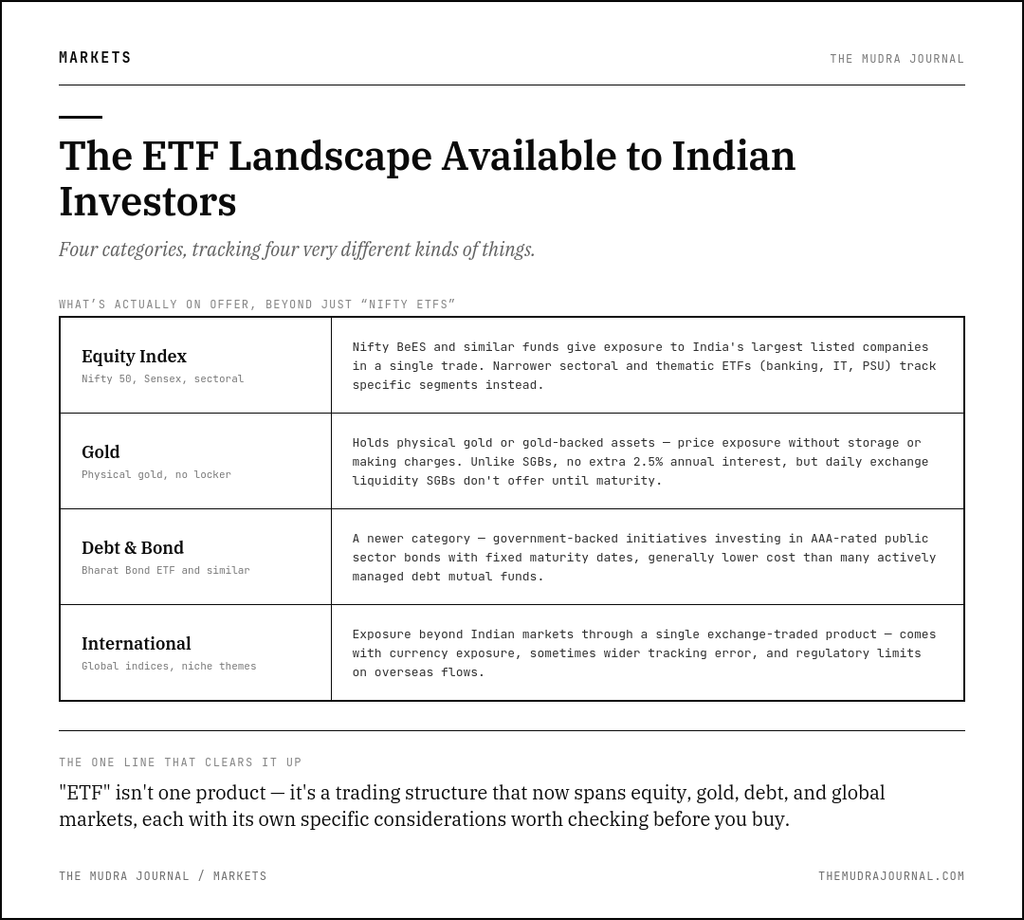
01 — EQUITY INDEX ETFs
Nifty 50, Sensex, and sector-specific baskets
The most common category tracks broad market indices — Nifty 50 ETFs (such as Nifty BeES, one of the oldest and most liquid in the Indian market) and Sensex-tracking ETFs give exposure to India’s largest listed companies in a single trade. Narrower sectoral and thematic ETFs (banking, IT, PSU-focused, and others) also exist, tracking specific segments of the market rather than the broad index.
02 — GOLD ETFs
Gold exposure without a locker
Gold ETFs hold physical gold (or gold-backed assets) and let investors gain price exposure to gold without storage, purity concerns, or making charges — a meaningfully different vehicle from the Sovereign Gold Bonds discussed in an earlier piece on gold as an investment, since Gold ETFs don’t carry the additional 2.5% annual interest SGBs offer, but do offer daily liquidity on the exchange that SGBs, held to maturity, don’t.
03 — DEBT AND BOND ETFs
A newer category, gaining ground
Products like the Bharat Bond ETF — a government-backed initiative investing in AAA-rated public sector bonds with fixed maturity dates — have introduced a relatively new, transparent way for retail investors to access debt market exposure through the exchange, with defined maturity and generally lower cost than many actively managed debt mutual funds.
04 — INTERNATIONAL AND NICHE ETFs
Exposure beyond Indian markets, with caveats
A growing number of ETFs offer exposure to international indices or specific global themes, letting Indian investors diversify beyond domestic markets through a single exchange-traded product. These come with their own considerations — currency exposure, sometimes wider tracking error, and regulatory limits on overseas investment flows from Indian mutual funds and ETFs — worth researching specifically for any international ETF before investing, rather than assuming it behaves identically to a domestic equity ETF.
The hidden costs beginners miss
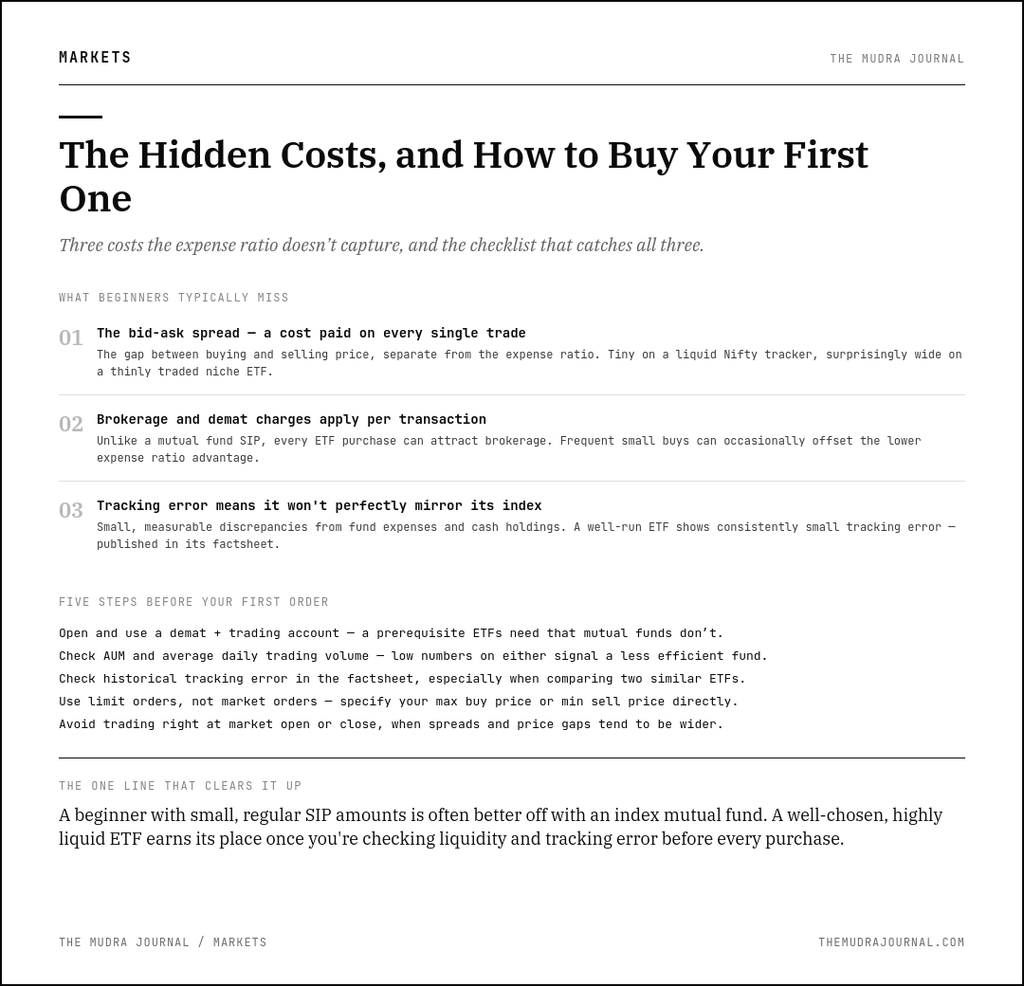
01 — THE BID-ASK SPREAD IS A COST THE EXPENSE RATIO DOESN’T CAPTURE
The gap between buying and selling price, paid every single trade
Every ETF trade happens at a bid price (what buyers are offering) or an ask price (what sellers want), and the gap between them — the spread — is an implicit cost paid on every transaction, separate from the fund’s expense ratio. For a highly liquid ETF like a major Nifty 50 tracker, this spread is usually tiny. For a thinly traded, niche ETF, it can be surprisingly wide, quietly eating into returns every time you buy or sell.
02 — BROKERAGE AND DEMAT CHARGES APPLY PER TRANSACTION
Frequent small purchases can add up faster than a mutual fund SIP
Because ETFs require a demat account and trade on the exchange, every purchase can attract brokerage charges (even if small or zero with some discount brokers) and demat account maintenance costs, unlike a mutual fund SIP, which typically has no separate per-transaction brokerage. Investors making frequent, small ETF purchases should factor this in — it can occasionally offset the ETF’s lower expense ratio advantage if trading very small amounts very often.
03 — TRACKING ERROR MEANS THE ETF WON’T PERFECTLY MIRROR ITS INDEX
A small, measurable gap between the ETF and what it claims to track
No ETF perfectly replicates its underlying index — small discrepancies (tracking error) arise from fund expenses, cash holdings, and the practical difficulty of holding every single constituent in exact proportion, especially for indices with less liquid smaller constituents. A well-run ETF should show consistently small tracking error over time; checking this figure, published in fund factsheets, is a genuine way to compare two ETFs tracking the same index rather than assuming they perform identically.
Liquidity: the detail that separates a good ETF from a bad one
This is worth its own section because it’s the single most common mistake beginners make with ETFs: assuming that because an ETF exists and is listed, it’s automatically easy and efficient to buy and sell. In reality, liquidity varies enormously between ETFs, even ones tracking the same underlying index.
A thinly traded ETF — one with low daily trading volume — tends to have a wider bid-ask spread, meaning you pay more to buy and receive less when you sell, purely due to lack of active trading rather than anything about the underlying assets. It can also show a larger, more volatile gap between its market price and its indicative Net Asset Value (iNAV) — the real-time estimate of what the ETF’s holdings are actually worth — particularly during periods of market stress when the creation-redemption mechanism that normally keeps prices aligned works less smoothly. Before investing in any specific ETF, checking its average daily trading volume and Assets Under Management (AUM) is a genuinely useful, easy step — generally, higher volume and larger AUM correlate with tighter spreads and prices that track the underlying value more reliably.
How to actually buy your first ETF
- Open and use a demat and trading account, since this is a prerequisite for ETFs that mutual funds don’t require.
- Check the ETF’s AUM and average daily trading volume before investing — low numbers on either front are a signal to look more closely or consider a more liquid alternative tracking the same index.
- Check the fund’s historical tracking error in its factsheet, especially if comparing two ETFs tracking the same index — smaller, more consistent tracking error indicates a more efficiently run fund.
- Use limit orders rather than market orders, specifying the maximum price you’re willing to pay (or minimum you’ll accept when selling), rather than accepting whatever price is live at the moment of your order.
- Avoid trading right at market open or close, when prices can be more volatile and the gap between market price and actual underlying value tends to be wider.
Making ETFs work in your portfolio
ETFs aren’t inherently better or worse than index mutual funds — they’re a different trading structure with their own specific advantages (typically lower expense ratios, intraday liquidity) and their own specific considerations (demat requirement, bid-ask spread, the need to actively check liquidity before investing). For a beginner just starting out with small, regular SIP amounts, an index mutual fund often remains the simpler entry point. For an investor who already has a demat account, invests larger amounts less frequently, and is comfortable checking liquidity and tracking error before each purchase, a well-chosen, highly liquid ETF can be a genuinely efficient, low-cost building block.
The mechanism behind an ETF — creation, redemption, live pricing against an ever-shifting basket of assets — was built to make this kind of exchange-traded fund efficient at scale. Understanding it doesn’t just satisfy curiosity; it tells you exactly what to check before your next ETF purchase, so the product works the way it’s actually designed to, rather than the way its simple, single-ticker appearance suggests.
FROM THE MUDRA JOURNAL — MARKETS / बाज़ार – Markets, Made Understandable