Most first-time founders start with a product idea and back into a business model almost as an afterthought — figuring out how the money actually gets made only after the idea already feels real. It usually should go the other way. The model you choose shapes your costs, your fundraising conversations, and how fast you can realistically grow, often more than the idea itself does.
10 MIN READ
THE LEDGER — FOUNDER’S OFFICE
WRITTEN FOR: THE FIRST BUSINESS PLAN → THE FIRST REVENUE LINE
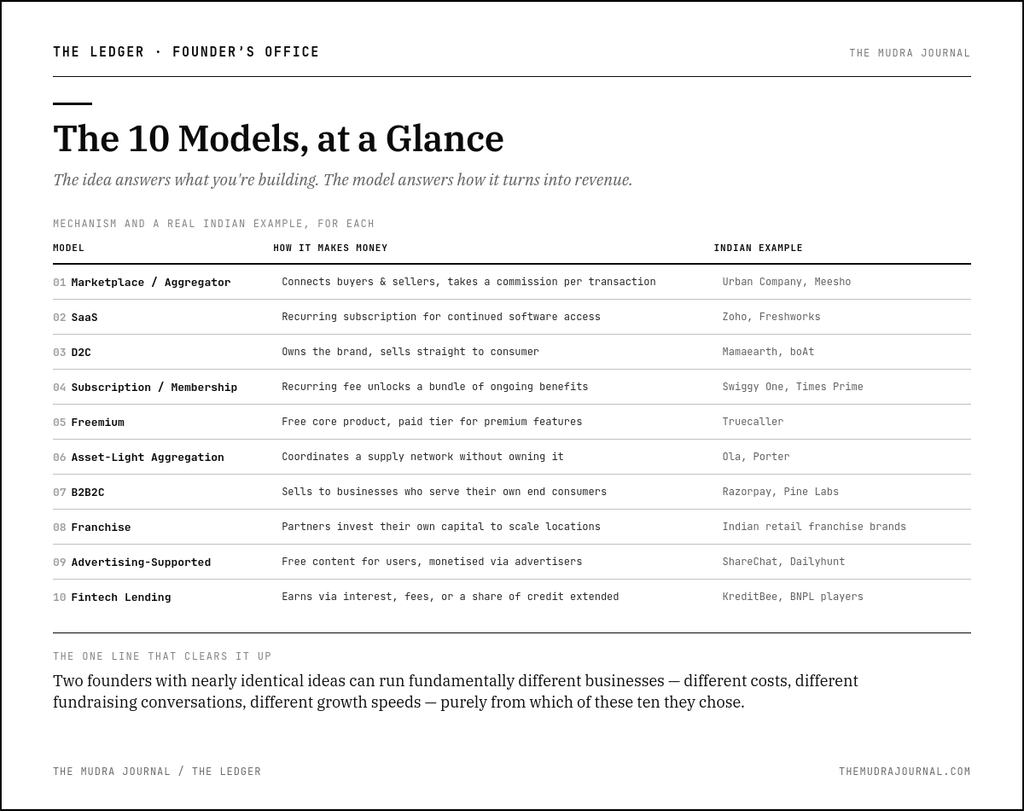
An idea answers “what are we building.” A business model answers a very different question: “how does this specific thing turn into revenue, reliably, at scale.” Two founders with nearly identical product ideas can end up running fundamentally different businesses — different cost structures, different growth speeds, different capital needs — purely because they chose different models to deliver the same underlying value. Understanding the common patterns before you commit to one saves a lot of expensive trial and error later.
Your business model isn’t a detail you figure out after building the product. It’s the decision that determines what “success” even looks like for your specific business — and it deserves to be chosen as deliberately as the product itself. Here are ten patterns worth understanding before you pick yours.
The models, and what makes each one work
01 — MARKETPLACE / AGGREGATOR
Connecting buyers and sellers, earning a commission
A marketplace doesn’t own the product or service being sold — it connects supply and demand and takes a cut of each transaction. Urban Company (home services) and Meesho (social commerce reselling) are Indian examples of this pattern. It scales without heavy inventory investment, but demands solving a genuine chicken-and-egg problem: enough supply to attract demand, and enough demand to attract supply, simultaneously, from day one.
02 — SAAS (SOFTWARE-AS-A-SERVICE)
Recurring subscription revenue for software
Companies like Zoho and Freshworks built globally competitive businesses on this model — customers pay a recurring fee (monthly or annual) for continued access to software, rather than a one-time purchase. It offers predictable, compounding revenue, but typically requires sustained investment in product development and customer retention to keep subscribers renewing.
03 — D2C (DIRECT-TO-CONSUMER)
Owning the brand and selling straight to the customer
D2C brands like Mamaearth and boAt build or source their own products and sell directly to consumers, often bypassing traditional retail entirely in the early years, using their own website and online marketplaces. This model gives full control over branding and margins, but requires real investment in customer acquisition, since there’s no existing retail footfall to rely on.
04 — SUBSCRIPTION / MEMBERSHIP
Paying regularly for ongoing access to bundled value
Distinct from SaaS in that the product itself may not be software — think Swiggy One or Times Prime, where a recurring fee unlocks a bundle of ongoing benefits. This model rewards businesses that can consistently demonstrate value month after month, since the entire revenue relationship depends on customers not cancelling.
05 — FREEMIUM
Free basic access, paid premium features
Truecaller is a well-known Indian example — a free core product with a paid tier unlocking additional features. This model is powerful for building a large user base quickly, but success depends heavily on getting the “free vs paid” line right: too generous a free tier, and few users ever convert; too restrictive, and the free tier fails to build the audience the model depends on.
06 — ASSET-LIGHT AGGREGATION
Coordinating supply without owning it
Ola and Porter don’t own the vehicles moving people and goods — they coordinate a network of independent drivers and vehicle owners, earning a share of each transaction. This keeps capital requirements lower than owning a fleet outright, but shifts the core challenge toward managing quality, reliability, and incentives across a network you don’t directly control.
07 — B2B2C
Selling to businesses who then serve their own consumers
Razorpay and Pine Labs sell payment infrastructure to businesses, who use it to serve their own end customers — the founder’s direct customer is a business, but the product’s ultimate impact reaches consumers indirectly. This model often means longer, more complex sales cycles than selling directly to consumers, but can offer more stable, larger contract sizes once a business customer is onboarded.
08 — FRANCHISE
Scaling a proven format through partner-operated locations
Certain Indian retail brands have used franchise or partnership models to scale physical presence faster than they could by funding every location themselves — a franchise partner invests their own capital to open and run a location, paying fees or a revenue share back to the parent brand. This accelerates physical footprint growth, but requires a genuinely replicable, well-documented operating model before it can be handed to partners successfully.
09 — ADVERTISING-SUPPORTED
Free for users, monetised through advertisers
Regional content and news platforms like ShareChat and Dailyhunt built large user bases by offering free content, monetising primarily through advertising rather than charging users directly. This model requires substantial scale to generate meaningful ad revenue, and typically means the product itself has to be genuinely engaging enough to hold attention long enough for advertising to be effective.
10 — FINTECH LENDING / EMBEDDED CREDIT
Earning through interest and fees on credit provided
Companies like KreditBee and various buy-now-pay-later players earn revenue through interest, processing fees, or a share of transaction value on credit extended to consumers or businesses. This model can be genuinely valuable in a market with significant unmet credit demand, but it carries real regulatory obligations (RBI guidelines on digital lending) and credit risk that founders need to understand deeply before entering, not treat as a secondary detail.
Choosing the right one for your budget and stage
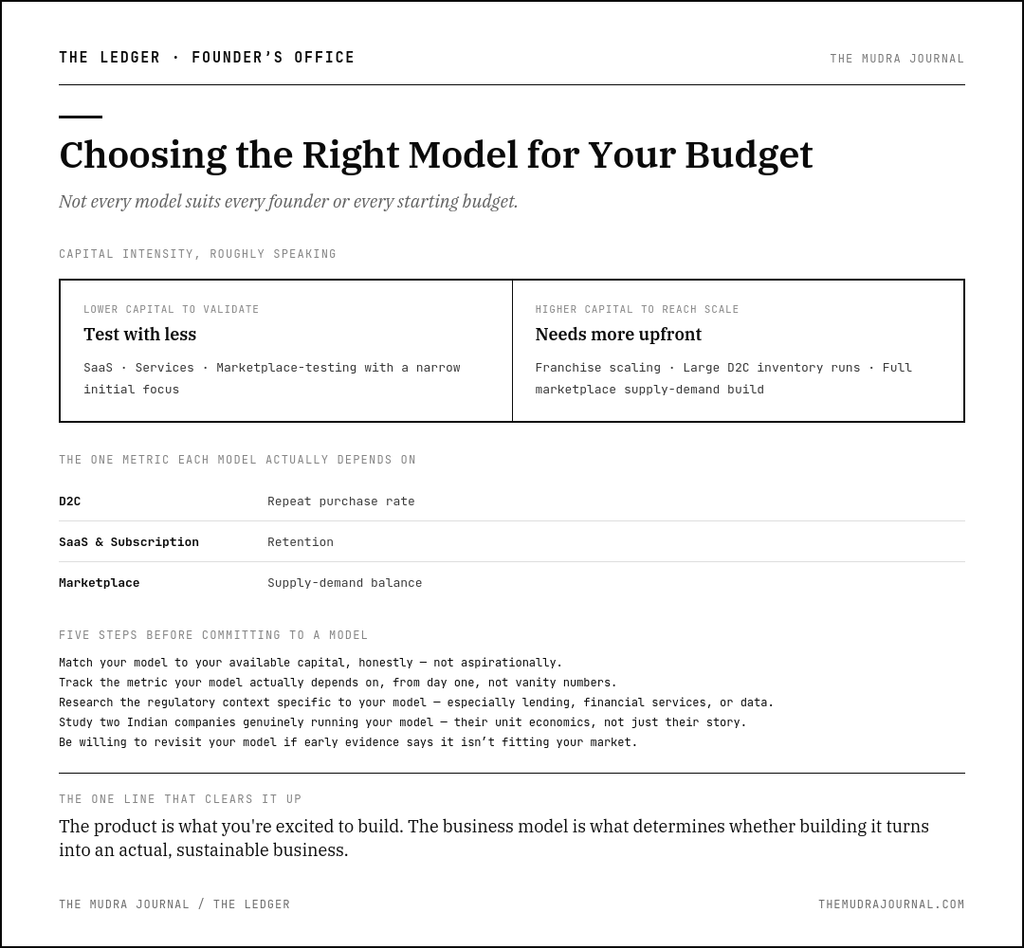
Not every model suits every founder or every starting budget — a point worth connecting back to something we’ve written about before: if you’re working with a modest starting budget like ₹10 lakh, asset-heavy models (franchise scaling, large D2C inventory runs) are generally a poor fit, while service-based, SaaS-lite, or marketplace-testing approaches with a narrow initial focus tend to demand far less capital to validate.
- Match your model to your available capital honestly — some models (marketplace, aggregator) can be capital-intensive to reach the scale where commissions become meaningful, while others (SaaS, services) can be tested with far less.
- Understand the core metric your chosen model actually depends on — repeat purchase rate for D2C, retention for SaaS and subscriptions, supply-demand balance for marketplaces — and track that metric from day one, not vanity numbers like downloads or sign-ups.
- Research the regulatory context specific to your model, particularly for anything involving lending, financial services, or data — these carry obligations well beyond typical startup compliance.
- Study at least two Indian companies genuinely operating your chosen model closely, not just as inspiration, but to understand their actual unit economics and what took them the longest to solve.
- Be willing to revisit your model if early evidence suggests it isn’t fitting your market — many successful companies pivoted their business model, not just their product, once real customer behaviour revealed what actually worked.
The product is what you’re excited to build. The business model is what determines whether building it turns into an actual, sustainable business. Choosing deliberately, with real examples and real constraints in mind, is worth as much early thought as the product itself gets.
FROM THE MUDRA JOURNAL — Rooted in India, inspired by the world.