very budgeting rule you’ll find online was written by someone who never had to explain to a landlord why the rent is late because a cousin’s wedding came up. ₹50,000 a month is a genuinely common Indian income — and it deserves a budget built for how that income actually gets spent here, not a percentage rule imported from somewhere else.
Check how much you can afford to spend every month using our calculator here – Interests / ब्याज
13 MIN READ
BUDGETING BASICS
WRITTEN FOR: THE FIRST PAYSLIP → THE FIRST BUDGET THAT ACTUALLY HOLDS
₹50,000 a month in hand is one of the most common early-career and mid-level salaries in India — common enough that it’s worth building a real, honest budget around, rather than a generic percentage split that assumes away everything specific to an Indian life. The usual advice — save 20%, spend 50% on needs, 30% on wants — isn’t wrong exactly, but it was built for a context where rent scales down easily with income, where nobody’s expected to send money home, and where “needs” doesn’t quietly include a festival, a family medical expense, or a wedding gift that wasn’t optional no matter how tight the month already was.
This is what an actual ₹50,000 monthly budget can look like when it’s built for those realities instead of around them.
A generic percentage rule tells you what proportions should look like. It doesn’t tell you what to do when your rent alone is 35% of your income because that’s simply what a liveable place costs in your city. At ₹50,000, the gap between the rule and reality shows up fast — which is exactly why this budget needs to be built bottom-up, from actual costs, rather than top-down, from percentages.
Why generic percentage rules struggle at this income level
01 — FIXED COSTS DON’T SHRINK PROPORTIONALLY
Rent doesn’t care what percentage rule you’re following
The 50-30-20 rule assumes your “needs” category flexes down comfortably as your income does, but rent, in particular, often doesn’t work that way — a liveable room or small flat in a working city has a fairly fixed minimum cost regardless of what percentage that represents in your specific budget. At ₹50,000, rent frequently ends up closer to 30-40% of take-home income in a metro, not the tidier 25-30% these rules assume, simply because there’s a floor below which housing options become genuinely difficult to find.
02 — FAMILY SUPPORT ISN’T A “WANT,” BUT IT’S RARELY BUDGETED FOR EITHER
An obligation that’s real but often invisible in generic rules
For a large number of Indian earners, sending money home — to parents, for a sibling’s education, for a family emergency — is a normal, expected part of monthly finances, not an occasional gift. Generic budgeting rules built elsewhere simply don’t have a category for this, which means many Indian budgets either ignore it (and then get derailed the first time it happens) or lump it uncomfortably into “wants,” which undersells how non-negotiable it often actually is.
03 — THE ₹50,000 IS ALREADY POST-DEDUCTION
PF, taxes, and other cuts already happened before this number appeared
Unlike a headline CTC figure, ₹50,000 in hand already has EPF contributions, professional tax, and income tax (where applicable) removed — this is the number you actually have to allocate, which is precisely why building the budget from this figure, rather than a larger gross salary figure, is the only version that reflects your real spending power.
Building the actual budget, line by line
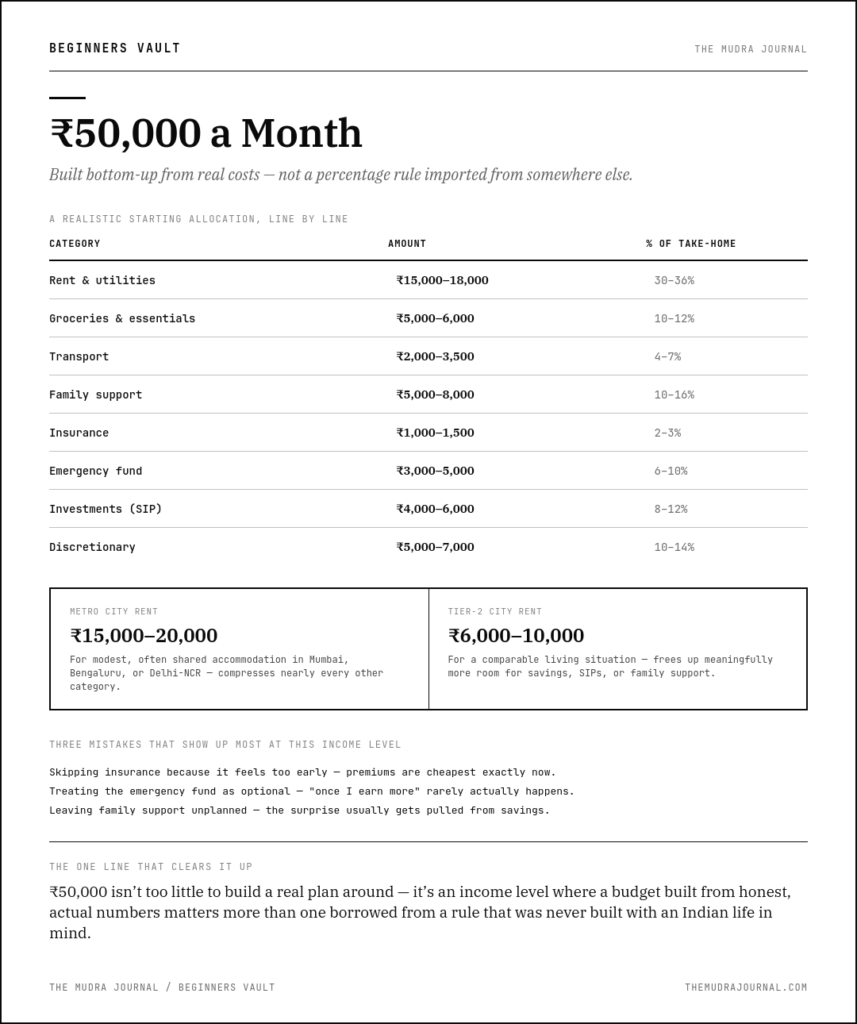
Here’s a realistic allocation for ₹50,000 in take-home pay, built bottom-up from actual cost categories rather than top-down from a percentage formula. Treat these as a starting structure to adjust against your own city and circumstances, not a fixed prescription.
Rent and utilities: ₹15,000–18,000 (30–36%). This is usually the single largest line item, and the one most dependent on your specific city — a shared flat in a tier-2 city might come in well under this range, while a metro can push toward or past the upper end.
Groceries and household essentials: ₹5,000–6,000 (10–12%). Covers food, household supplies, and basic recurring essentials — a category worth tracking closely for the first few months, since it’s easy to underestimate.
Transport: ₹2,000–3,500 (4–7%). Public transport, fuel, or ride-hailing costs, varying significantly based on commute distance and city infrastructure.
Family support: ₹5,000–8,000 (10–16%). Whether this is a fixed monthly amount sent home or a flexible buffer for family needs, budgeting for it explicitly — rather than treating it as an occasional surprise — is what prevents it from derailing the rest of the month when it comes up.
Insurance: ₹1,000–1,500 (2–3%). A basic term life policy (if you have dependents) and health insurance beyond any employer cover — a small monthly cost that matters disproportionately the one time it’s actually needed.
Emergency fund building: ₹3,000–5,000 (6–10%). Set aside toward a target of 3-6 months of essential expenses, held somewhere accessible rather than locked away — this is what stands between a job loss or medical emergency and a genuine crisis.
Investments (SIP): ₹4,000–6,000 (8–12%). Directed toward long-term goals through mutual fund SIPs or similar instruments — even a modest, consistent amount at this stage compounds meaningfully over a working career.
Discretionary and lifestyle: ₹5,000–7,000 (10–14%). Eating out, entertainment, subscriptions, and general lifestyle spending — worth keeping deliberately bounded rather than letting it silently absorb whatever’s “left over” at the end of the month.
These figures won’t sum to a single fixed total across every city and household, and that’s intentional — the point of building bottom-up is that your own numbers, particularly rent and family support, will shift the balance of everything else.
What changes depending on where you live
In a metro city like Mumbai, Bengaluru, or Delhi-NCR, rent alone can realistically consume ₹15,000-20,000 even for modest, shared accommodation, which compresses almost every other category and often makes the emergency fund and discretionary allocations the first to shrink in a tight month.
In a tier-2 city, rent might come in closer to ₹6,000-10,000 for a comparable living situation, freeing up meaningfully more room for savings, investments, or family support without the same month-to-month pressure — which is a significant part of why cost of living, not just salary, matters so much when comparing job offers across cities.
Neither situation is “better” in absolute terms — a higher metro salary often exists specifically because metro costs are higher too — but building your budget around your actual city’s numbers, rather than a national average, is what makes the plan usable rather than aspirational.
Common mistakes at this income level
01 — SKIPPING INSURANCE BECAUSE IT FEELS TOO EARLY
The cheapest time to buy cover is exactly now
Term insurance premiums are lowest when you’re young and healthy, and health insurance matters most precisely when you least expect to need it. Deferring this because ₹50,000 feels too tight to spare ₹1,000-1,500 a month often means paying significantly more for the same cover later, or worse, facing a medical cost with no cover in place at all.
02 — TREATING THE EMERGENCY FUND AS OPTIONAL
“I’ll start once I earn more” rarely actually happens
It’s tempting to defer emergency fund building until income feels more comfortable, but the habit of setting aside even a small amount consistently matters more than the amount itself in the early stages — and income rarely feels “comfortable enough” on its own; the habit has to be built deliberately, at whatever income level you’re currently at.
03 — LETTING FAMILY SUPPORT STAY UNPLANNED
An unplanned obligation is what actually breaks a budget
When family support isn’t given its own line item, it tends to arrive as a surprise that gets pulled from wherever there’s slack — usually the emergency fund or investments — which quietly undermines the parts of the budget meant to build long-term stability. Planning for it explicitly, even as a flexible range rather than a fixed number, keeps it from cannibalising everything else.
Making it sustainable
- Build your version of this budget using your actual rent and city, not the ranges above — they’re a starting structure, not your specific numbers.
- Automate the SIP and emergency fund transfers to happen right after your salary lands, before discretionary spending has a chance to compete for that money.
- Give family support its own explicit monthly amount or range, even if it’s modest, rather than leaving it to be figured out reactively each time it comes up.
- Track actual spending against this budget for at least two full months before adjusting it — the first month rarely reflects a stable, realistic pattern.
- Revisit the whole structure every time your income, rent, or family obligations change, since a ₹50,000 budget built today won’t necessarily still fit a year from now.
₹50,000 a month isn’t too little to build a real financial plan around — it’s simply an income level where a plan built from actual, honest numbers matters more than one borrowed from a percentage rule that was never built with an Indian life in mind.
FROM THE MUDRA JOURNAL — Rooted in India, inspired by the world.