Ten lakh rupees sounds like a fortune to someone who’s never started a business, and laughably small to anyone who has. Both reactions are wrong. It’s not enough money to build a company. It’s exactly enough to find out whether you should.
9 MIN READ
THE LEDGER — FOUNDER’S OFFICE
WRITTEN FOR: THE IDEA ON A NAPKIN → THE FIRST INVOICE RAISED
Every founder conversation in India eventually arrives at the same number, dressed differently each time — a friend’s PF withdrawal, a parent’s “if it fails, at least try,” a personal loan taken quietly and never mentioned again. Somewhere around ₹10 lakh, most first-time founders decide they either have enough to start, or not enough to bother. Neither read is quite right. ₹10 lakh, spent correctly, is real validation money — enough to build something people will actually pay for and find out if the idea holds up in the market. Spent the way most first-timers spend it, it’s enough for a nice logo, a rented desk, and a slow, expensive lesson in what a runway actually is.
The single biggest determinant of whether this amount works isn’t the idea. It’s the order you spend it in.
₹10 lakh isn’t company-building money. It’s proof-of-concept money — and every rupee spent on anything that isn’t proof is a rupee you don’t get back. Understanding that distinction changes almost every early decision a founder makes.
What ₹10 lakh actually is — and isn’t
01 — IT’S TESTING CAPITAL, NOT EMPIRE CAPITAL
The job of this money is to answer one question
At this budget, the entire purpose of the capital is to answer a single question as cheaply and quickly as possible: will people pay for this? Everything that doesn’t move you toward that answer — polish, scale, permanence — is a distraction the budget can’t afford. Founders who treat ₹10 lakh as company-building money end up with the trappings of a company and no evidence it should exist.
02 — IT HAS TO SURVIVE COMPLIANCE BEFORE IT BUYS ANYTHING ELSE
Registration, GST, and basic legal setup come out first
Company incorporation, GST registration (if applicable), a current account, and basic contracts or terms of service aren’t optional extras — they’re the floor, and skipping them to save money early is one of the most common ways Indian founders create expensive problems later, from tax notices to unenforceable client agreements. Budget for this first, before it feels urgent, because it always becomes urgent eventually.
03 — IT NEEDS A DEADLINE, NOT JUST A BUDGET
Runway is a countdown, not a cushion
₹10 lakh isn’t meant to last indefinitely — treating it as a comfortable cushion rather than a ticking clock is how founders drift for a year without a real answer to whether the business works. Decide upfront how many months this capital needs to last you to reach a clear validation milestone, and let that deadline drive every spending decision that follows.
Where founders typically waste it
01 — OFFICE SPACE BEFORE REVENUE
A co-working desk doesn’t validate anything
A premium co-working membership can run ₹8,000–15,000 a month per seat in most Indian metros — money that buys comfort and a sense of legitimacy, but nothing that a customer will ever pay for. Until there’s a reason to meet clients in person daily or house a growing team, this is one of the easiest costs to defer, and one of the first most first-time founders pay anyway.
02 — HIRING BEFORE THE PRODUCT HAS PROVEN ITSELF
A team is expensive proof you haven’t found the answer yet
Bringing on employees before you have paying customers or a validated offering means paying salaries against hope rather than evidence — and at this budget, even one or two premature hires can consume a meaningful share of the total runway within a few months. Most early validation work can be done solo, with freelancers, or with a co-founder, before it needs a payroll.
03 — OVER-INVESTING IN BRAND BEFORE THE OFFER IS PROVEN
A beautiful logo doesn’t answer “will they pay”
Custom branding, a polished website, and professional photography feel like progress because they’re visible and shareable — but they don’t tell you anything about demand. Spending ₹1-2 lakh on brand identity before a single paying customer exists is optimising the packaging of a product nobody’s confirmed they want yet.
Where the money should actually go
A rough allocation that keeps the budget pointed at validation rather than appearances:
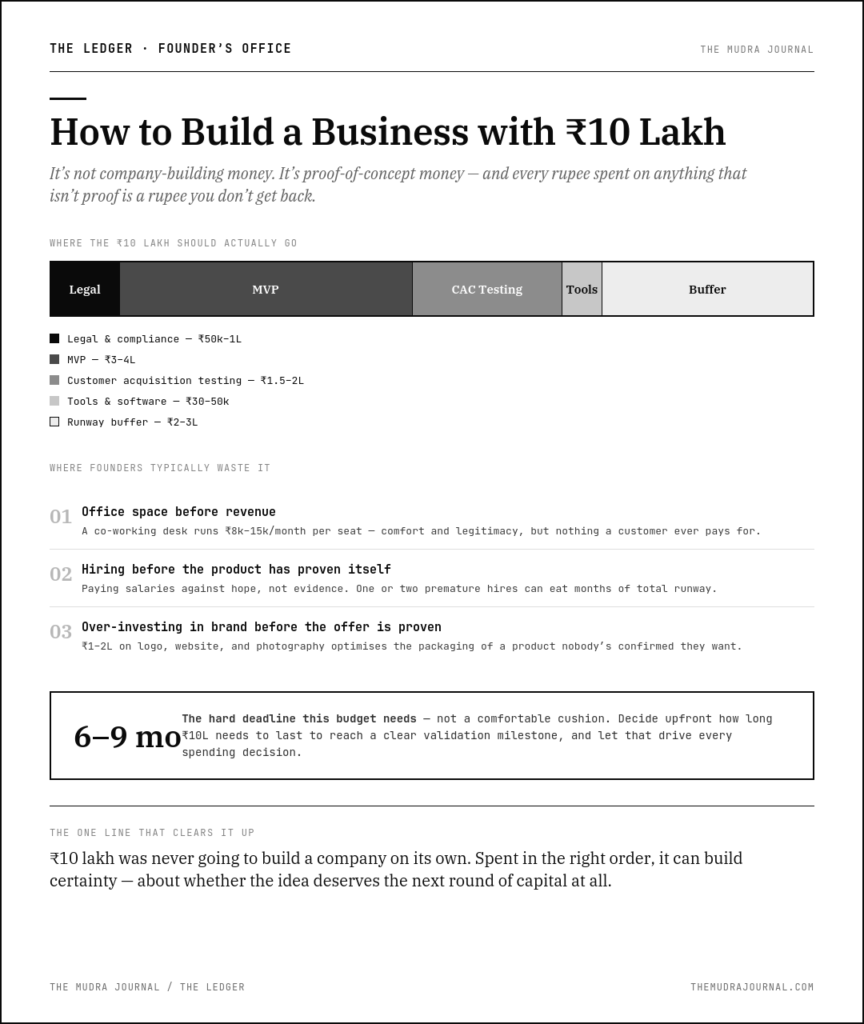
Legal and compliance (roughly ₹50,000–1,00,000): Incorporation, GST registration if needed, a lawyer-reviewed contract template, and basic accounting setup. Non-negotiable, done early.
Minimum viable product (roughly ₹3,00,000–4,00,000): Whatever “product” means for your business — a working app built by a freelance developer, a small manufacturing run for a physical product, or a genuinely useful service delivered manually before it’s automated. This should be the largest single line item.
Customer acquisition testing (roughly ₹1,50,000–2,00,000): Small, deliberate spends on ads, outreach, or content specifically designed to find out whether people beyond your immediate network will pay — not a “marketing budget” in the traditional sense, but a series of small experiments.
Tools and software (roughly ₹30,000–50,000): The genuinely necessary subscriptions — accounting software, basic design tools, whatever your specific business needs to function, kept lean and cancelled the moment they’re not earning their cost.
Runway buffer (roughly ₹2,00,000–3,00,000): Money that isn’t spent on anything specific yet — held back deliberately, because the biggest risk to a ₹10 lakh business isn’t spending too little on any one thing, it’s running out before you’ve learned enough to make the next decision well.
What kind of business actually fits this budget
Not every business idea suits a ₹10 lakh starting point, and being honest about that early saves a lot of wasted motion.
Service-based businesses — consulting, freelance-adjacent agencies, specialised B2B services — tend to fit well, since the primary cost is your own time and expertise rather than inventory or infrastructure.
Small-batch D2C brands can work if the first production run is genuinely small and testing-focused, rather than a large inventory bet made before demand is confirmed.
Solo or outsourced-development SaaS can fit if the founder is technical enough to build a lean first version themselves, or disciplined enough to commission a narrow, specific MVP rather than a full-featured product.
Content or audience-first businesses — where the “product” is trust and attention built over time, monetised later — can start on very little capital, though they typically require more time than money to validate.
Capital-intensive ideas — manufacturing at meaningful scale, anything requiring significant inventory upfront, businesses needing a physical retail presence from day one — generally don’t fit this budget, and forcing them to often just means running out of money before reaching a real answer.
Making the ₹10 lakh actually work
- Set aside legal and compliance costs first, before anything else, even though it won’t feel like “building the business.”
- Write down the specific question this money needs to answer, and the specific evidence that would prove it — not a vague goal, but something you could show someone else.
- Delay office space and hiring until revenue or a validated pilot genuinely requires them, not before.
- Treat customer acquisition as a series of small, trackable experiments, not a single marketing budget spent all at once.
- Set a hard deadline — commonly 6 to 9 months for this budget size — by which you’ll have a clear answer, and be honest with yourself when that date arrives, whichever way the answer points.
₹10 lakh was never going to build a company on its own. What it can build, if spent in the right order, is certainty — about whether the idea deserves the next round of capital, effort, and time. That answer, either way, is worth more than the money itself.
FROM THE MUDRA JOURNAL — Rooted in India, inspired by the world.