
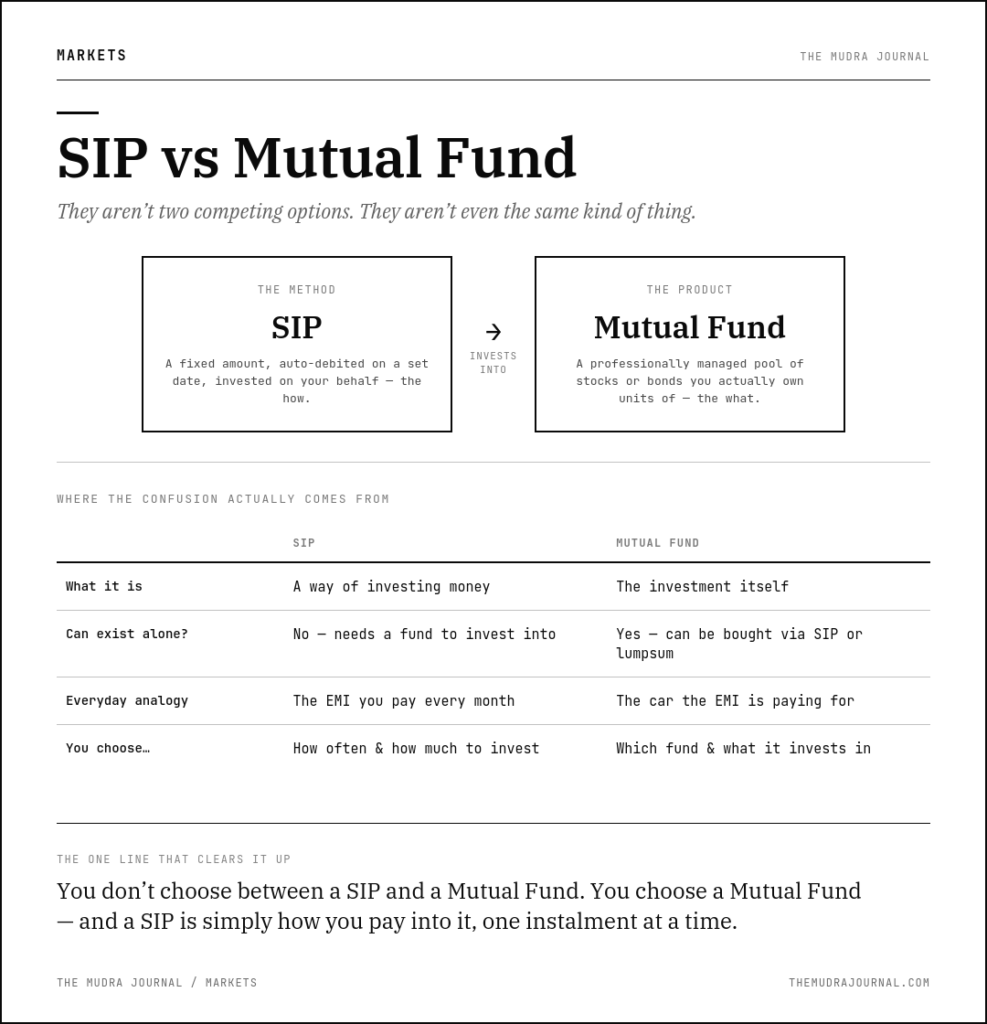
“I’ve invested in a SIP” is one of the most common sentences in Indian personal finance — and one of the most technically incorrect. You can’t invest in a SIP. You invest in a mutual fund, and a SIP is simply how the money gets there.
6 MIN READ
MARKETS / बाज़ार
WRITTEN FOR: THE FIRST SIP FORM → THE FUND FACTSHEET READER
Walk into any conversation about investing in India, and you’ll hear “SIP” and “mutual fund” used as if they’re two competing products — “should I do a SIP or a mutual fund?” is a genuinely common question, asked in complete sincerity. It’s an understandable mix-up, because SIP has become such dominant shorthand for investing itself that it’s swallowed the actual product it’s attached to. But the two aren’t alternatives. One is a destination. The other is a mode of transport.
A mutual fund is the actual investment — a pool of money from many investors, managed by professionals, put into stocks, bonds, or other assets. A SIP is simply a method of putting money into that fund: a fixed amount, deducted automatically, on a fixed date, every month. You could put the exact same amount into the exact same fund as a single lump sum instead — same fund, different mode of entry.
A SIP is not a product you buy. It’s a standing instruction for how you buy a product you’ve already chosen. Once that distinction is clear, a lot of confusing advertising and advisor-speak stops being confusing.
Here’s where the two terms actually diverge, and why the mix-up is so persistent.
Why the confusion happens
01 — THE MARKETING MADE THEM SOUND LIKE THE SAME DECISION
“Start a SIP” replaced “choose a fund” in everyday language
Banks, apps, and advertisements overwhelmingly promote “starting a SIP” rather than “choosing a mutual fund,” because SIP is the easier, friendlier sell — small amount, automatic, painless. The actual harder decision — which fund, which category, which risk level — gets buried under the SIP branding, so many investors start a SIP without ever really evaluating the fund it’s going into.
02 — SIP BECAME THE DEFAULT, SO IT BECAME THE IDENTITY
Almost everyone’s first investment was a SIP
For most young Indian investors, a SIP is the very first way they ever put money into the market — so the word becomes permanently linked to “investing” itself in their mental vocabulary, the way some people say “Xerox” instead of “photocopy.” The method became the label for the entire activity.
03 — THE APPS SHOW “YOUR SIPS,” NOT “YOUR FUNDS”
The interface reinforces the mix-up
Most investment apps have a dashboard section literally called “My SIPs,” listing your recurring investments by their SIP amount and date rather than emphasizing the fund name or category first. It’s a small design choice, but it quietly trains investors to think of their portfolio as a collection of SIPs rather than a collection of funds that happen to be funded via SIP.
What actually matters when you’re deciding
01 — THE FUND CHOICE MATTERS FAR MORE THAN THE SIP DECISION
You’re choosing what to invest in, not just how
Whether it’s an index fund, a large-cap fund, a mid-cap fund, or a sector-specific fund changes your risk, expected return, and volatility enormously. Whether you fund it via SIP or lump sum barely moves the needle by comparison. Spending five minutes deciding between two apps’ SIP dates and zero minutes reading the fund’s category and past performance has the priorities exactly backwards.
02 — SIP VS LUMP SUM IS A TIMING DECISION, NOT A FUND DECISION
Both go into the same fund — just on a different schedule
A SIP spreads your investment across several months, which averages out the price you pay and reduces the risk of investing everything right before a downturn — genuinely useful for regular income earners investing monthly savings. A lump sum puts the full amount in at once, which can work better if markets are attractively priced or if you’ve received a windfall like a bonus. Neither mode changes what the underlying fund actually holds.
03 — YOU CAN RUN BOTH IN THE SAME FUND, ANYTIME
It’s not a permanent commitment either way
A SIP isn’t a locked-in contract — you can pause it, increase it, decrease it, or stop it anytime without penalty in most funds, and you can add a lump-sum top-up to a fund you’re already SIPing into whenever you have extra money. Treating “starting a SIP” as a big, final decision adds unnecessary pressure to something that’s actually quite flexible.
Getting the order of decisions right
The fix here isn’t complicated — it’s just about deciding things in the correct order.
- Choose the fund first: check its category, its benchmark index, its expense ratio, and its 3–5 year performance against that benchmark, before thinking about SIP amount or date at all.
- Decide your monthly investable amount based on your budget, not based on a round number an app suggests by default.
- Pick a SIP date shortly after your salary credits, so the deduction happens before the money gets spent elsewhere.
- Don’t create a new SIP for every small goal — you can run multiple SIPs into the same fund, or better, choose separate funds if your goals genuinely need different risk levels.
- Review the fund itself, not just the SIP, once a year — check whether it’s still meeting its benchmark, not just whether the deduction is still going through.
The confusion was never really about two competing things. It’s about one decision — which fund — wearing the costume of a completely different one: how you pay into it. Get the fund right first, and the SIP is just the easy part that happens automatically every month after.
FROM THE MUDRA JOURNAL — MARKETS / बाज़ार – Markets, Made Understandable