“What’s your package?” is the first financial question most Indians are ever asked — and often the last one they think to answer for themselves. Salary is a single input. Financial health is built from at least four others that nobody asks about at family functions.
7 MIN READ
BEGINNERS VAULT / ज्ञान
WRITTEN FOR: THE HIKE ANNOUNCEMENT → THE ACTUAL FINANCIAL CHECKUP
We’ve written before about why net worth matters more than salary — but net worth is a snapshot, taken on a single day. It tells you where you stand right now. It doesn’t tell you whether you’re actually managing money well, or just happened to land on a good number this year. Financial health is a different, more useful question: not “what do I have today,” but “is the way I handle money actually working?” That answer lives in your habits and ratios far more than in your CTC.
A person earning ₹18 lakh a year with no savings discipline, mounting credit card debt, and zero emergency fund is not financially healthier than someone earning ₹9 lakh who saves consistently, carries manageable debt, and could handle a job loss for six months without panic. Salary describes potential. These other numbers describe what you’re actually doing with it.
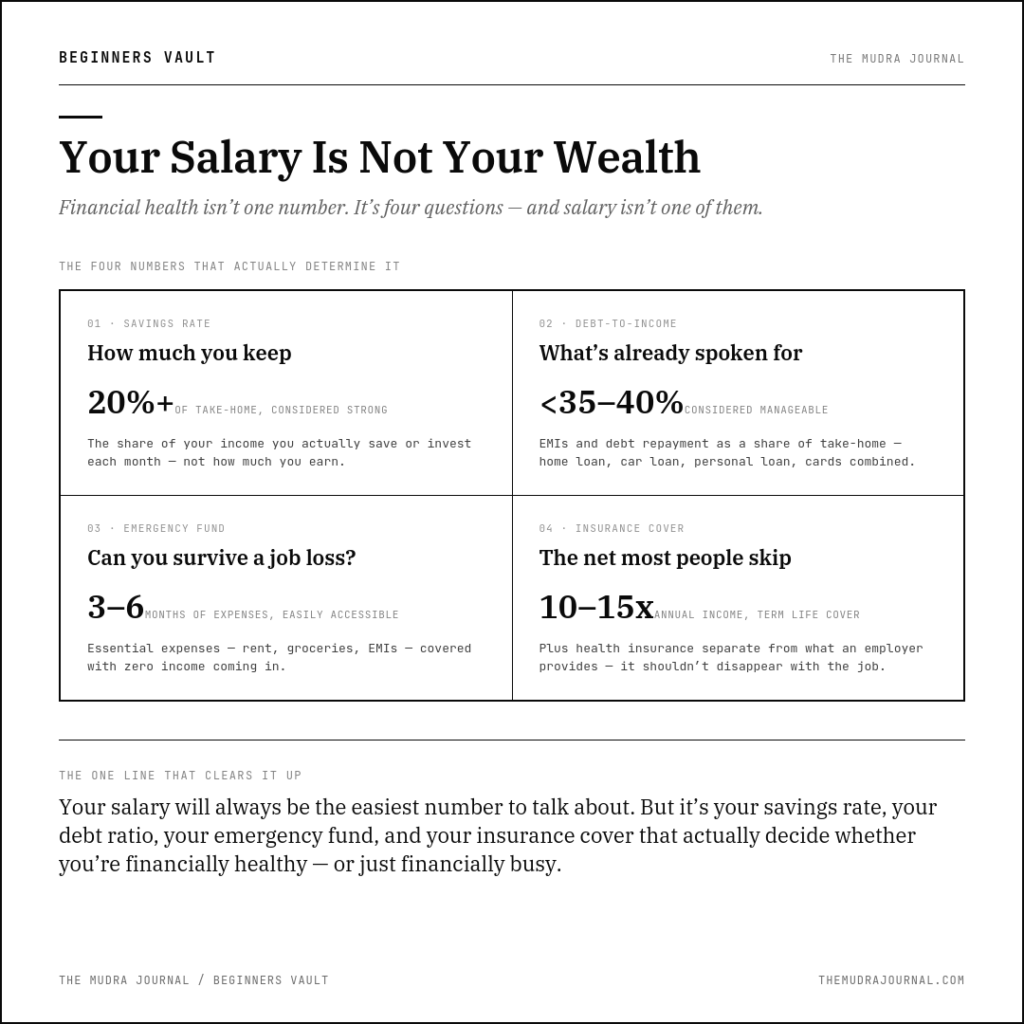
Financial health isn’t one number — it’s four questions, and salary isn’t one of them. Here’s what those four questions actually are, and how to answer them honestly about your own situation.
Why salary keeps getting mistaken for the whole picture
01 — “PACKAGE” BECAME A SOCIAL SCORE
CTC is the number everyone asks for first
From matrimonial conversations to LinkedIn hike posts to the annual appraisal season buzz, Indian culture has turned salary into a public scoreboard in a way few other numbers are. It’s the easiest thing to compare, so it became the thing everyone compares — even though it says nothing about savings behaviour, debt, or how prepared someone actually is for a setback.
02 — A HIGHER SALARY OFTEN JUST RAISES THE SPENDING, NOT THE SAVINGS
Lifestyle inflation eats the hike before it lands
Most people who get a 20% hike don’t save 20% more — they spend enough of it that their actual financial position barely moves. This is such a common, well-documented pattern that it has a name: lifestyle inflation. Without tracking anything beyond the salary figure, this quiet erosion is invisible, because the headline number — the CTC — keeps climbing every year regardless.
03 — INCOME SAYS NOTHING ABOUT WHAT YOU OWE
Two identical salaries can hide two very different realities
A salary slip has no column for credit card dues, a personal loan, or how much of next month’s income is already spoken for. Financial health depends heavily on what’s flowing out, not just what’s flowing in — and that’s precisely the part a salary number can’t show you.
The four things that actually determine it
01 — YOUR SAVINGS RATE
Not how much you earn, but how much you keep
Your savings rate — the percentage of your take-home income you actually save or invest each month — is one of the most honest indicators of financial health there is. Someone saving 25% of a modest salary is building wealth faster than someone saving 5% of a large one. Most financial advisors consider anything above 20% a strong habit; if you don’t know your number, that’s usually the first sign it needs attention.
02 — YOUR DEBT-TO-INCOME RATIO
How much of your income is already spoken for
This is the percentage of your monthly take-home that goes toward EMIs and debt repayment — home loan, car loan, personal loan, credit card minimums combined. A ratio under 35–40% is generally considered manageable in India; anything higher starts to seriously limit your ability to save, invest, or absorb a financial shock, no matter how large the salary behind it is.
03 — YOUR EMERGENCY FUND
Can you survive your own job loss?
This is simply the number of months you could cover essential expenses — rent, groceries, EMIs — with zero income coming in. Three to six months’ worth of expenses, kept in something easily accessible like a liquid fund or savings account, is the commonly recommended range. Without this, even a strong salary and a good savings rate can unravel fast the moment something unexpected happens — a job loss, a medical emergency, a family need.
04 — YOUR INSURANCE COVERAGE
The safety net most people underestimate until they need it
Adequate term life cover (roughly 10–15 times annual income, if you have dependents) and health insurance separate from what your employer provides are what stop a single bad event from undoing years of careful saving. This is the pillar most Indians skip or under-fund, often relying entirely on employer-provided health cover that disappears the moment they change or lose a job.
Running your own checkup
None of these four numbers require an advisor to calculate. Ten honest minutes and last month’s bank statement are enough to start.
- Calculate your savings rate: total saved and invested last month, divided by your take-home income, times 100.
- Calculate your debt-to-income ratio: total monthly EMI and debt payments, divided by take-home income, times 100.
- Add up three to six months of essential expenses, and check that against what’s actually sitting in an accessible account today.
- Check your term insurance cover against 10–15 times your annual income, and confirm your health insurance doesn’t disappear if you change jobs.
- Revisit all four numbers together every six months — not just when a hike or a bonus makes you feel like checking.
Your salary will always be the easiest number to talk about, because it’s the only one anyone ever asks for directly. But it’s your savings rate, your debt ratio, your emergency fund, and your insurance cover — quietly, in the background — that actually decide whether you’re financially healthy or just financially busy.
FROM THE MUDRA JOURNAL — Rooted in India, inspired by the world.