Every Indian household has run on the same three instruments for fifty years — a fixed deposit for safety, gold for tradition, an LIC policy for “just in case.” Gen Z hasn’t rejected any of them out loud. They’ve just quietly stopped renewing them.
8 MIN READ
OLD MONEY / धन
WRITTEN FOR: THE FD RENEWAL FORM → THE INDEX FUND SIP
If you ask any Indian parent to name a financial plan, you’ll get the same three words in some order: FD, gold, LIC. Not because anyone sat down and compared instruments — this was never a competition. It was gospel, passed down the same way a recipe is: without measurements, without questioning, just “this is what we do.” A fixed deposit for the emergency fund. Gold for the wedding and the what-if. An LIC policy taken out the year you were born, maturing sometime around your own child’s wedding. Three decisions made once, for you, that you were expected to keep making for the rest of your life.
Gen Z isn’t burning that playbook. Most of them are quietly not opening a fourth FD, not buying the LIC policy their parents suggest, and buying gold in a form their grandparents wouldn’t recognize as gold at all.
The trinity wasn’t wrong. It was built for an economy with 12% fixed deposit rates, no other accessible options, and no way to verify anything except a bank stamp. None of those three conditions are true anymore — which is exactly why the instruments built around them are quietly being retired, one by one.
Here’s what each one was actually solving for, and what’s replacing it.
Why the trinity became gospel
01 — THE FIXED DEPOSIT: SAFETY YOU COULD SEE
Guaranteed, boring, and that was the entire point
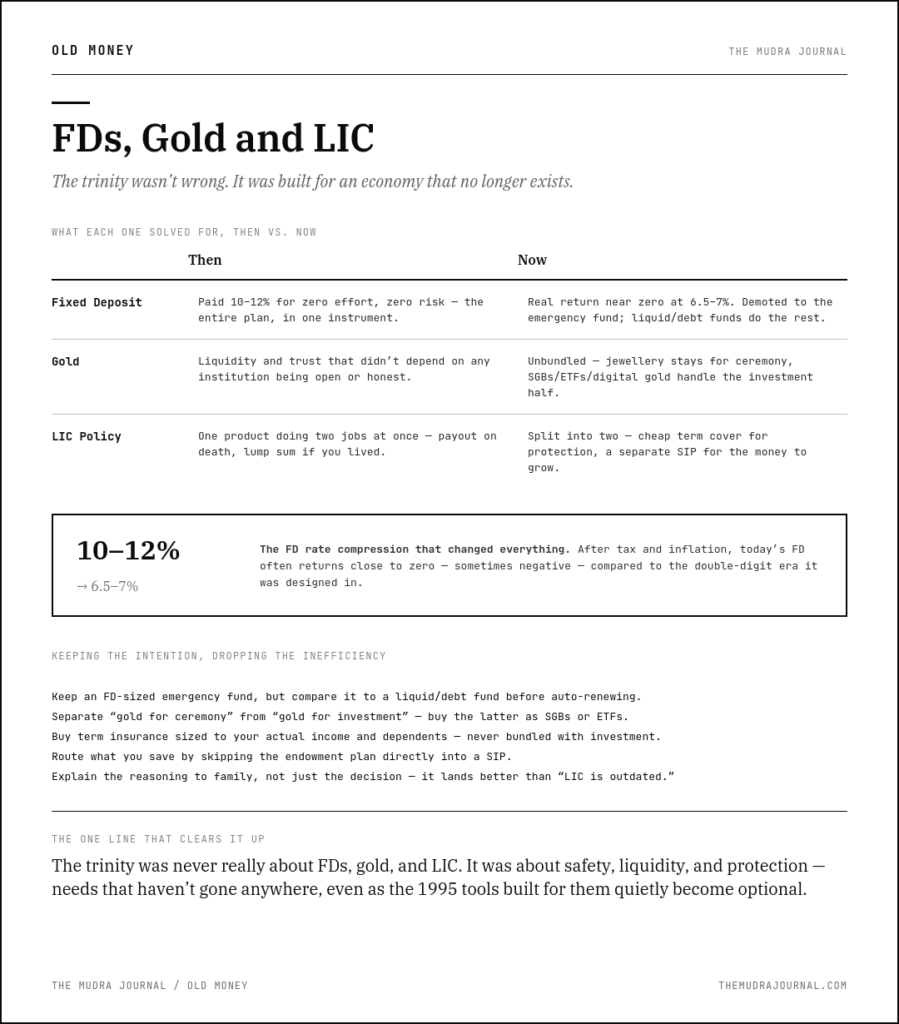
In the 1990s and early 2000s, FDs paid 10–12% with zero effort and zero risk — a number that genuinely made sense against inflation and against every other option available to a saver with no demat account and no financial literacy. It didn’t need to be understood, only renewed. That predictability made it the default answer to “what should I do with this money” for an entire generation of savers who had every reason to distrust anything more complicated.
02 — GOLD: THE ASSET THAT NEEDED NO INSTITUTION
Value that survived every kind of family emergency
We’ve covered this one in depth before — gold’s real appeal was never returns, it was liquidity and trust that didn’t depend on a bank being open or honest. It solved for a specific fear: needing money urgently, in a system where formal credit and insurance were unreliable or simply unavailable.
03 — LIC: THE POLICY THAT DID TWO JOBS BADLY INSTEAD OF ONE WELL
“Insurance-cum-investment” sounded efficient
An LIC endowment or money-back policy promised two things at once — a payout if something happened to you, and a lump sum if nothing did. For a generation with no separate concept of “insurance” and “investment,” a single product doing both felt efficient, even patriotic — LIC was, after all, the government’s own institution, and trusting it was as automatic as trusting the postal service.
What Gen Z is quietly dropping — and why
01 — THE FD IS BEING REPLACED BY WHATEVER BEATS ITS OWN MATH
The guarantee stayed. The return didn’t keep up.
Today’s FD rates hover around 6.5–7%, and after tax and inflation, the real return is often close to zero — sometimes negative. Gen Z hasn’t abandoned safety; they’ve moved the “safe” allocation into liquid funds and debt mutual funds that offer comparable stability with slightly better post-tax outcomes, while keeping equity SIPs for the money that’s actually meant to grow. The FD isn’t gone — it’s been demoted from “the whole plan” to “the emergency fund,” which is closer to what it was always good for.
02 — PHYSICAL GOLD IS BEING UNBUNDLED, NOT REJECTED
The locker is being replaced by the app
As we’ve explored before, Sovereign Gold Bonds, gold ETFs, and digital gold now let this generation hold gold as a pure financial instrument — no making charges, no locker rent, no purity anxiety — while jewellery stays reserved for its actual emotional purpose: weddings, gifting, ceremony. The trinity’s gold requirement hasn’t disappeared. It’s just been split into “gold to wear” and “gold to hold,” bought through two entirely different channels.
03 — LIC ENDOWMENT PLANS ARE BEING REPLACED BY DOING BOTH JOBS SEPARATELY
Term insurance plus a mutual fund, done deliberately
A pure term insurance plan costs a fraction of an endowment policy’s premium for the same or higher cover, precisely because it does one job — pay out if something happens to you — and doesn’t try to also function as a savings vehicle. Gen Z is increasingly buying term cover separately and directing the difference into index funds or SIPs, effectively doing what LIC did with one hand tied behind its back, except with both hands free. The insurance still gets bought. It’s just no longer expected to also make you rich.
Keeping the safety without keeping the inefficiency
You can carry the trinity’s actual intention forward — safety, tradition, protection — without carrying its outdated math. Here’s how that split typically looks in practice.
- Keep an FD-sized emergency fund, but compare it against a liquid fund or short-duration debt fund before automatically renewing — the safety is comparable, the post-tax return usually isn’t.
- Separate “gold for ceremony” from “gold for investment” as two different purchase decisions, buying the latter through SGBs or ETFs specifically because they can be sold back near actual value.
- Buy term insurance for the cover your family needs, calculated honestly against your income and dependents — not the amount an agent suggests, and not bundled with an investment component.
- Route whatever premium you save by not buying an endowment plan directly into a SIP, so the “investment half” of LIC’s old promise still happens, just more efficiently.
- Explain the reasoning to family when you make these swaps, not just the decision — “I’m keeping us covered and keeping us saving, just through two separate products” lands better than “LIC is outdated.”
The trinity was never really about FDs, gold, and LIC specifically. It was about safety, liquidity, and protection — three needs that haven’t gone anywhere. Only the tools built to solve them in a 1995 economy have quietly become optional in a 2026 one.
FROM THE MUDRA JOURNAL — Rooted in India, inspired by the world.