Every headline about a ₹10,000 crore merger or a blockbuster IPO mentions the deal size in bold, and almost never mentions what the bank advising on it actually earned. That number exists, it’s often substantial, and understanding how it’s calculated tells you a great deal about how investment banking actually functions as a business.
14 MIN READ
THE LEDGER — BOARDROOM
WRITTEN FOR: THE M&A HEADLINE → THE FEE STRUCTURE BEHIND IT
We’ve written before about what an investment banker actually does day to day — the modelling, the pitch books, the due diligence coordination. This piece answers a different, related question: once all that work is done, how does the bank itself actually get paid for it? The answer isn’t a single number or a simple salary-style arrangement. It’s a collection of distinct fee businesses, each with its own structure, its own cyclicality, and its own relationship to the size and success of a deal — and understanding this structure explains a lot about why investment banking revenue behaves so differently from the steady, predictable income of a commercial bank.
An investment bank doesn’t earn money by predicting markets correctly or by holding deposits and lending them out. It earns fees for being present at extremely large financial decisions — a fundamentally different, much more deal-dependent business than the one most people picture when they hear the word “bank.” Here’s exactly how those fees work.
The core fee businesses
01 — UNDERWRITING FEES: GETTING PAID TO BRING A COMPANY TO MARKET
A percentage of the amount raised, for managing the entire process
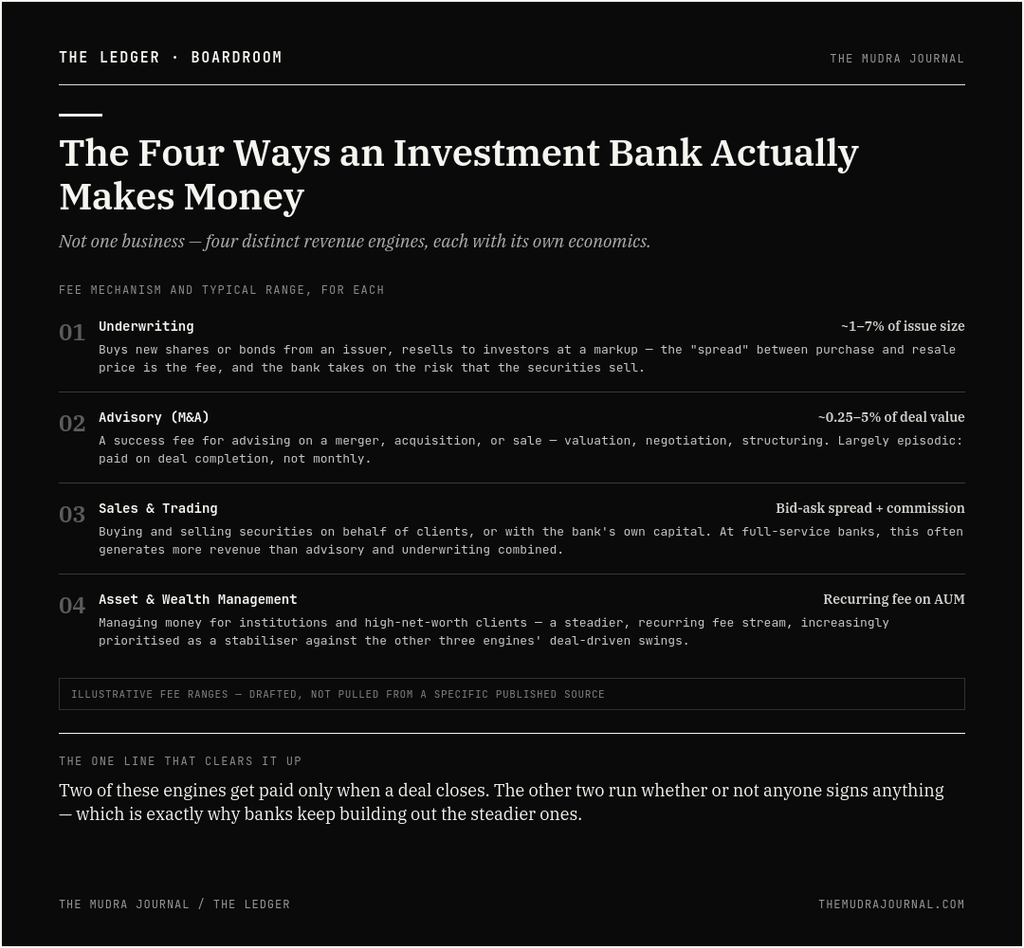
When a company goes public through an IPO, or raises money through a bond issuance, the investment bank (or banks — large deals are often handled by a syndicate of several banks together) managing the process earns an underwriting fee, typically structured as a percentage of the total amount raised. This fee compensates the bank for pricing the offering, marketing it to institutional investors, managing regulatory filings, and in many underwriting arrangements, committing to purchase any unsold shares itself — a real risk the bank is being paid to absorb, not just an administrative service charge.
02 — M&A ADVISORY FEES: GETTING PAID FOR GUIDING A DEAL TO CLOSE
Often structured as “success fees,” tied to the deal actually completing
When a bank advises a company on acquiring another business, merging with a competitor, or selling a division, the advisory fee is frequently structured predominantly as a success fee — payable mainly if and when the deal actually closes, sometimes alongside smaller retainer fees paid during the process regardless of outcome. This structure aligns the bank’s financial interest directly with getting the deal done, which is worth understanding both as a founder or executive engaging an advisor, and as a reader trying to understand why banks pursue certain deals so aggressively.
03 — MERCHANT BANKING AND REGULATORY LEAD-MANAGER ROLES IN INDIA
A specific, SEBI-regulated function unique to Indian capital markets
In India, any entity managing a public issue — acting as a “lead manager” for an IPO — must be registered with SEBI as a merchant banker, a specific regulatory category with its own compliance obligations, disclosure requirements, and fee structures, distinct from how the same function might be labelled elsewhere globally. This is a meaningful, India-specific layer worth knowing: the “investment bank” managing an Indian IPO is operating under a defined SEBI framework, not simply an informal advisory arrangement.
Beyond advisory: the other revenue engines
01 — SALES AND TRADING: SPREADS AND COMMISSIONS, NOT ADVISORY FEES
A genuinely separate business, often within the same parent bank
Large banks with investment banking divisions frequently also run sales and trading operations — buying and selling securities on behalf of clients or, within regulatory limits, the bank’s own account, earning revenue through bid-ask spreads, commissions, and market-making activity. This is a structurally different business from advisory work: revenue here depends on trading volumes and market activity, not on completing a specific merger or IPO, and it typically sits in a separate division with different staff, incentives, and regulatory oversight, even under the same corporate umbrella.
02 — ASSET AND WEALTH MANAGEMENT: FEES BASED ON MONEY MANAGED, NOT DEALS DONE
A steadier, AUM-linked revenue stream
Many large financial institutions with an investment banking arm also run asset management or wealth management businesses, earning fees calculated as a percentage of assets under management (AUM) rather than tied to specific transactions. This tends to be a more stable, recurring revenue source than deal-dependent advisory or underwriting fees, since it grows or shrinks gradually with market values and net new money, rather than swinging sharply based on whether a specific IPO or merger closes this quarter.
03 — TREASURY AND PROPRIETARY ACTIVITIES: MORE LIMITED THAN BEFORE
A smaller, more tightly regulated slice since the 2008 financial crisis
Some banks also generate revenue through proprietary trading and treasury operations — investing the bank’s own capital rather than executing trades purely on behalf of clients. Globally, this activity has been significantly curtailed by post-2008 financial crisis regulation aimed at reducing risk-taking with a bank’s own balance sheet, and it typically represents a smaller, more tightly governed share of revenue at most major institutions today than in the years before that regulatory shift.
How fee structures actually work, mechanically
Underwriting fees for IPOs in India and globally are commonly structured as a percentage of the total issue size, and this percentage typically decreases as deal size increases — a very large IPO often carries a smaller percentage fee than a modest-sized one, though the absolute rupee amount earned can still be substantial given the scale involved. M&A advisory fees follow a broadly similar pattern: smaller transactions often carry a higher percentage fee, larger transactions a lower percentage but a larger absolute number, a structure sometimes informally described using variations of what’s historically been called the “Lehman formula” in global finance circles, though actual fee arrangements vary significantly by deal, region, and negotiating leverage between the client and the bank.
It’s also worth understanding that these fees are frequently split when multiple banks jointly manage a large transaction — a lead manager typically retains a larger share, with co-managers and other syndicate participants receiving smaller portions, reflecting their differing levels of involvement and risk in the deal.
Why this revenue is genuinely cyclical
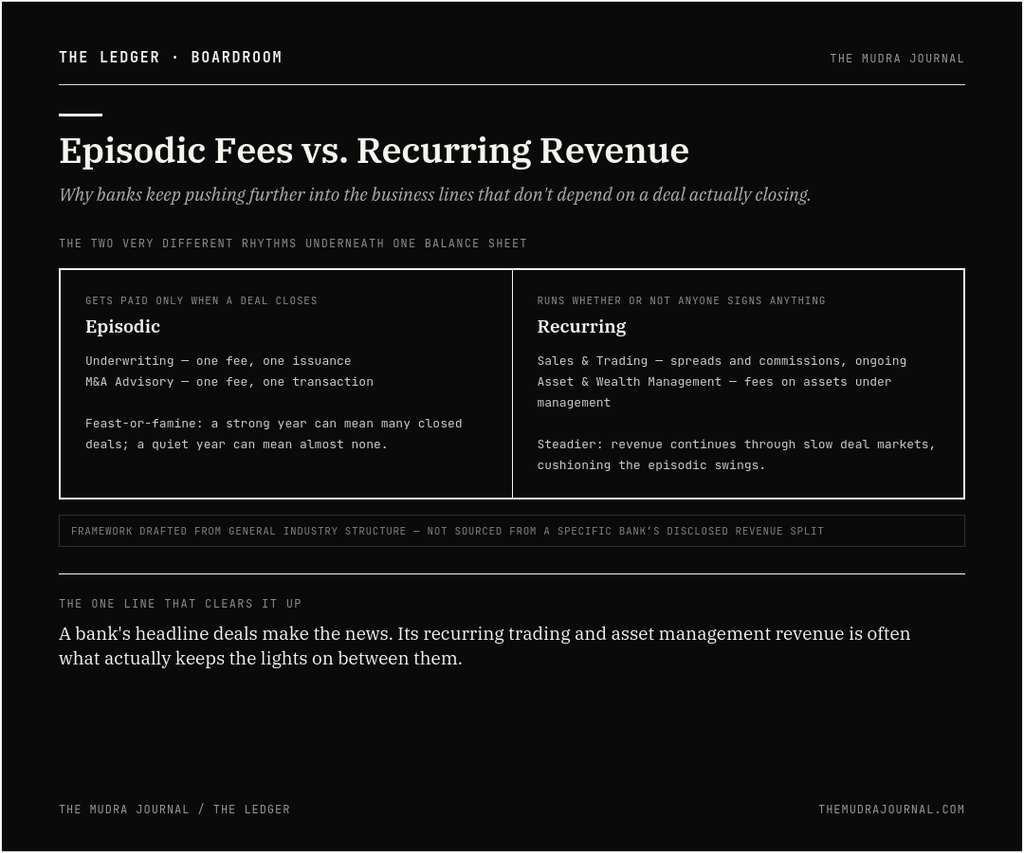
This is one of the most important structural differences between investment banking and commercial banking as businesses, and it’s worth stating plainly: investment banking revenue rises and falls sharply with deal activity. A strong year for IPOs and M&A — often correlated with buoyant stock markets, business confidence, and available credit — can mean a very strong year for advisory and underwriting fee revenue. A quiet year, where companies delay IPOs and executives postpone major acquisitions amid uncertainty, can mean a significantly leaner year for the exact same division, through no fault of the bankers’ individual effort or skill.
Commercial banking, by contrast, earns a comparatively steadier interest-rate spread on deposits and loans regardless of deal market sentiment — a structural difference we’ve explored before, and one that explains why banking groups with both businesses often see their investment banking revenue swing far more dramatically, year to year, than their retail banking income does.
The Indian regulatory backdrop
In India, SEBI regulates merchant banking activities, IPO processes, and broader securities market conduct, including disclosure requirements around fees charged for managing public issues. The RBI, meanwhile, regulates the commercial banking entities that often sit within the same corporate group — meaning a large Indian financial conglomerate can have its retail banking arm primarily answerable to the RBI, while its investment banking or merchant banking arm operates under a largely separate SEBI-regulated framework, a structural split that reflects the fundamentally different nature of the two businesses we’ve discussed throughout this series.
Why this matters even if you’re not in banking
Understanding how investment banks earn their fees is useful well beyond anyone considering the career itself. If you’re a business owner or founder eventually engaging an advisor for a fundraise or a sale, understanding typical fee structures — percentage-based, often success-linked — helps you negotiate from an informed position rather than an unfamiliar one. If you’re an investor evaluating a banking group’s stock, understanding the mix between steady interest income and cyclical fee income helps explain why a bank’s earnings might move differently than interest rates alone would suggest in a given quarter. And simply as a reader of financial news, knowing that a headline deal size and the advisor’s actual fee are two very different numbers — related, but not always proportionally obvious — makes the coverage more legible.
Making sense of it, practically
- If you’re evaluating a bank’s stock or quarterly results, look separately at its fee-based (advisory, underwriting) income and its steadier interest or AUM-based income — the mix tells you a lot about how sensitive that business is to deal market cycles.
- If you’re a founder or executive eventually hiring an investment bank or advisor, ask directly about fee structure — retainer versus success fee, and the percentage tied to different deal size ranges — before assuming a standard, uniform rate applies.
- When reading M&A or IPO news, remember that the advisor’s fee, while real and often substantial, is a separate figure from the headline deal size, and rarely gets reported alongside it.
- If you’re considering a career in this space, understand that compensation, especially at senior levels, is often closely tied to the fee revenue a banker personally originates — which shapes a lot of the incentive structure discussed in our earlier piece on what the job actually involves.
- Recognise that a “quiet year” for deal activity genuinely affects investment banking revenue and, often, bonus pools and hiring — a cyclicality that’s structurally different from the steadier business of a commercial bank, even within the same institution.
Investment banks were never in the business of predicting markets or managing anyone’s personal savings. They’re in the business of getting paid, transaction by transaction, for helping very large financial decisions happen — a business model that’s lucrative when deals are flowing, and genuinely, structurally lean when they’re not.
FROM THE MUDRA JOURNAL — Rooted in India, inspired by the world.