Most first-time founders walk into a VC pitch with one of two mental models: either “I explain my idea, they write a cheque,” or a quieter fear that the idea itself is the valuable part, and someone might simply take it. Neither is close to how venture capital actually works — and understanding the real process changes how you prepare, what you should expect, and what a “no” actually means.
13 MIN READ
THE LEDGER — FOUNDER’S OFFICE
WRITTEN FOR: THE PITCH DECK → THE TERM SHEET
Pitching a venture capital fund feels, from the outside, like a single dramatic moment — a room, a deck, a decision. In practice, a pitch is closer to the opening move in a much longer, much more procedural evaluation, most of which happens after you leave the room and involves people you’ll never meet: analysts checking your market sizing against industry data, associates calling your former colleagues and early customers, partners debating your business in an investment committee meeting you’re not present for. The idea you pitched is almost never the thing actually being evaluated in isolation. It’s being evaluated as one part of a larger, fairly mechanical question: can this specific team, in this specific market, plausibly become large enough to matter to a fund’s overall returns.
That question, and the unglamorous process behind answering it, is what this piece actually walks through.
A VC isn’t buying your idea. They’re underwriting a bet that this specific team can execute this specific idea, inside a specific market, well enough to eventually return many times the fund’s investment. Nearly everything about how VCs behave — the questions they ask, the deals they pass on, the ones they move fast on — follows from that one underlying calculation.
What actually happens after you pitch
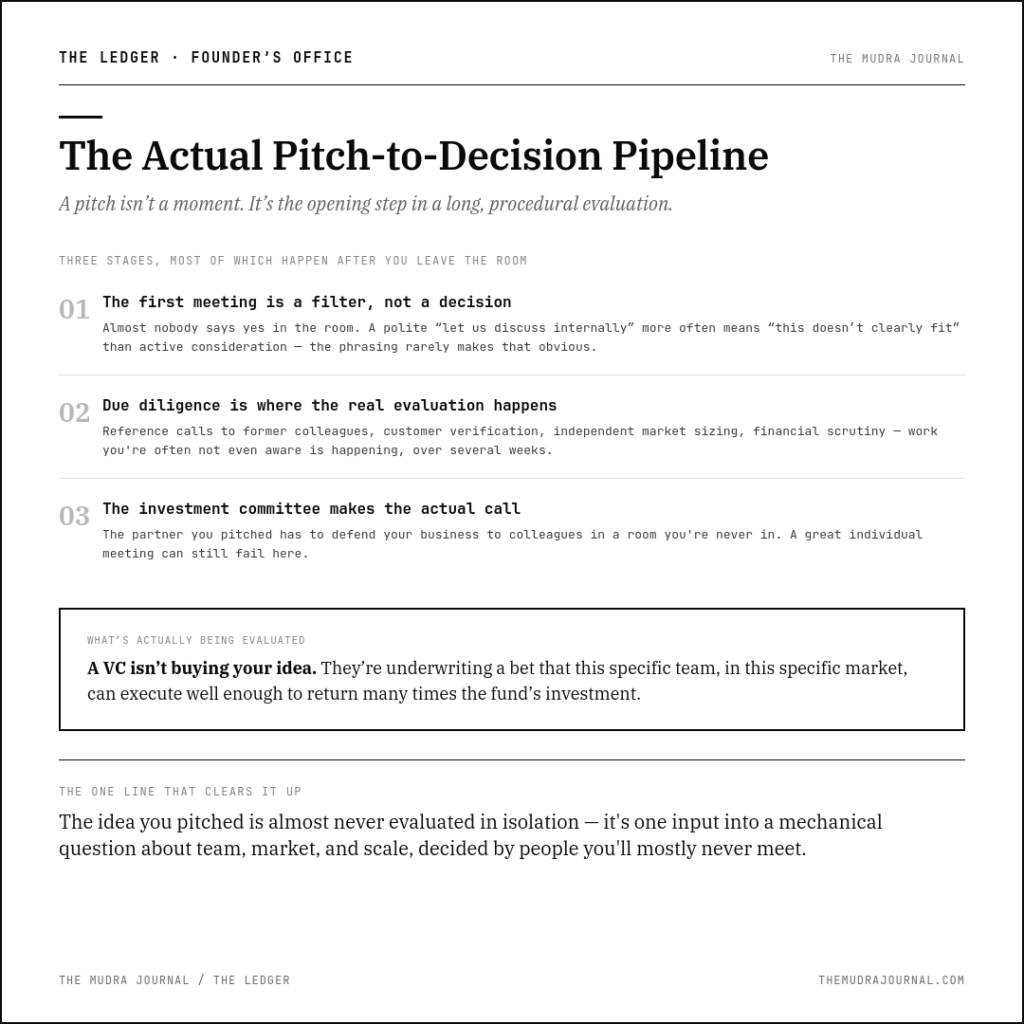
01 — THE FIRST MEETING IS A FILTER, NOT A DECISION
Almost nobody says yes in the room
A first pitch meeting, whether with an associate, principal, or partner, is primarily a screening step — assessing whether the opportunity is even worth the fund’s limited time to investigate further, not a final judgment on the business. Most first meetings end in a polite “let us discuss internally,” which more often means “this doesn’t clearly fit what we’re looking for” than it means active consideration, though the phrasing rarely makes that distinction obvious to a first-time founder.
02 — DUE DILIGENCE IS WHERE THE REAL EVALUATION HAPPENS
Reference calls, data verification, and market research you won’t see
If a fund is genuinely interested, the next phase involves real investigative work — calling your former colleagues and managers, speaking to early customers to verify the traction you’ve claimed, independently sizing the market rather than trusting the number in your deck, and scrutinising your financials and any existing metrics closely. This phase can take weeks, involves people you’re not always aware are being contacted, and is where a large share of promising-looking pitches quietly fall apart.
03 — THE INVESTMENT COMMITTEE MAKES THE ACTUAL CALL
A meeting you’re never in the room for
At most funds, the final decision to invest doesn’t rest with the single partner you pitched — it goes to an investment committee, where that partner has to make the case for your business to their colleagues, often defending assumptions and answering tough questions on your behalf. A founder can have a genuinely great individual meeting and still get turned down at this stage, simply because the partner couldn’t convince the rest of the committee, a dynamic that’s almost entirely invisible from outside the fund.
Why “they’ll steal my idea” is mostly a myth
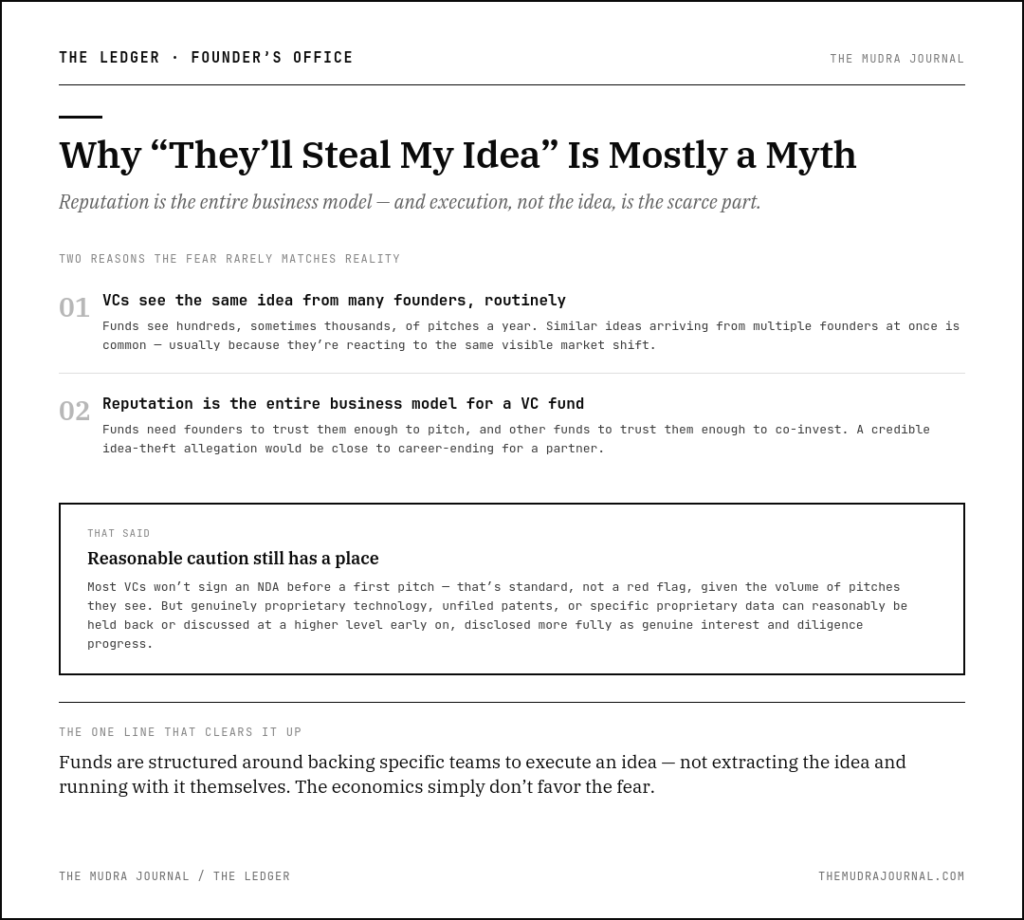
01 — VCS SEE THE SAME IDEA FROM MANY FOUNDERS, ROUTINELY
Your idea is rarely as unique as it feels
Active VC funds see hundreds, sometimes thousands, of pitches a year, and it’s extremely common for similar ideas to arrive from multiple founders around the same time, often because they’re responding to the same visible market shift. Execution — not the idea itself — is almost always the scarce, valuable part, which is precisely why funds are structured around backing specific teams to execute an idea, not extracting the idea and running with it themselves.
02 — REPUTATION IS THE ENTIRE BUSINESS MODEL FOR A VC FUND
Stealing a founder’s idea is close to career-ending
Venture capital runs entirely on reputation and deal flow — funds need founders to trust them enough to pitch, and other funds to trust them enough to co-invest. A credible allegation of idea theft would be devastating to a fund’s ability to raise its next fund or see future deal flow, making it an enormously high-risk, low-reward move that’s genuinely rare in practice, however often it gets discussed in founder circles.
03 — THAT SAID, REASONABLE CAUTION STILL HAS A PLACE
Protect what’s genuinely protectable, and expect open conversation about the rest
Most VCs won’t sign an NDA before a first pitch, and that’s standard practice, not a red flag — the volume of pitches they see makes individual NDAs impractical. But this doesn’t mean sharing everything indiscriminately: genuinely proprietary technology, unfiled patents, or specific proprietary data can reasonably be held back or discussed at a higher level in early conversations, disclosed more fully only as a fund’s genuine interest and diligence process progresses.
What VCs are actually evaluating
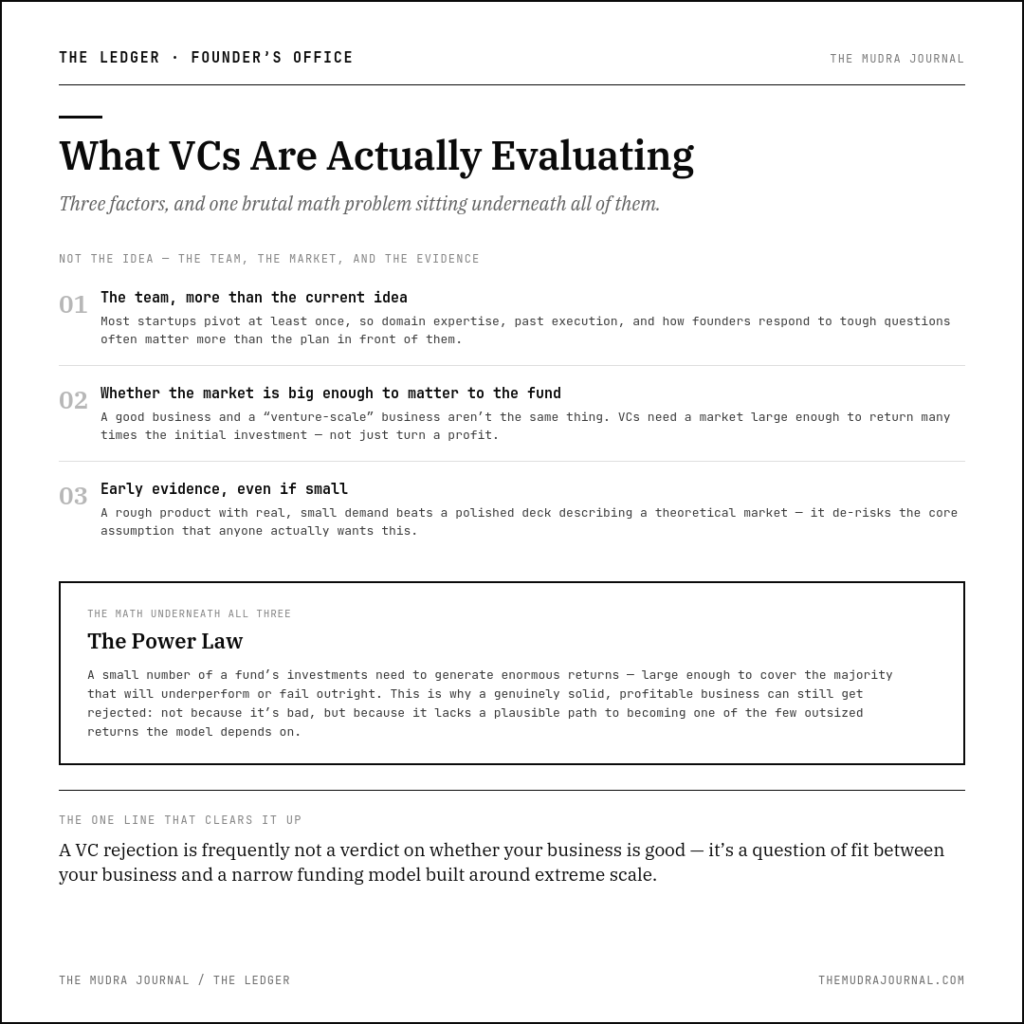
01 — THE TEAM, MORE THAN THE CURRENT IDEA
Can these people execute and adapt when the plan inevitably changes
Because most startups pivot at least once from their original idea, VCs are often evaluating founder capability and resilience as much as the specific business plan in front of them — domain expertise, evidence of past execution, and how the team responds to tough questions all factor in heavily, sometimes more than the idea’s current details.
02 — WHETHER THE MARKET IS BIG ENOUGH TO MATTER TO THE FUND
A good business and a “venture-scale” business aren’t the same thing
VCs need a small number of their investments to become very large in order to make the fund’s overall economics work, which means they’re specifically evaluating whether a market is large enough to support a business that could return many times the initial investment — not simply whether the business could become profitable and sustainable, which is a lower, different bar.
03 — EARLY EVIDENCE, EVEN IF SMALL
Some signal beats a purely theoretical pitch
Early user traction, a working prototype, initial revenue, or even strong qualitative signals from potential customers meaningfully change how a pitch is received, because they de-risk the core assumption that anyone actually wants what you’re building. A polished deck describing a theoretical market is a weaker pitch than a rough product with real, if small, evidence of demand.
The power law, and why good businesses still get rejected
Venture capital’s entire model is built around a pattern known as the power law: a small number of investments in a fund’s portfolio need to generate enormous returns, large enough to cover the losses from the majority of investments that will underperform or fail outright. This is precisely why a genuinely solid, profitable, sustainable business can still get turned down by a VC — not because it’s a bad business, but because it doesn’t have a plausible path to becoming large enough to be one of those few outsized returns a fund’s model depends on.
This is worth understanding clearly, because it reframes a VC rejection: it’s frequently not a verdict on whether your business is good, but on whether it fits a specific, narrow funding model built around extreme scale. Plenty of strong businesses are simply better suited to bootstrapping, revenue-based financing, angel investment, or the kind of disciplined, validation-focused capital allocation we’ve written about before — approaches built around sustainable growth rather than venture-scale outcomes.
What happens if the answer is yes
A term sheet — the document outlining the proposed investment terms — typically covers the valuation at which the fund is investing, how much ownership (equity) that represents, and various rights attached to the investment, such as board seats, information rights, and protections in future funding rounds. Accepting funding also means accepting dilution — your own ownership percentage decreases as new investors come in — and it’s worth understanding these mechanics honestly, ideally with a lawyer or experienced advisor reviewing terms, before signing anything. This piece won’t walk through every clause a term sheet can contain, but knowing that this stage involves real, consequential negotiation — not just a cheque arriving — is the essential first step.
The Indian VC landscape, briefly
India’s venture ecosystem includes a wide range of funds operating at different stages and sector focuses — from large, multi-stage funds like Peak XV Partners (formerly Sequoia India), Accel, Elevation Capital, and Nexus Venture Partners, to funds with a strong early-stage focus like Blume Ventures, Matrix Partners India, and Chiratae Ventures. Beyond institutional VC funds, angel networks like the Indian Angel Network and platforms like LetsVenture connect founders to individual angel investors, and government-backed initiatives like the Startup India Seed Fund Scheme offer another early-stage funding route. Each of these plays a different role depending on your stage and sector, and researching which specific funds actually invest in your space is far more useful than treating “VC funding” as a single undifferentiated pursuit.
Preparing to pitch, realistically
- Research a fund’s specific thesis and portfolio before pitching — a fund focused on enterprise SaaS is very unlikely to be the right audience for a consumer app idea, however strong the idea itself might be.
- Know your market sizing cold, and be ready to defend it under direct questioning — this is one of the most commonly probed areas in due diligence.
- Bring whatever early evidence you have, even if modest — a small number of genuinely engaged early users is more persuasive than an ambitious projection with nothing behind it yet.
- Expect multiple rounds of conversation, not a single decisive meeting, and treat early “let’s discuss internally” responses as information, not necessarily rejection or acceptance.
- Understand basic term sheet mechanics — valuation, dilution, board rights — before you’re in a negotiation, so you’re evaluating an offer rather than learning the vocabulary in real time.
Venture capital was never designed to fund every good business — it’s designed to find the rare few that can become enormous, and it evaluates every pitch against that specific, narrow lens. Understanding that doesn’t make rejection sting less, but it does make the process legible: less a verdict on your idea’s worth, and more a question of fit between your business and a very particular kind of capital.
FROM THE MUDRA JOURNAL — Rooted in India, inspired by the world.