Every placement season, a handful of students at India’s top campuses disappear into a world everyone talks about and almost nobody outside it can actually describe. The package gets discussed in detail. The actual job almost never does.
13 MIN READ
THE LEDGER — BOARDROOM
WRITTEN FOR: THE CAMPUS PLACEMENT BROCHURE → THE FIRST PITCH BOOK
Ask someone what an investment banker does, and you’ll usually get one of two answers. Either a vague gesture at “stocks and trading” borrowed from a film that was actually about a trading floor, or an even vaguer “manages a lot of money” that sounds more like a description of a mutual fund manager or a wealth advisor. Neither is accurate. Investment bankers, in the sense the term is actually used in finance, don’t trade stocks for a living and don’t manage anyone’s personal wealth. They help large companies and governments raise money and make major financial decisions — and the actual day-to-day work behind that sentence looks almost nothing like what the compensation numbers and campus prestige suggest from the outside.
This piece is for anyone who’s heard the phrase “investment banking” thrown around — in a placement brochure, a LinkedIn post, a relative’s proud mention of where a cousin works — and wants to understand what the job actually involves, hour by hour, deal by deal, not just what it pays.
Investment banking isn’t stock-picking, it isn’t trading, and it isn’t personal wealth management. It’s helping companies raise capital and execute major transactions — built mostly out of financial modelling, presentation decks, and an enormous number of hours under deadline pressure. Everything else about the role — the hierarchy, the hours, the exit opportunities — follows from that core description.
What the job title actually covers
01 — CAPITAL RAISING: HELPING COMPANIES GET MONEY FROM THE MARKET
IPOs, bond issuances, and everything in between
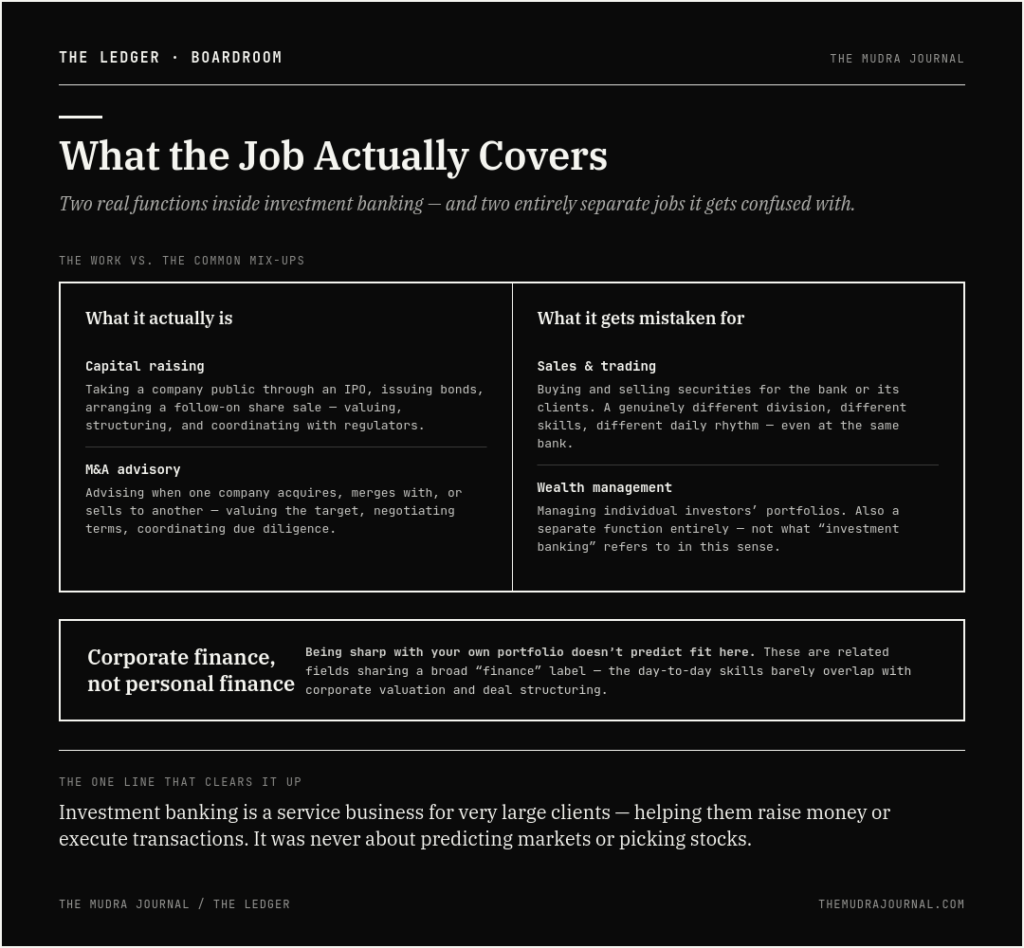
A significant part of investment banking work involves helping companies raise capital — taking a company public through an IPO, issuing bonds, or arranging a follow-on share sale. This means valuing the company, structuring the offering, coordinating with regulators, and managing the process of selling shares or bonds to institutional investors. It’s detailed, deadline-heavy work that determines how a transaction gets priced and executed, not a trading activity.
02 — M&A ADVISORY: HELPING COMPANIES BUY, SELL, OR MERGE WITH EACH OTHER
The deals that make the business news headlines
When one company acquires another, merges with a competitor, or sells off a division, investment bankers are typically advising one or both sides — valuing the target company, structuring the deal, negotiating terms, and coordinating the enormous amount of due diligence required before a transaction closes. This is often the highest-profile, highest-stakes work in the industry, and the one most associated with “investment banking” in popular imagination.
03 — WHAT IT ISN’T: TRADING, PORTFOLIO MANAGEMENT, OR PERSONAL FINANCE
A different division, a different job entirely
Buying and selling securities on behalf of the bank or its clients is the work of a separate division — sales and trading — which is a genuinely different career path with different skills and a different daily rhythm, even within the same bank. Managing individual investors’ portfolios is wealth management, also a separate function. Investment banking, in the specific sense this piece uses, is advisory and capital-raising work for corporate and institutional clients — not trading, and not anyone’s personal financial planning.
The actual work behind the prestige
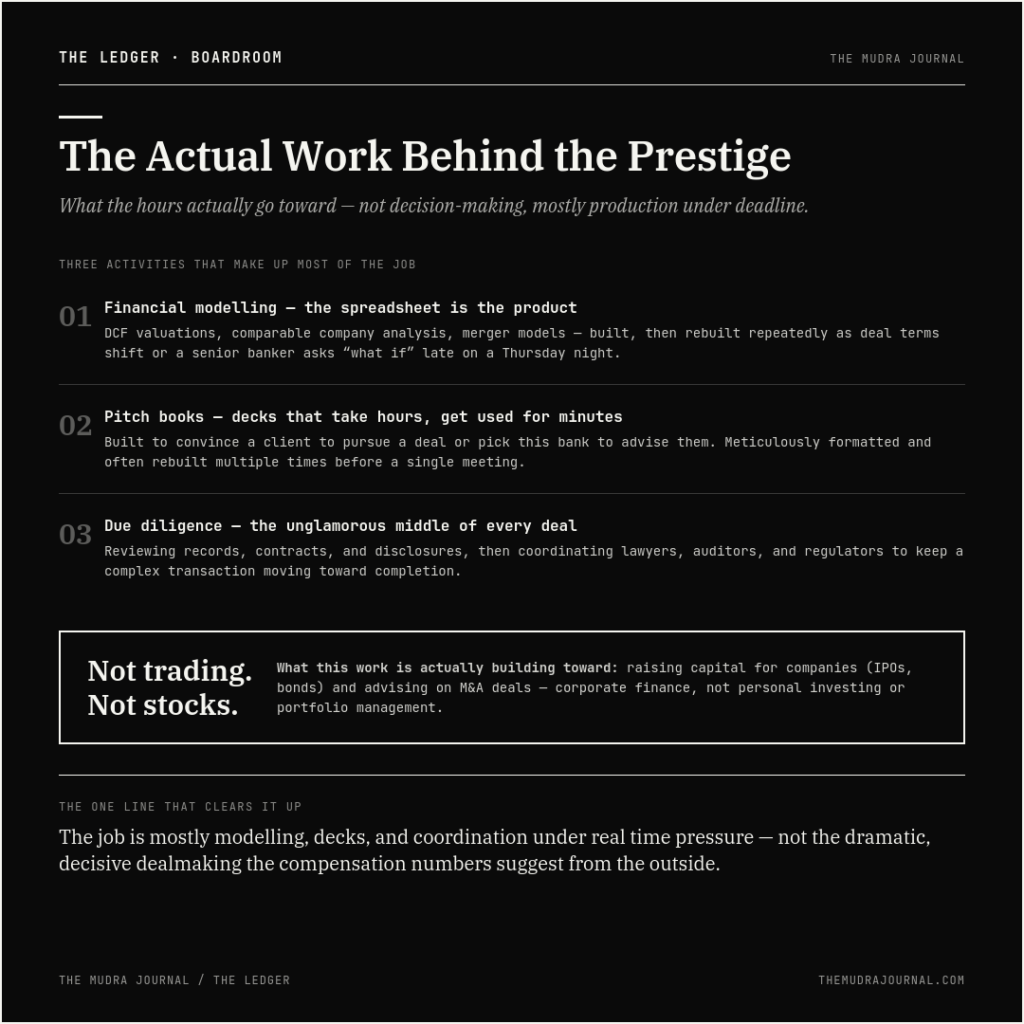
01 — FINANCIAL MODELLING: THE SPREADSHEET IS THE PRODUCT
Valuation models, built and rebuilt under pressure
A large share of an analyst’s or associate’s time goes into building and refining financial models — discounted cash flow valuations, comparable company analysis, merger models that project what a combined company’s financials would look like. These aren’t one-time exercises; they get updated repeatedly as deal terms shift, new information arrives, or a senior banker asks “what if” late on a Thursday night, and accuracy under time pressure is a core, unglamorous skill of the job.
02 — PITCH BOOKS AND PRESENTATIONS: SELLING THE IDEA, NOT JUST THE NUMBERS
Decks that take hours and get used for minutes
Much of the visible output of investment banking work is the pitch book — a detailed presentation built to convince a client to pursue a transaction, choose this bank to advise them, or approve specific deal terms. These decks demand meticulous formatting, precise numbers, and a clear narrative, often rebuilt multiple times before a single client meeting, because the deck is frequently the only tangible thing a client sees representing weeks of underlying analysis.
03 — DUE DILIGENCE AND DEAL COORDINATION: THE UNGLAMOROUS MIDDLE OF EVERY TRANSACTION
Coordinating lawyers, accountants, and mountains of documents
Once a deal is underway, a huge amount of work goes into due diligence — reviewing financial records, contracts, and disclosures to confirm a company is what it claims to be — and coordinating between lawyers, auditors, regulators, and the client’s own team to keep a complex transaction moving toward completion. This is where a large amount of an analyst’s actual working hours go: not glamorous decision-making, but detailed, high-stakes coordination and document review.
The hierarchy — who actually does what

Investment banks are structured in a fairly consistent pyramid across the industry, and understanding it explains a lot about why the job changes so dramatically as you move up.
Analysts (typically the entry-level role for campus hires) do the bulk of the modelling, formatting, and grunt work — building models, preparing decks, and supporting live deals, often working the longest and least predictable hours of anyone on the team, with the least client-facing exposure.
Associates (often MBA hires or promoted analysts) take on more responsibility for managing the analyst’s work, begin having some direct client interaction, and start shaping deal strategy rather than only executing it.
Vice Presidents manage the day-to-day execution of deals, interact regularly with clients, and begin to be evaluated partly on relationship management, not just technical output.
Directors and Managing Directors focus heavily on originating new business — building relationships with corporate clients, pitching for new mandates, and bringing in the deals that the rest of the team executes. At this level, the job looks far more like sales and relationship-building than the spreadsheet-heavy work of the analyst years.
Compensation rises sharply at each level, and so does the shift away from technical execution toward client relationships and deal origination — a trajectory worth understanding honestly if you’re choosing this path expecting the work itself to look the same throughout a career.
Why this isn’t the same as “being good with money”
01 — IT’S CORPORATE FINANCE, NOT PERSONAL FINANCE
Being sharp with your own investments doesn’t predict fit here
Someone who manages their own portfolio well, follows the markets closely, or gives good informal investment advice to friends and family isn’t necessarily suited to — or interested in — the specific work of corporate valuation, deal structuring, and model-building that investment banking actually involves. These are related fields sharing a broad “finance” label, but the day-to-day skills barely overlap.
02 — IT’S NOT ABOUT PREDICTING THE MARKET
Success here depends on execution, not forecasting
Unlike trading or active fund management, where a big part of the job is forming a view on where markets are headed, investment banking advisory work is largely indifferent to market direction — a merger gets modelled and executed regardless of whether the broader market is up or down that week. The skill being tested is precision, structure, and the ability to manage a complex process, not market timing or prediction.
03 — IT’S CLIENT SERVICE, JUST FOR VERY LARGE CLIENTS
The core job is still serving someone else’s needs, at scale
Fundamentally, an investment banker is a service provider — advising a company on the best way to raise money or execute a transaction, the same basic relationship a smaller advisor might have with a smaller business, just at a scale involving crores or thousands of crores, and correspondingly higher stakes and complexity.
Is this actually the right career — an honest look
The hours during active deals are genuinely demanding, commonly running well beyond a standard workday for extended stretches, and this reality is worth weighing seriously rather than dismissing as an exaggeration. In exchange, entry-level compensation in investment banking tends to be significantly higher than most other campus-hire roles, and the exit opportunities are broad — many analysts move into private equity, corporate strategy roles, or entrepreneurial ventures after a few demanding years, often citing the intensity of the experience as genuinely valuable training in execution under pressure.
This tends to suit people who are highly detail-oriented, comfortable with ambiguity and shifting priorities, resilient under sustained pressure, and genuinely motivated by the pace and stakes of the work. It tends to suit people less well if they’re looking for predictable hours, a slower-paced learning curve, or work that’s primarily about long-term market analysis rather than transaction execution.
Neither profile is better. But choosing this path based only on the headline compensation, without an honest look at what the daily work and hours actually involve, is one of the more common regrets among people who enter it for the wrong reasons.
Making an informed decision if you’re considering this path
- Research the difference between bank divisions before applying — investment banking, sales and trading, and wealth management are genuinely different jobs inside the same institution, and it’s worth applying to the one you actually want.
- Look specifically at Indian investment banking arms and independent advisory firms (SBI Capital Markets, ICICI Securities, Axis Capital, Kotak Investment Banking, JM Financial, Avendus) alongside global banks with an India presence (Goldman Sachs, Morgan Stanley, JPMorgan), since analyst program structures and deal exposure can differ meaningfully between them.
- Talk to people currently one or two years into the role, not just senior bankers or recruiters, since the day-to-day analyst experience is what you’ll actually be signing up for first.
- If you’re coming from a non-finance background, build a genuine grounding in valuation, accounting, and financial modelling before interviews — these are consistently tested in technical rounds, regardless of your degree.
- Be honest with yourself about the hours trade-off specifically, since it’s the single factor most likely to determine whether the first two years feel worthwhile or unsustainable.
Investment banking was never really about being “good with money” in the way that phrase usually gets used. It’s a specific, demanding craft — building models, building decks, and coordinating complex transactions for very large clients, under very real time pressure. The prestige is real. So is the workload behind it, and understanding both honestly is the actual job of deciding whether this path is right for you.
FROM THE MUDRA JOURNAL — Rooted in India, inspired by the world.