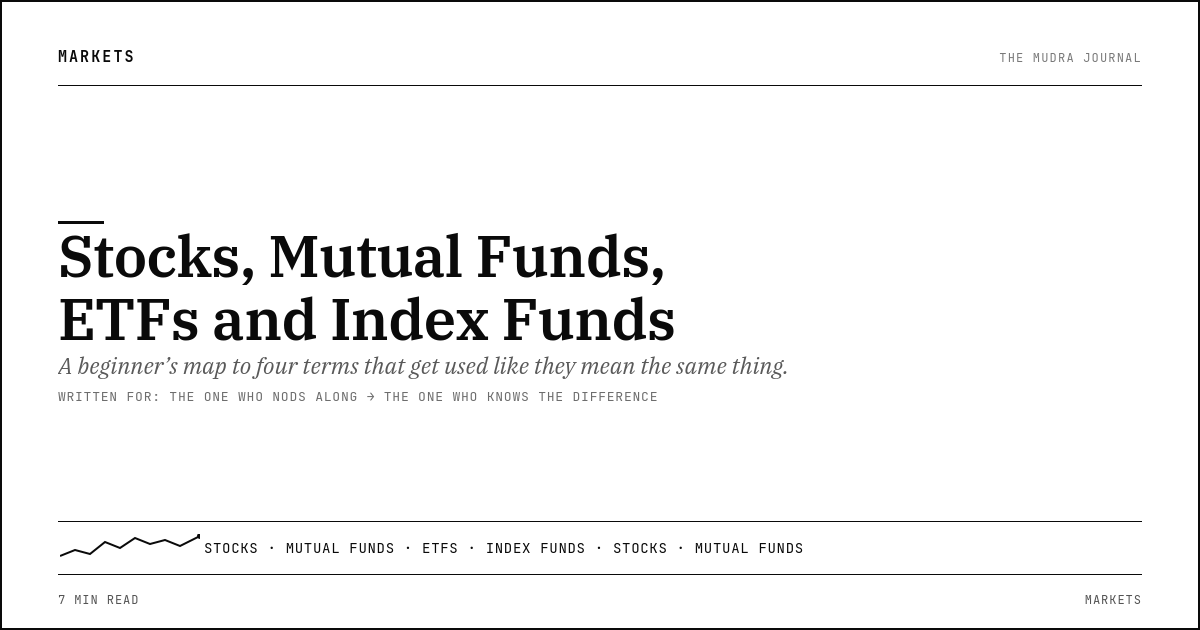
Open a demat account in India today and you’ll be offered four things that all sound like “the stock market” — stocks, mutual funds, ETFs, and index funds — with almost no explanation of how they relate to each other. They’re not four competing options. They’re four different layers of the same system, and once you see the layers, the choice gets a lot simpler.
13 MIN READ
MARKETS / बाज़ार
WRITTEN FOR: THE FIRST DEMAT ACCOUNT → THE FIRST DIVERSIFIED PORTFOLIO
Most first-time investors in India encounter these four terms in roughly the same week — a broker’s app suggesting stocks to buy, a bank pushing a mutual fund SIP, a finance influencer explaining ETFs, and an index fund quietly recommended by almost every serious long-term investor they read about. Nobody sits them down and explains that these aren’t four rungs of the same ladder, ranked by sophistication. They’re four different structures, and understanding the actual relationship between them — not just a definition of each in isolation — is what turns four confusing words into a genuinely useful mental map.
Here’s that map, built properly, layer by layer.
A stock is a single building block. A mutual fund and an ETF are both baskets built from many such blocks. An index fund isn’t a separate structure at all — it’s a philosophy about how the basket should be built, one that can apply to either a mutual fund or an ETF. Once that hierarchy is clear, most of the usual confusion about these four terms disappears on its own.
The map, in one paragraph
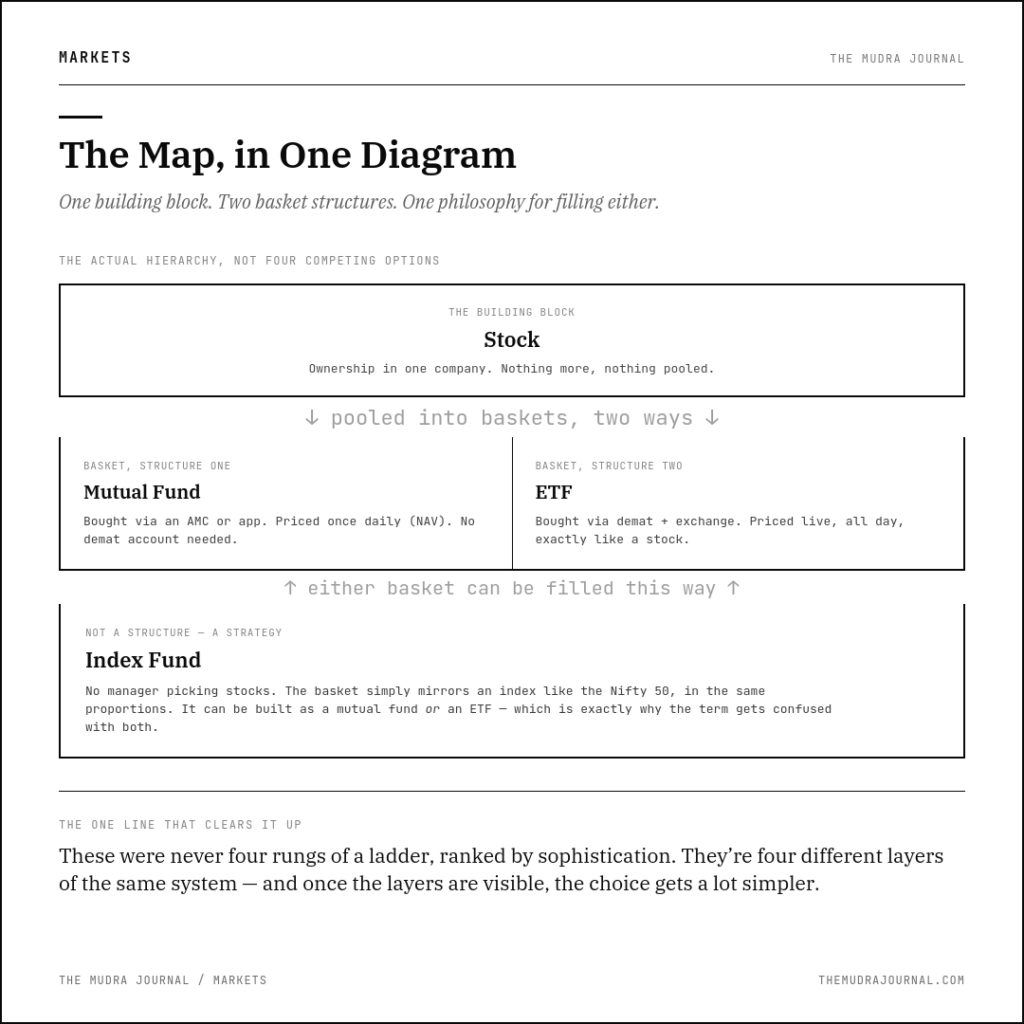
Picture stocks as individual ingredients — one stock is ownership in one company, nothing more. A mutual fund is a professionally managed basket that pools money from many investors and buys a mix of these ingredients, chosen by a fund manager who decides what goes in and what comes out. An ETF is also a basket of ingredients, similarly diversified, but structured so it can be bought and sold on the stock exchange throughout the day, just like a single stock. An index fund isn’t a fourth type of basket — it’s a specific approach to filling either a mutual fund or an ETF: instead of a manager actively choosing ingredients, the basket simply mirrors a market index like the Nifty 50, holding the same companies in the same proportions. That’s the whole map. Everything else is detail.
What each one actually is
01 — STOCKS: DIRECT OWNERSHIP, ONE COMPANY AT A TIME
You own a small piece of a specific business
Buying a stock means buying a small ownership stake in one specific company — Reliance, Infosys, Tata Motors, whichever it may be. Your returns depend entirely on that one company’s performance, which means stock investing carries concentrated risk: if that company does well, your investment does well; if it struggles, so does your money, with no built-in diversification cushioning the impact.
02 — MUTUAL FUNDS: A MANAGED BASKET OF MANY STOCKS (OR BONDS)
A professional decides what goes in the basket
A mutual fund pools money from thousands of investors and invests it across a basket of stocks, bonds, or other instruments, managed by a professional fund manager who actively decides what to buy, hold, and sell, aiming to beat a benchmark index. You’re not picking individual companies — you’re trusting a manager’s judgment and paying a fee (the expense ratio) for that active decision-making, which in India commonly ranges from around 1% to 2% annually for actively managed equity funds.
03 — ETFS: A BASKET YOU CAN TRADE LIKE A STOCK
Similar diversification, different trading mechanism
An Exchange-Traded Fund is also a basket of stocks or other assets, but structurally different from a mutual fund in one key way: it trades on the stock exchange throughout the day, at a live price, exactly like a share — you need a demat account to buy one, the same account you’d use for individual stocks. Most ETFs in India passively track an index rather than being actively managed, which typically makes their expense ratios significantly lower than actively managed mutual funds, often well under 0.5% annually.
04 — INDEX FUNDS: A PHILOSOPHY, NOT A STRUCTURE OF ITS OWN
Passively mirroring the market instead of trying to beat it
An index fund simply buys and holds the same companies, in the same proportions, as a specific market index — no active stock-picking, no manager trying to outguess the market, just a mechanical replication of the index’s composition. Crucially, an index fund can be structured either as a mutual fund (bought through an AMC or investment app, priced once a day) or as an ETF (bought on the exchange, priced live throughout the day) — which is exactly why “index fund” and “ETF” get confused so often, even though one describes a strategy and the other describes a trading structure.
Where the confusion actually comes from
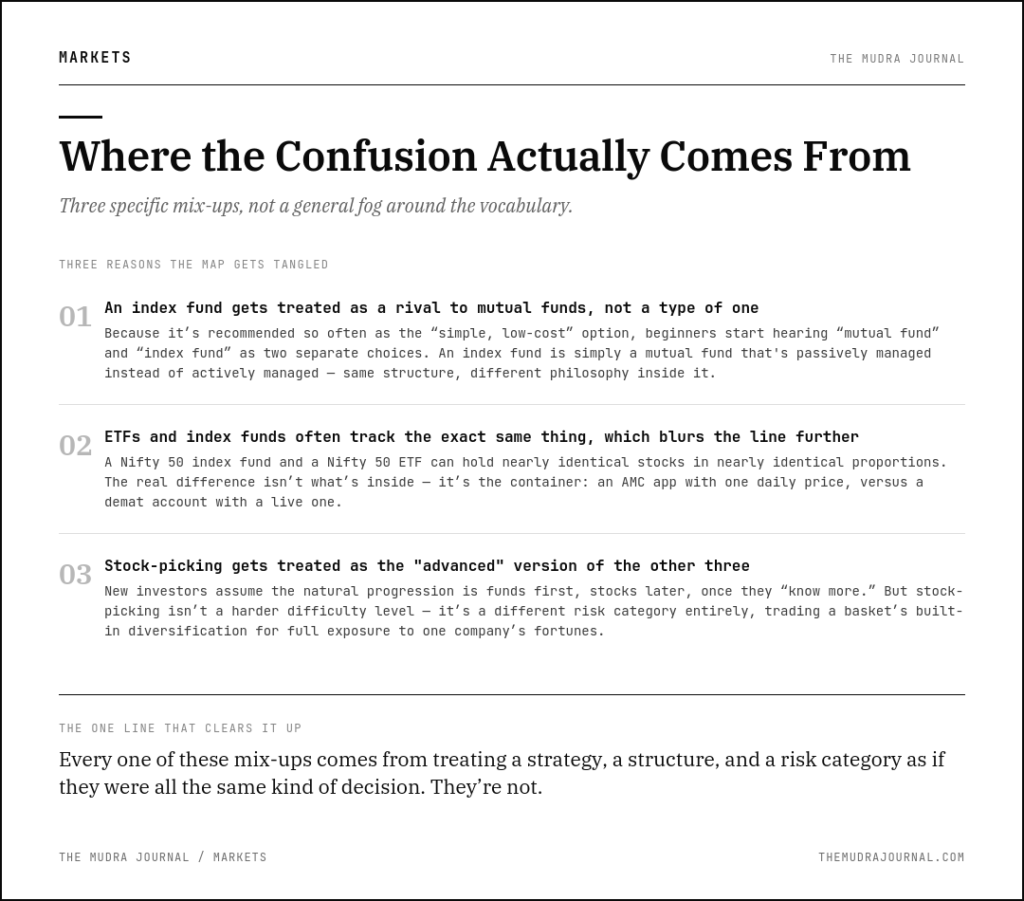
01 — PEOPLE DON’T REALISE AN INDEX FUND IS A TYPE OF MUTUAL FUND
It’s a subcategory, not a competing product
Because index funds get recommended so often as the “simple, low-cost” option, many beginners start thinking of “mutual funds” and “index funds” as two separate, competing choices. In reality, an index fund is simply a mutual fund that happens to be passively managed rather than actively managed — the same regulatory structure, the same way of buying it, just a different investment philosophy inside.
02 — ETFS AND INDEX FUNDS OFTEN TRACK THE SAME THING, WHICH BLURS THE LINE FURTHER
Same index inside, different container outside
A Nifty 50 index fund and a Nifty 50 ETF can hold nearly identical underlying stocks in nearly identical proportions — the meaningful difference isn’t what’s inside, but how you buy it: an index fund through an AMC or investing app with a fixed daily price, an ETF through a demat account and stock exchange with a live, fluctuating price throughout the trading day. Many beginners assume these are fundamentally different investments, when they’re often the same strategy wrapped in two different trading mechanisms.
03 — STOCK-PICKING GETS TREATED AS THE “ADVANCED” VERSION OF THE OTHER THREE
It’s a different risk category, not a higher difficulty level
New investors sometimes assume the natural progression is mutual funds first, then ETFs, then eventually “graduating” to picking individual stocks once they know more. But stock-picking isn’t a more advanced version of fund investing — it’s a fundamentally different risk profile, trading the built-in diversification of a basket for full exposure to a single company’s fortunes. Skilled or not, a stock-picker is taking on concentration risk that a fund investor, by design, isn’t.
How they actually differ for a retail investor in India
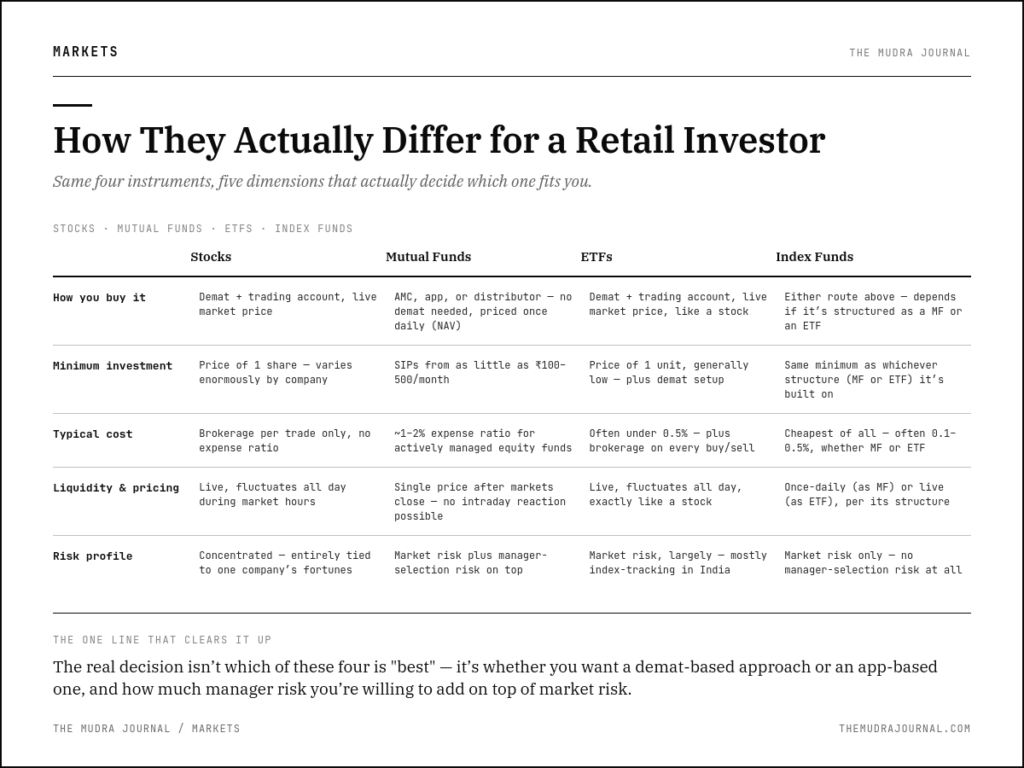
How you buy it: Stocks and ETFs both require a demat and trading account, and are bought at live market prices during exchange hours. Mutual funds (including mutual-fund-structured index funds) can be bought directly through an AMC’s website, a mobile investing app, or a distributor, priced once a day after markets close (the NAV), with no demat account required.
Minimum investment: Stocks require enough money to buy at least one share, which varies enormously by company. Mutual funds typically allow SIPs starting from as little as ₹100–500 a month. ETFs require enough to buy at least one unit, generally a low amount, but do require the additional step of having a demat and brokerage account set up.
Cost: Actively managed mutual funds generally carry the highest expense ratios (roughly 1–2% for equity funds). Index mutual funds are meaningfully cheaper (often 0.1–0.5%). ETFs are usually the cheapest of all on the expense ratio, though brokerage and demat charges apply on every buy and sell, which can add up for investors who trade frequently in small amounts.
Liquidity and trading behaviour: Stocks and ETFs can be bought and sold throughout the trading day at fluctuating prices. Mutual funds are bought and redeemed at a single price calculated after markets close, which removes the temptation (and the ability) to react to intraday price swings — a genuine advantage for investors prone to emotional, reactive trading.
Diversification and risk: A single stock carries concentrated, company-specific risk. Mutual funds and ETFs, by holding many stocks, spread that risk across an entire basket — actively managed funds add manager-selection risk on top of market risk, while index funds and index ETFs largely just carry market risk, since they’re mechanically replicating an index rather than making individual calls.
Taxation, broadly: Equity-oriented mutual funds, index funds, and ETFs are generally taxed similarly under Indian capital gains rules when the underlying holding is predominantly equity, though the specific treatment can depend on the fund’s structure and holding period — this is a good area to verify with a tax professional or the fund’s own documentation rather than assuming uniformity across all products.
Which one actually fits which kind of investor
Someone who enjoys researching individual companies, has the time to track them, and is comfortable with concentrated risk might reasonably include direct stocks as part of a portfolio — but rarely as the entire portfolio.
Someone who wants a completely hands-off, automated approach, is comfortable investing through an app without needing a demat account, and prefers a single daily price rather than watching live market movements, is usually well suited to a mutual fund SIP — actively managed if they want to try to beat the market, or an index mutual fund if they’d rather mirror it at a lower cost.
Someone who already has a demat account, wants the lowest possible ongoing cost, and doesn’t mind executing trades during market hours is often well suited to ETFs, particularly index-tracking ones.
Most long-term, low-effort portfolios in India lean heavily on index funds or index ETFs as a core holding, precisely because they combine diversification, low cost, and a strategy that doesn’t depend on correctly predicting which manager or which stock will outperform.
Building your first portfolio using this map
- Decide first whether you want a demat-account-based approach (stocks, ETFs) or an app/AMC-based approach (mutual funds) — this is a logistics decision as much as an investment one.
- If you’re starting out and want simplicity, begin with an index mutual fund via SIP rather than picking individual stocks or navigating ETF mechanics on day one.
- Add individual stocks only with money you’re prepared to see concentrated in a handful of companies — treat this as a satellite to your core holdings, not the foundation.
- If you later move to ETFs for their lower cost, factor in brokerage charges on every transaction, especially if you plan to invest small amounts frequently.
- Whatever you choose, check what index or benchmark it’s measured against, and review your actual returns against that benchmark at least once a year — a habit that matters regardless of which of these four instruments you end up using.
These four terms were never meant to represent four different levels of investing sophistication. They’re four different layers of the same underlying system — one building block, two basket structures, and one philosophy for filling either basket. Once the map is clear, the actual decision of what to invest in gets a great deal simpler than the vocabulary made it sound.
FROM THE MUDRA JOURNAL — MARKETS / बाज़ार – Markets, Made Understandable