
Your salary account, your father’s fixed deposit, and the ₹20,000 crore IPO in the news last week were all handled by institutions called “banks.” Almost nothing else about them is the same.
13 MIN READ
THE LEDGER — BOARDROOM
WRITTEN FOR: THE SAVINGS ACCOUNT HOLDER → THE M&A ANALYST
Say the word “bank” to most Indians, and a very specific image shows up: a branch with a token number system, a passbook, a loan officer, maybe a long queue near the end of the financial year. Say “investment banker” in the same breath, and the image shifts entirely — sharp suits, all-night deal rooms, campus placements with numbers that make the rest of the batch go quiet. Both are technically called banks. Almost nothing else about them overlaps.
This confusion isn’t accidental, and in India it runs deeper than in most places — because the same institution often does both. SBI is a commercial bank you can walk into with a passbook, and it also owns SBI Capital Markets, a full investment bank advising on multi-thousand-crore mergers. ICICI Bank takes your salary deposits; ICICI Securities helps companies go public. The brand name stays identical while the actual business underneath splits into two almost entirely separate worlds, regulated differently, earning money differently, and employing people who do fundamentally different jobs.
Understanding the difference isn’t just useful trivia for finance students. It changes how you read business news, understand where IPOs actually come from, and make sense of why the same bank’s name shows up both on your loan paperwork and in headlines about a corporate takeover.
A commercial bank makes money on the difference between what it pays you for deposits and what it charges someone else for loans. An investment bank makes money by charging a fee for advice, and never touches your salary account at all. Everything else about how these institutions are structured, regulated, and staffed flows from that one distinction.
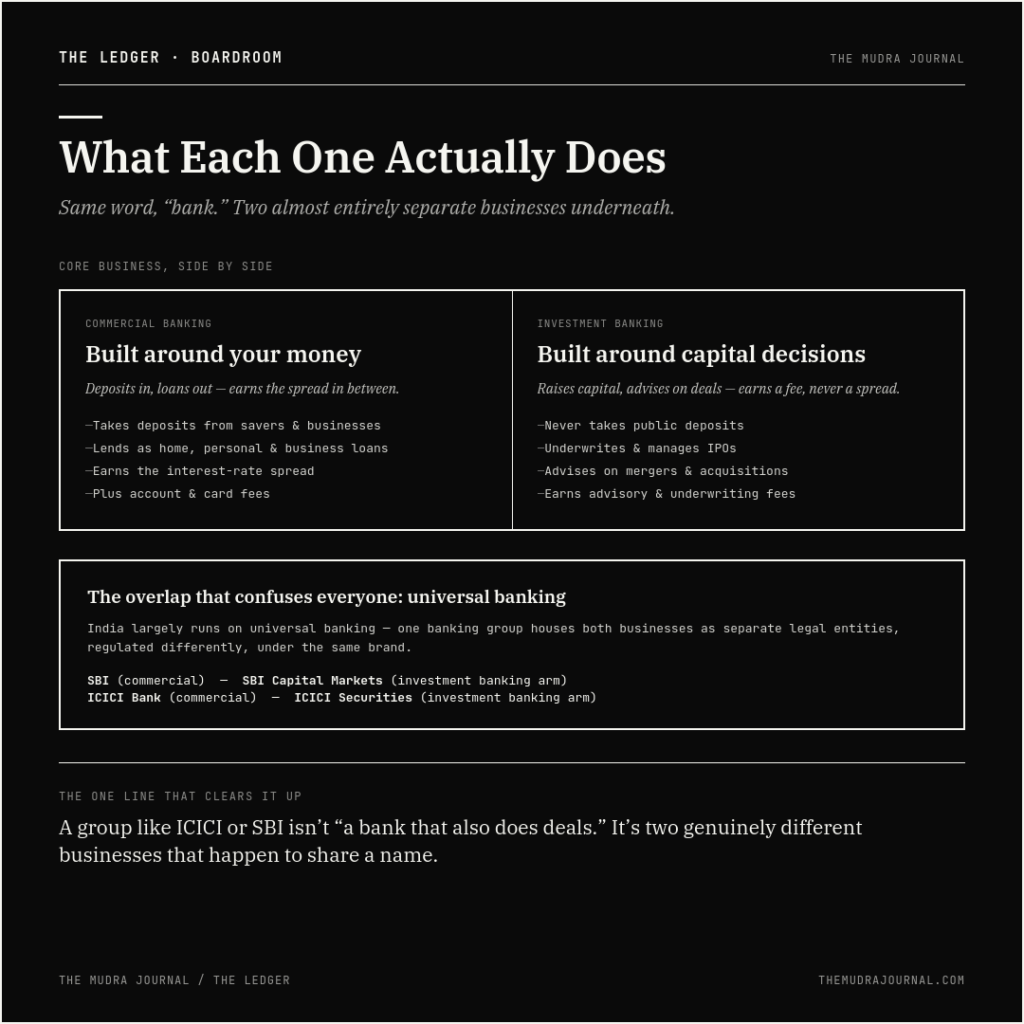
What each one actually does
01 — COMMERCIAL BANKING: THE INSTITUTION BUILT AROUND YOUR MONEY
Deposits in, loans out, and a spread in between
A commercial bank’s core business is taking deposits from ordinary savers and businesses, and lending that money out as home loans, personal loans, business loans, and credit. It earns the difference — the spread — between the low interest it pays depositors and the higher interest it charges borrowers, plus fees for services like account maintenance, card issuance, and payments. This is what most people mean when they say “my bank”: the entity holding their salary account, processing their UPI payments, and occasionally calling about a pre-approved loan.
02 — INVESTMENT BANKING: THE INSTITUTION BUILT AROUND OTHER PEOPLE’S CAPITAL DECISIONS
Raising money and advising on deals, not lending it out
An investment bank doesn’t take deposits from the public or offer savings accounts at all. Its core work is helping large companies and governments raise capital — by underwriting and managing IPOs, arranging bond issuances, and advising on mergers and acquisitions — in exchange for advisory and underwriting fees, which are often substantial given the size of the transactions involved. When a company “goes public,” an investment bank is the institution running that process behind the scenes: pricing the shares, managing the sale to institutional investors, and structuring the entire offering.
03 — THE OVERLAP THAT CONFUSES EVERYONE: UNIVERSAL BANKING
Same brand, two entirely different licenses and businesses
India largely follows a universal banking model, where a single banking group can house both a commercial bank and an investment banking arm, often as separate legal entities operating under the same brand. SBI, ICICI, Axis, and Kotak all do this — a retail branch and an investment banking division exist under the same parent name, regulated differently, staffed differently, and serving completely different clients, but sharing enough branding that the public reasonably assumes it’s all one function.
Why this confusion is specifically pronounced in India
01 — THE SAME LOGO APPEARS IN TWO ENTIRELY DIFFERENT CONTEXTS
Your bank’s name shows up in the deal section of the newspaper too
When a headline reads “ICICI Securities advises on ₹5,000 crore merger,” and your own ICICI Bank account is where your salary lands, it’s entirely reasonable to assume it’s the same operation doing both things. In reality, ICICI Securities and ICICI Bank operate under different regulatory frameworks, different leadership structures, and serve entirely different clients, connected mainly by shared ownership and a shared brand name.
02 — CAMPUS PLACEMENT CULTURE FLATTENS THE DISTINCTION
“I got into banking” can mean two very different jobs
At Indian business schools and top engineering colleges, “I got a banking offer” is used loosely to describe both a retail or corporate banking role at a commercial bank and an analyst position at an investment bank — two jobs with vastly different compensation structures, working hours, and day-to-day responsibilities. The shared vocabulary in campus placement conversations makes the two sound like variations of the same career, when they’re closer to different professions that happen to share a industry label.
03 — MEDIA PORTRAYAL COLLAPSES BOTH INTO ONE IMAGE
Popular culture has one template for “the banker”
Films and shows about finance overwhelmingly depict the investment banking image — high-stakes deals, dramatic trading floors, enormous bonuses — and that image gets loosely applied in public imagination to “bankers” as a category, even though the vast majority of people working at Indian banks are in commercial banking roles: branch management, credit underwriting, retail operations, roles that look nothing like the cinematic version.
How they actually differ, side by side

Revenue model: Commercial banks earn primarily through interest rate spreads and account-related fees, generating steady, relatively predictable income tied to the broader interest rate environment. Investment banks earn through advisory and underwriting fees tied to specific transactions — a slower year for IPOs or M&A activity can mean a genuinely slower year for revenue, in a way that doesn’t affect a commercial bank’s basic deposit-and-lending business nearly as much.
Regulatory oversight: Commercial banks in India are primarily regulated by the Reserve Bank of India (RBI), which governs everything from capital reserve requirements to interest rate policies affecting deposits and loans. Investment banking activities — particularly those involving public share issuances, mergers, and securities markets — fall largely under the Securities and Exchange Board of India (SEBI), which governs disclosure norms, underwriting rules, and market conduct. A single banking group can therefore be answering to two different regulators for its two different arms.
Risk exposure: Commercial banks primarily carry credit risk — the risk that borrowers default on loans — which is why loan underwriting, credit scores, and collateral matter so much to them. Investment banks carry a different kind of risk, tied to underwriting commitments (guaranteeing a company it will raise a certain amount in an IPO, regardless of investor demand on the day), market volatility during a deal process, and reputational risk if an advised transaction goes badly.
Client base: A commercial bank’s customers are overwhelmingly individuals and small-to-medium businesses — anyone with a savings account, a loan, or a business current account. An investment bank’s clients are almost exclusively large corporations, institutional investors, and governments — entities raising large amounts of capital or executing complex financial transactions, not individuals opening a savings account.
Career path and daily life: Commercial banking roles — branch management, relationship management, credit analysis — typically follow more conventional working hours and a steadier, longer-term career progression. Investment banking analyst roles are well known for extremely demanding hours, especially during active deal periods, in exchange for significantly higher starting compensation — a trade-off that’s central to why the two are recruited for, and experienced, so differently.
Real examples from the Indian market
On the commercial banking side, names like SBI, HDFC Bank, ICICI Bank, Axis Bank, and Kotak Mahindra Bank are the institutions most Indians interact with directly — savings accounts, home loans, credit cards, UPI.
On the investment banking side, the market includes both the investment banking arms of these same groups (SBI Capital Markets, ICICI Securities, Axis Capital, Kotak Investment Banking) and independent investment banks and advisory firms (JM Financial, Avendus, Edelweiss), alongside global investment banks with a significant presence in India (Goldman Sachs, Morgan Stanley, JPMorgan), which handle major IPOs, cross-border M&A, and large capital raises for Indian and multinational companies alike.
The key thing to notice: a group like ICICI or Kotak isn’t “a bank that also does deals.” It’s two genuinely different businesses, licensed and regulated differently, that happen to share a name and a parent company.
Why this matters even if you’re not chasing a banking career
Understanding this distinction changes how you read financial news. When you see “XYZ Bank advises on the Tata-Adani merger” (to use an illustrative example), that’s the investment banking arm at work — not the same part of the institution managing anyone’s fixed deposit. When a company you’ve invested in through the stock market goes public, an investment bank priced and managed that IPO, and its fee is one of the reasons IPO pricing and allotment work the way they do. And if you’re ever advising a family business on raising funds or considering a sale, knowing that this is investment banking territory — not something your regular bank branch handles — saves you from asking the wrong institution the wrong question entirely.
Making sense of it, whether you’re a career-seeker or a curious reader
- If you’re evaluating a “banking” job offer, ask specifically whether the role sits within commercial/retail banking or an investment banking division — the compensation, hours, and career trajectory differ enormously even within the same parent company.
- When reading business news about an IPO or merger, remember the “bank” named is very likely a separate investment banking arm, not the retail bank you might personally use.
- If you’re a business owner exploring fundraising or a sale, understand that this conversation belongs with an investment bank or advisory firm, not your regular relationship manager at a retail branch.
- As an investor, recognise that investment banking revenue is cyclical and deal-dependent — a useful thing to know if you’re ever evaluating a banking group’s stock and wondering why its revenue moved differently from what interest rates alone would suggest.
- When comparing career paths, weigh the investment banking trade-off honestly — significantly higher early compensation against significantly more demanding hours — rather than assuming one path is a strictly “better” version of the other.
The word “bank” was never doing enough work to describe either of these institutions properly. One holds your money and lends it back out at a margin. The other helps large entities raise money and make big financial decisions, for a fee, without ever touching an individual’s savings account. They share a name, and in India, often a logo — but they are, in almost every operational sense, two different businesses wearing the same coat.
FROM THE MUDRA JOURNAL — Rooted in India, inspired by the world.