Every news bulletin in India ends with the same two numbers — Sensex up, Nifty down — delivered with total confidence, to an audience that mostly has no idea what either number actually measures.
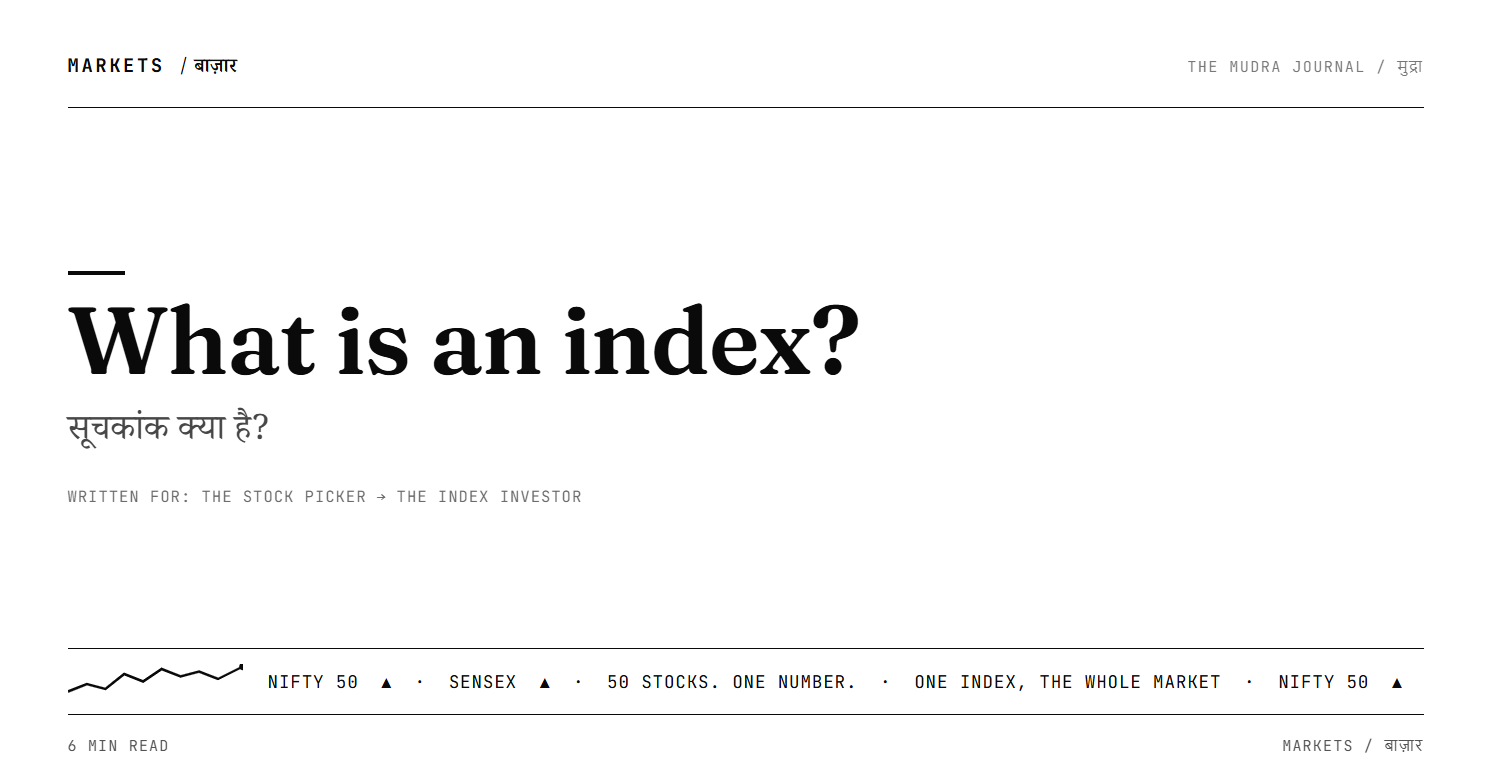
6 MIN READ
MARKETS / बाज़ार
WRITTEN FOR: THE FIRST DEMAT ACCOUNT → THE FIRST INDEX FUND SIP
Sensex and Nifty are probably the two most-heard financial terms in India — on the evening news, in every uncle’s dinner-table market commentary, in every “market crashed today” WhatsApp forward. And yet ask most people what these numbers actually represent, and the honest answer is usually “the stock market went up or down” — which isn’t quite wrong, but isn’t really right either. An index isn’t the stock market. It’s a sample of it, built to represent the whole without literally being the whole.
Understanding this one distinction changes how useful these headlines actually are to you.
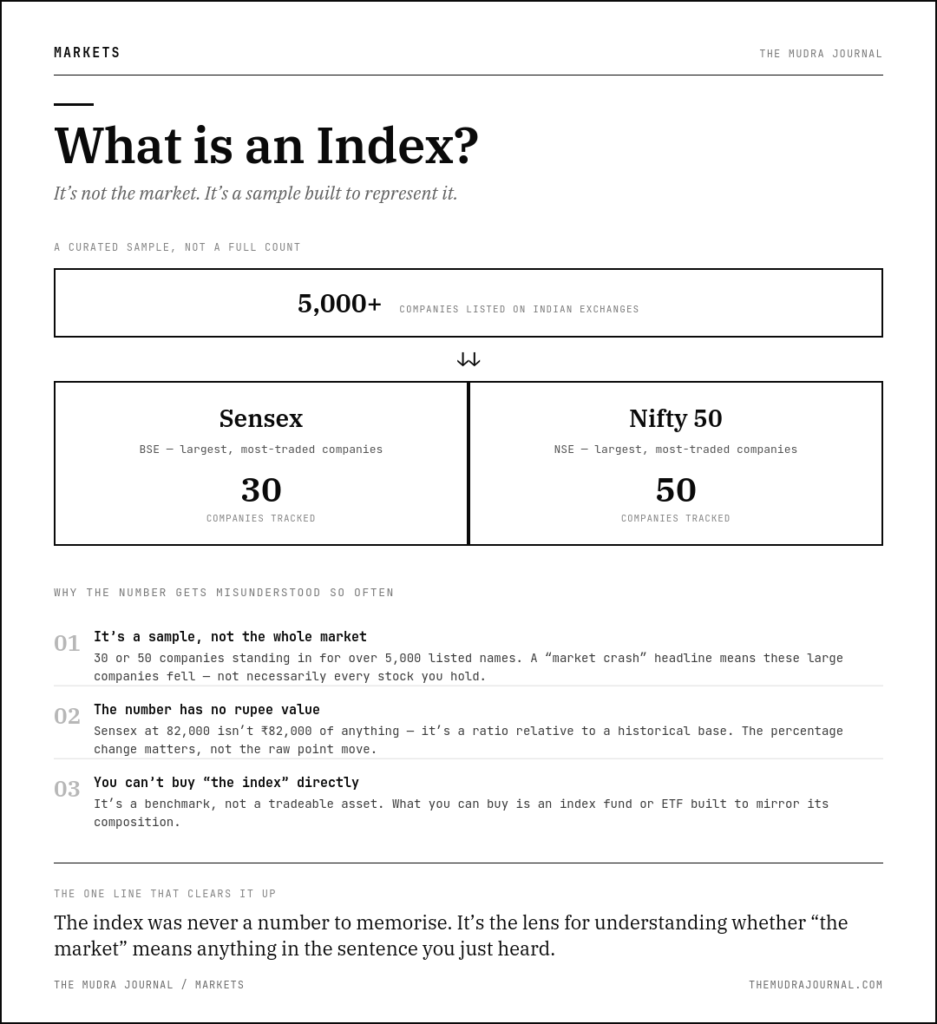
An index is a scorecard built from a representative basket of stocks — not a single investment, not the entire market, and not a number with rupees attached to it. Once that clicks, a lot of confusing market commentary starts making a lot more sense.
Here’s what’s actually inside that number you’ve been hearing your whole life.
What an index actually is
Think of an index as a curated sample, the way a survey doesn’t ask every single citizen a question but still claims to represent the country’s opinion. The Sensex tracks 30 of the largest, most-traded companies listed on the BSE. The Nifty 50 tracks 50 such companies on the NSE. Both are chosen and periodically reshuffled to represent the broader market’s health — when most of these large companies are doing well, the index number rises; when they’re not, it falls.
The number itself — Sensex at, say, 82,000 — isn’t a price, a value in rupees, or anything you can withdraw. It’s a calculated figure that reflects the combined, weighted movement of all the stocks inside the index, relative to a fixed starting point decades ago. It goes up when the basket, on average, goes up. That’s the entire mechanism.
Why the number gets misunderstood so often
01 — IT’S A SAMPLE, NOT THE WHOLE MARKET
30 or 50 companies standing in for thousands
There are over 5,000 companies listed across Indian stock exchanges, but the Sensex and Nifty each track a tiny fraction of them — the largest, most liquid names. A “market crash” headline usually means these large companies fell, which often does reflect the broader mood, but it doesn’t mean every listed company, and certainly not every mutual fund or stock you personally hold, moved by the same amount.
02 — THE NUMBER HAS NO RUPEE VALUE
82,000 doesn’t mean ₹82,000 of anything
Because the index is a calculated ratio relative to a historical base value, it can’t be read like a price tag. A 500-point drop sounds dramatic, but what actually matters is the percentage change, not the raw number — a 500-point fall means something very different when the index is at 20,000 versus when it’s at 80,000. News headlines rarely make this distinction, which is exactly why the same-sized point move gets reported with identical urgency regardless of what it represents proportionally.
03 — YOU CAN’T BUY “THE INDEX” DIRECTLY
It’s a benchmark, not a product
The Sensex and Nifty are indicators, not tradeable assets — you can’t call your broker and buy “one Nifty.” What you can buy is an index fund or an ETF specifically built to mirror the index’s composition, which is a different, purchasable product that tries to replicate the benchmark’s performance as closely as possible, minus a small fee.
Why this distinction is actually useful to you
01 — IT’S THE BENCHMARK YOUR MUTUAL FUND SHOULD BEAT
“Good returns” only means something in comparison
When a fund advertises a 14% annual return, the real question is what the relevant index did over the same period. A fund that returned 14% while the Nifty returned 18% actually under performed the market, even though the number on its own sounds impressive. The index is what makes a return meaningful instead of just a big, standalone claim.
02 — IT’S THE SIMPLEST WAY TO INVEST IN “THE MARKET”
Index funds let you own a slice of the whole basket
Rather than picking individual stocks and hoping to beat professional fund managers, an index fund simply buys all the companies in an index, in the same proportion, for a very low fee. Over long periods, a large number of actively managed funds fail to beat their benchmark index — which is exactly why index investing has become one of the simplest, most repeated pieces of advice for beginners who don’t want to spend years picking stocks.
03 — IT TELLS YOU WHAT’S ACTUALLY MOVING
Sectoral indices show you where the story is
Beyond Sensex and Nifty, there are dozens of narrower indices — Nifty Bank, Nifty IT, Nifty Pharma — each tracking a specific sector. When you hear “IT stocks fell today,” it’s usually this kind of index doing the reporting. Knowing these exist lets you understand market news at the actual level it’s describing, instead of assuming every headline is about the entire economy.
Putting this to use
You don’t need to trade to make this knowledge useful. Most people benefit from it passively.
- Next time you see a Sensex or Nifty headline, check the percentage change, not just the point movement — that’s the number that actually tells you something.
- If you invest in a mutual fund, look up which index it benchmarks against, and compare its returns to that index over 3 and 5-year periods, not just the past year.
- Consider a low-cost index fund or ETF as part of your portfolio if you’d rather not actively pick stocks — it’s a legitimate, widely-used strategy, not a lesser one.
- When you hear about a specific sector “falling” or “rallying,” check whether it’s a broad market move or a sector-specific index move before reacting.
- Remember that the index reflects large, listed companies — your own portfolio, especially if it includes smaller companies or different asset classes, can and will move differently.
The Sensex and Nifty were never meant to be numbers you memorise and repeat. They’re a lens for understanding whether “the market” is a useful phrase to describe what’s actually happening — and now, when you hear it on the evening news, you’ll know exactly what’s being measured.
FROM THE MUDRA JOURNAL — MARKETS / बाज़ार – Markets, Made Understandable