Your bank has a relationship manager whose job is to advise you on money. You’ve probably never spoken to one of them, yet you’ve taken advice from a stranger on Instagram. That’s not carelessness. It’s a rational response to two very different track records Gen Z faces in finance.
7 MIN READ
THE JOURNAL
WRITTEN FOR: THE ONE WHO SKIPS THE RM CALL → THE ONE WHO SCREENSHOTS THE REEL
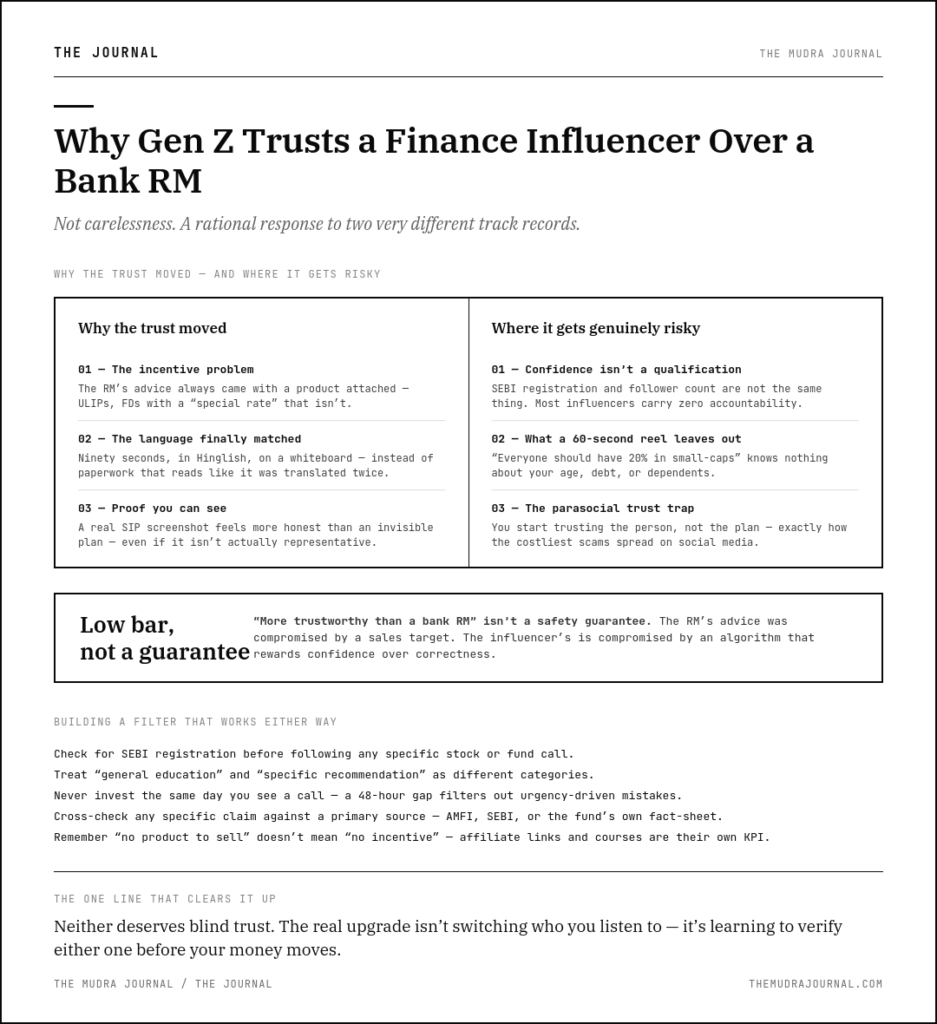
Why the trust moved
01 — THE INCENTIVE PROBLEM
The RM’s advice always came with a product attached
Walk into an Indian bank branch and ask about investing.
The conversation often ends at ULIPs or fixed deposits with a ‘special rate’ that isn’t.
Gen Z grew up watching parents sold expensive, low-return policies for tax saving.
They learned early that the person behind the bank counter wasn’t optimizing for their goals.
02 — THE LANGUAGE FINALLY MATCHED
Someone explained it like you actually think
Bank paperwork still reads like it was translated twice. A finance influencer explaining the same concept — say, why a ULIP underperforms a mutual fund plus term insurance — does it in ninety seconds, in Hinglish, using a whiteboard sketch or a relatable meme instead of a term sheet. It’s not that the information is different. It’s that one version respects your time and intelligence, and the other assumes you’ll nod along and sign.
03 — PROOF YOU CAN SEE
Screenshots feel more honest than a sales pitch
An RM tells you a plan will grow your money. An influencer shows you their actual SIP screenshot, returns, sometimes losses. Whether or not that portfolio is representative or real, it feels transparent. It looks like proof, not a pitch. In a country where financial mis-selling scandals have made the news for two decades, Gen Z prefers a visible track record — real or curated — over an invisible one.
Where this gets genuinely risky
The shift in trust was earned. But “more trustworthy than a bank RM” is a low bar, not a safety guarantee — and this is the part worth sitting with before you act on the next reel.
01 — CONFIDENCE ISN’T A QUALIFICATION
SEBI registration and follower count are not the same thing
Anyone can open an account and start giving stock tips by sunset. SEBI’s finfluencer guidelines exist precisely because unregistered individuals were recommending trades, sometimes with undisclosed positions in the very stock they were hyping. A bank RM, whatever their incentives, is at least a licensed, identifiable person you can complain about. Most finance influencers carry no accountability at all if their “can’t-miss” call costs you money.
02 — WHAT GETS LEFT OUT OF A 60-SECOND REEL
Your situation doesn’t fit in a trending format
A reel that says “everyone should have 20% in small-caps” has no idea about your age, your dependents, your existing debt, or your risk appetite — it’s built for engagement, not for you specifically. Even good financial advice becomes bad advice when it’s applied to the wrong person’s life. The RM’s advice was product-biased. A lot of influencer advice is context-blind. Neither is automatically safer.
03 — THE PARASOCIAL TRUST TRAP
You trust the person, not the plan
Following someone daily creates a sense of knowing them — which quietly turns into trusting whatever they say next, without applying the same scrutiny you’d give a stranger. That’s exactly how the more damaging finance scams spread on social media: not through obviously fake accounts, but through creators people had trusted for months, right up until the “guaranteed returns” scheme.
Building a filter that actually works
You don’t have to pick a side between “bank RM” and “Instagram.” You need a filter that works regardless of where the advice comes from.
- Check for SEBI registration before following anyone’s specific stock or fund calls — a Registered Investment Adviser (RIA) number is publicly verifiable in seconds.
- Treat “general education” and “specific recommendation” as different categories — explaining what a mutual fund is is very different from telling you which one to buy today.
- Never invest in something the same day you see it, from an RM or an influencer — a 48-hour gap filters out almost every bad decision made on urgency.
- Cross-check any specific claim (a return percentage, a tax rule, a scheme’s rules) against a primary source — AMFI, SEBI, or the fund’s own fact-sheet — before acting on it.
- Remember that “no product to sell” doesn’t mean “no incentive” — many creators earn from affiliate links, brokerage referrals, or course sales, which is its own version of the RM’s KPI.
The RM’s advice was compromised by a sales target. The influencer’s advice is compromised by an algorithm that rewards confidence over correctness. Neither deserves blind trust — the actual upgrade isn’t switching who you listen to, it’s learning to verify either one before your money moves.
FROM THE MUDRA JOURNAL — Rooted in India, inspired by the world.